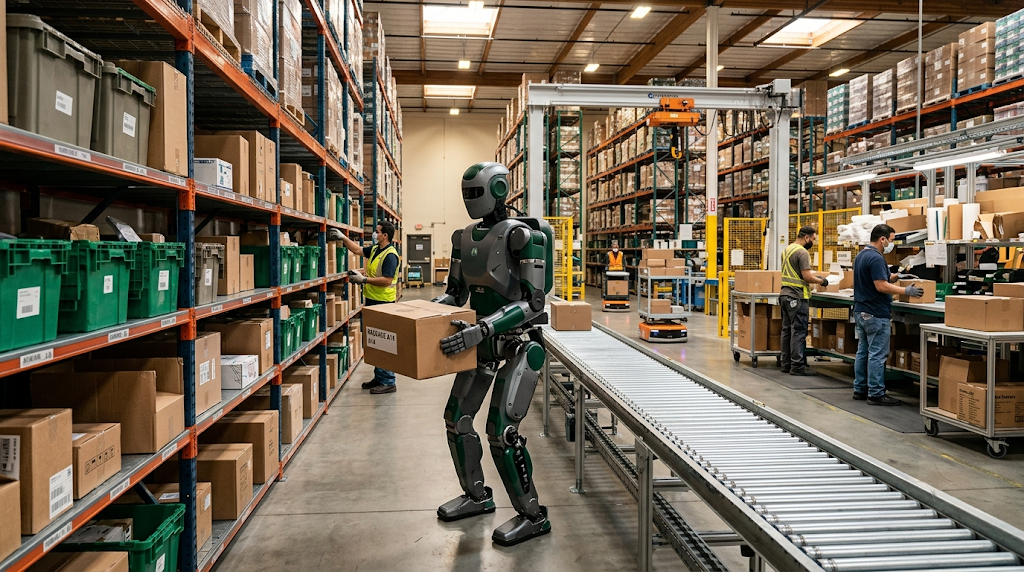
Imagine a robot working in a warehouse, picking up boxes and moving them like a human worker. On November 12, 2026, GXO Logistics and Apptronik announced plans to test Apollo humanoid robots in more warehouses.
The companies signed an agreement to expand their testing. If everything goes well, GXO could use up to 1,000 Apollo robots in the future. However, this is only a plan, not a confirmed order.
How Did the Partnership Begin?
GXO and Apptronik started working together in 2024.
According to GXO, Apollo completed a test in the United States earlier in 2026. During the test, the robot picked up small consumer products on its own.
The companies now plan to begin larger warehouse trials in 2027.
They will check how quickly the robots work, how safely they operate and whether they can handle daily warehouse tasks.
What Jobs Will Apollo Do?
Apollo is being developed to help with different warehouse activities.
These include picking products from shelves, carrying boxes, moving storage bins, packing items and sorting goods.
Apptronik says it has tested Apollo on more than 50 logistics tasks at its Robot Park training facility in Austin, Texas.
However, these tests happened at Apptronik's own facility, not in a real GXO warehouse.
The next step is to see whether Apollo can perform these jobs in busy warehouses.
Why Is Warehouse Testing Important?
A robot may work perfectly during a short demonstration, but working for an entire shift is much harder.
Warehouses need robots that can complete tasks quickly, work safely around people and operate without frequent problems.
GXO and Apptronik are also considering a Robotics-as-a-Service model. This means GXO could pay to use the robots as a service instead of buying them directly.
However, the companies have not shared pricing or detailed performance results.
What Are the Challenges?
Apollo still needs to prove that it can work reliably in real warehouses.
In a separate factory test involving Mercedes-Benz, Apollo 2 reportedly achieved a 96% success rate while sorting metal parts.
However, that result does not prove it will perform equally well in warehouses.
GXO has also tested robots from other companies. For example, Agility Robotics' Digit has reportedly moved more than 100,000 storage bins at a GXO facility in Georgia.
Apollo has not yet reported similar warehouse results.
What Happens Next?
GXO and Apptronik are planning their first North American deployment for late 2027, depending on the test results.
If Apollo meets their expectations, they could expand to as many as 1,000 robots over four years.
However, the companies must first prove that the robots can work safely and efficiently.
Apollo could become useful in warehouses, but its success will depend on how well it performs during real working shifts, not just short demonstrations.