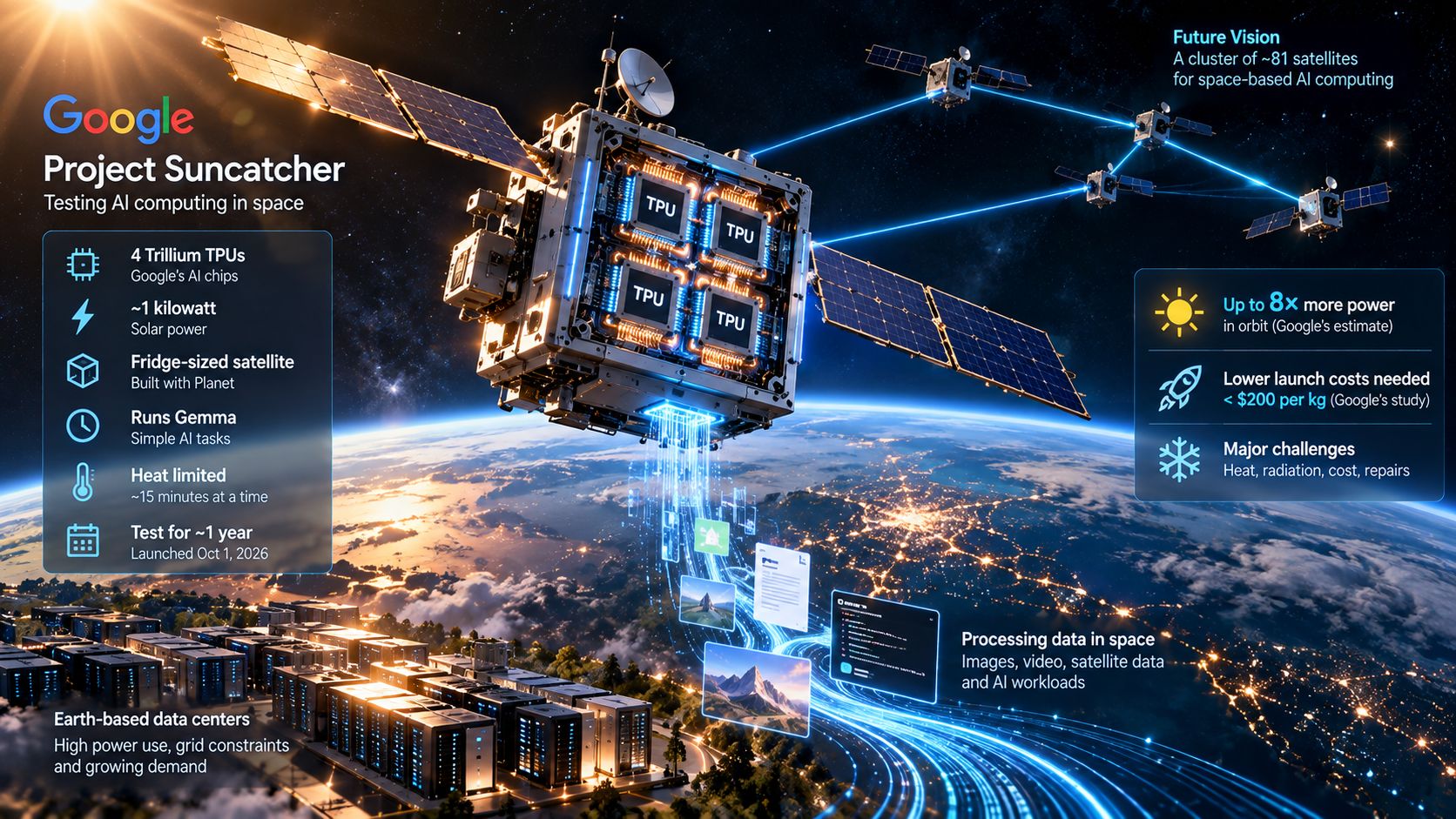
On October 1, four Google AI chips reached orbit on a SpaceX rocket. Google says its team has made contact with the satellite and that it is working as expected. It is the first hardware test of Project Suncatcher, a plan to run AI computing from space.
Why try this? AI uses huge amounts of power, and some communities are pushing back on new data centers on Earth. In orbit, the sun shines almost nonstop. Google's research estimates that panels there can make up to eight times more power than panels on the ground. That is an estimate, not a measured result. And this first flight is a small test, not a data center. So what does it really prove?
What Is Actually in Orbit
The satellite is about the size of a fridge. Google built it with Planet, a satellite imagery company. It carries four Trillium TPUs, which are Google's AI chips, and reportedly runs on about one kilowatt of solar power. The chips will run Gemma, Google's open AI model, to answer simple questions. Heat limits them to 15 minutes at a time.
This is a demonstration, not a product. Google's own project lead called it a "very minimal test." The plan is to run it for about a year. In 2027, Google wants to launch two more satellites to test laser links between them. The long-term idea is a cluster of about 81 satellites. That is still a design on paper.
Google also tested the chips on the ground. It says they handled more radiation than five years in orbit would bring. Its cost study has passed peer review in the journal Joule. But the ground tests and the orbit results all come from Google so far. No outside team has tested these chips in space.
Google Is Not Alone
A startup called Starcloud, backed by Nvidia, got there first. In November 2025, it sent up a satellite with one Nvidia H100 chip. The company says it trained a small language model there and ran Gemma too. I found no independent check of those results. Reports also say the chip could not run nonstop because it overheated. A second Starcloud satellite with newer chips is planned for January 2027.
Others want in. Elon Musk has said SpaceX will build data centers in space, and SpaceX has pitched the idea to investors since going public in June. Nvidia has announced chips designed for space. China launched the first 12 satellites of a planned 2,800-satellite computing network in 2025. Most of this is plans and early tests. Nobody has a working space data center.
The Hard Parts
Heat is the biggest problem. On Earth, fans and water carry heat away from chips. In space, there is no air, so a satellite can only radiate heat out. That takes large radiators, and they get heavy at scale. Brandon Lucia, an engineering professor at Carnegie Mellon, told NPR that much of the technology has been proven in research, but heat is a big challenge.
Radiation can also flip bits in a chip and cause errors. Companies try to handle this with error-correcting memory and backup checks, but that adds cost. And there is no repair crew in orbit. On Earth, a broken part is swapped out in a day.
Cost is the biggest question. A Falcon 9 rocket still costs well over $1,000 per kilogram to reach low Earth orbit. Google's study says space only starts to compete with Earth when launch costs fall below $200 per kilogram. It thinks that could happen by the mid-2030s, but only if SpaceX's giant Starship rocket works at scale. That is a forecast, not a fact. Skeptics argue the real gap is larger. Also, solar power is clean, but the rockets that launch these satellites burn fuel.
What Could Happen Next
In the near term, we will get real data. The 2027 laser test and Starcloud's second satellite will show whether chips can work together and stay cool in orbit. Small satellites that process data in space, such as images, also look realistic.
The big version is long-term speculation. A real space data center needs cheap launches, better cooling, and a way to fix things. Nobody has solved all three. If they do, AI would depend less on Earth's power grids. If not, the experiments still teach engineers how chips behave in space. The real question is not whether chips can survive launch. It is whether the numbers add up. For now, Suncatcher is a smart test of a big idea, not proof that data centers are moving to space.