Humanoid robots may look impressive in videos, but working inside a real factory is much harder. Parts can be in different positions, and people are often working nearby. On November 10, 2026, Google DeepMind introduced Gemini Robotics 2.5, a new AI model designed to help robots handle these situations.
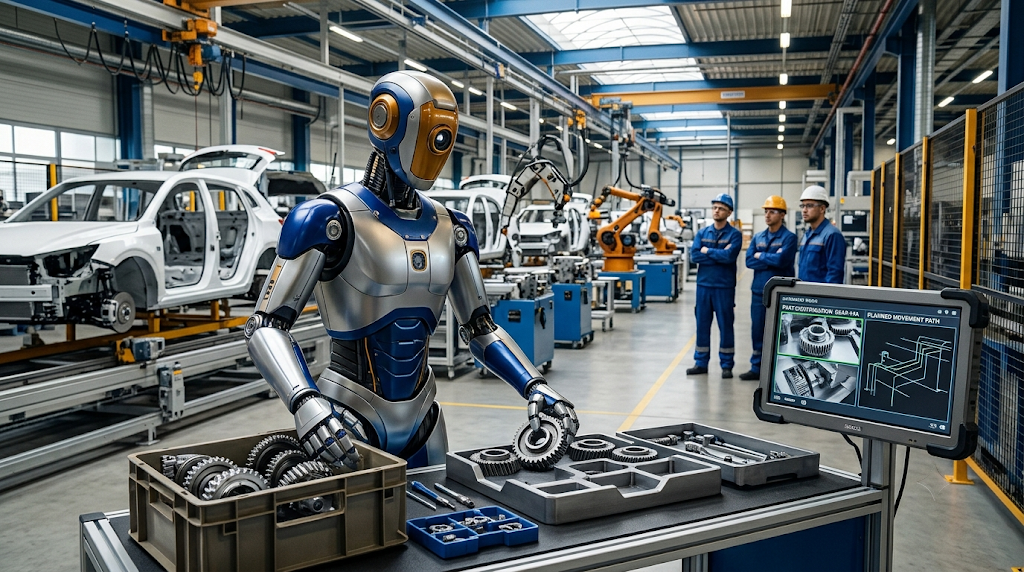
Google says Apptronik's Apollo 2 humanoid robot used this model to sort car parts at Mercedes-Benz factories with a 96% success rate.
What Is Gemini Robotics 2.5?
Gemini Robotics 2.5 is an AI model that helps robots understand what they see and decide how to move.
For example, if someone asks a robot to pick up a metal part, the model helps it find the part and move its arms correctly.
Google says it tested the model on more than 200 tasks. It can work with different robots, including Apollo 2 and Franka Duo robotic arms.
How Did Apollo 2 Work in the Factory?
Apollo 2 was tested at Mercedes-Benz factories in Hungary and Germany.
Its job was called kitting. This means picking car parts from containers and arranging them in trays for workers.
The robot picked up metal brackets and placed them in the correct order for different vehicles.
A separate AI system helped plan the work, while Gemini Robotics 2.5 controlled the robot's arms and hands.
Google also says the model helped robots avoid obstacles and work more safely near people.
In its own tests, Google reported a 33% improvement in safe task completion around obstacles and 43% near people.
What Does the 96% Success Rate Mean?
Google reported that Apollo 2 completed its task successfully 96% of the time.
This sounds impressive, but it also means around four failures in every 100 attempts.
For example, if the robot tried 1,000 times, it could fail around 40 times at the same success rate.
Google has not shared the total number of attempts or explained how the robot handled mistakes.
The test also focused on sorting parts, not building an entire car.
How Is It Better Than Earlier Models?
Google says Gemini Robotics 2.5 performed better than its earlier AI models.
In company tests, success rates improved by 30% to 100%, depending on the task. Robots also completed some tasks 20% to 30% faster.
Google says another model, Gemini 4 Argon, helped create virtual practice situations for training.
However, these results come from Google's own testing and have not been independently confirmed.
What Happens Next?
Gemini Robotics 2.5 is currently available only to Google's robotics partners.
The company has not announced when everyone will be able to use it.
Researchers still need to test how these robots handle mistakes, work around people and perform during long factory shifts.
Gemini Robotics 2.5 shows progress in factory robotics. But one successful parts-sorting test does not mean humanoid robots are ready to handle every factory job.