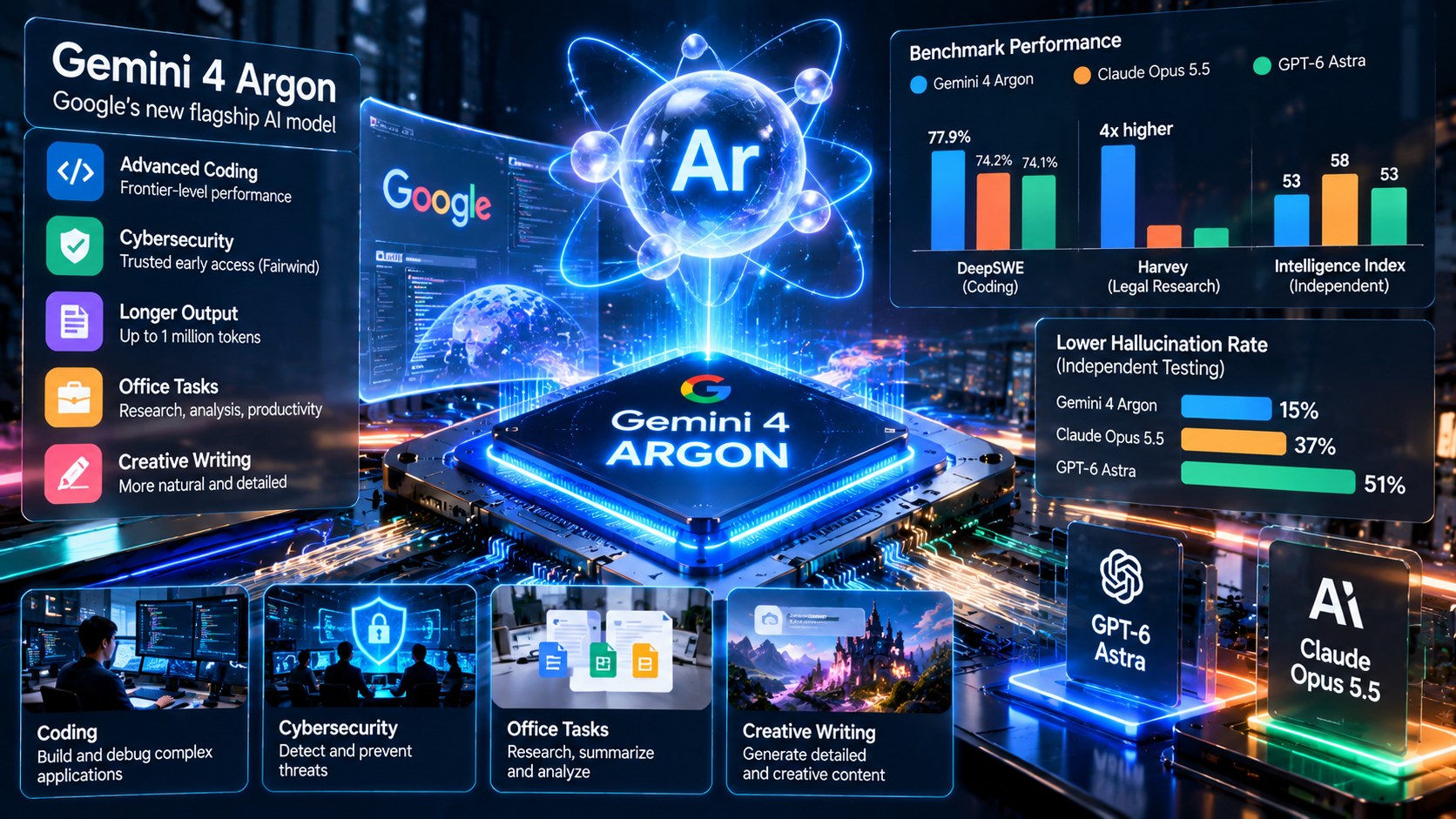
On September 30, Google released its newest AI model. It's called Gemini 4 Argon. The launch matters less for the model itself than for what came before it. Google has had a rough few months compared to its rivals. Argon is Google's way of showing it hasn't fallen behind OpenAI and Anthropic.
A Model Born From a Cancelled One
Back in May 2026, Google showed off a model called Gemini 3.5 Pro at its developer event. It said the model was coming "next month." It never came out. Bloomberg reported that Google quietly changed Gemini's training data in June, just to improve its coding skills. The results disappointed people inside the company. By August, a research firm called SemiAnalysis said Google had quietly cancelled Gemini 3.5 Pro. The team moved on to a new Gemini 4 line instead. Google never confirmed this in public. That backstory matters. It means Argon isn't just the next model on schedule. It's a restart. That's also why Google gave it a new kind of name. Argon looks like the first in a series named after chemical elements.
What Google Is Claiming
Google says Argon can do "frontier-level" work in coding, cybersecurity, office tasks, and creative writing. Its output limit jumped from 64,000 words worth of tokens to 1 million. In Google's own tests, Argon leads or ties on several benchmarks. It scored 77.9% on a coding test called DeepSWE. That beats Claude Opus 5.5's 74.2% and GPT-6 Astra's 74.1%. On a legal-research test from a company called Harvey, it scored almost four times higher than either rival. Google is also rolling Argon out slowly and carefully. The first people to get it aren't paying customers at all. They're trusted cybersecurity teams in a program called "Fairwind." Google is also working with a US government program that reviews frontier AI models before they launch.
What Independent Testing Actually Found
Artificial Analysis is a company that runs its own tests. It doesn't just trust the numbers companies hand it. It published results the same day Argon came out. On its main scoring system, called the Intelligence Index, Argon scored 53. That ties GPT-6 Astra exactly. It sits about five points behind Claude Opus 5.5, which scored 58. That's a pretty different story than Google "retaking the lead." There's another detail worth knowing. Google's own comparison chart used a score of 66.4% that Anthropic itself reported for one coding test. But Artificial Analysis's own, independent test measured Opus 5.5 at only about 60% on that same test. That narrows the gap Google was advertising.
Argon really did do well on two things, though. Artificial Analysis found its hallucination rate, basically how often it just makes things up, was only 15%. That's the lowest of any model that scored 45 or higher on the index. GPT-6 Astra, for comparison, got things wrong 51% of the time. Argon also came out on top on an independent test of how well it handles multi-step tasks, called AutomationBench-AA. But there's a catch. Argon uses about 62,000 words worth of tokens per task. That's more than double what GPT-6 Astra uses. So some of that price advantage disappears once you're not paying the introductory rate anymore.
Why the Caution Matters
Before the launch, Bloomberg reported that some Google employees privately doubted whether Argon could actually compete with Anthropic or OpenAI's newest models. Separate interviews with Google staff describe a pattern that keeps coming up. People inside Google like the underlying models. But turning that into a product that actually beats the competition has been a weak spot, especially in coding, where staff reportedly compare Gemini unfavorably to Claude. Starting the rollout with cybersecurity teams looks like a smart move. It lets Google collect real proof that the model works before outside developers get to run their own tests on it.
What This Means Going Forward
In the near future, the real test will be when Argon goes wider. First to paying API customers, then to developers and regular users. A careful release to friendly partners just isn't the same as the open market reacting to it. The price drop is real, and you can check it yourself right now. It's $2 per million input tokens, compared to roughly $10 for GPT-6 Astra. That alone was enough to push Alphabet's stock up about 2% after the news came out.
Looking further ahead, Argon is really a sign that the top AI companies are now close enough in quality that the competition is shifting. It's becoming less about who scores highest, and more about who's cheaper and more reliable, since Argon ties its rivals instead of beating them outright. Whether Google can turn its lower price into real, lasting business customers, after a year of delays and doubts from its own staff, is still an open question. We just don't have the data to answer that yet.