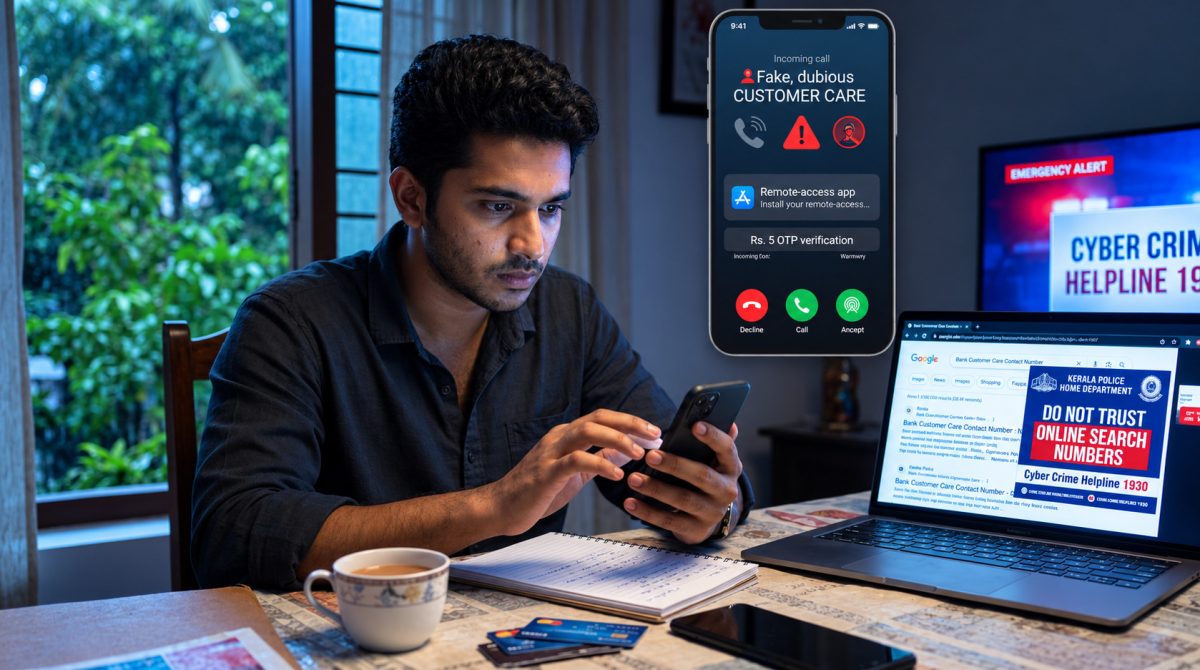
You search for your bank’s helpline and dial the first number that appears. The call does not connect. A few minutes later, a polite stranger calls you back and offers to fix your problem. According to Kerala’s Home Department, this small moment is how a growing fraud begins.
The Warning From Kerala
On 2 October 2026, the Kerala Home Department urged the public to stay alert to cyber fraud involving fake customer care numbers, as reported by Kerala Kaumudi and Outlook India. Fraudsters post false numbers online in the names of banks, e-commerce platforms and other institutions, and wait for worried customers to call. Police advised people not to trust numbers found through internet searches. They should use only the official website or app of the service provider, then reach the institution through its official channels or visit the nearest branch.
How the Callback Scam Works
The Home Department described the scam as a short sequence. The number a victim dials may not connect directly. The fraudsters then call back, pose as customer support agents and claim they can resolve the complaint. They ask the victim to install a remote-access or screen-sharing app, which lets another person view and control the phone. They may then request a small payment, such as Rs 5, called a registration or verification fee. The department said this process is used to steal banking and personal details and carry out large financial fraud.
Delhi Police’s cybercrime website describes a similar variant. Fraudsters pose as customer care executives and ask for a token payment of Rs 1, 2 or 5. While the victim pays, they capture the card credentials. Using remote access to the phone, they then make multiple unauthorised transactions through the Unified Payments Interface (UPI), India’s instant payment system.
Hospital Numbers Were Targeted Too
This was the second Kerala warning in under two weeks. On 20 September, Kerala Police warned of a related fraud, reported by the Press Trust of India. It targeted people who search Google for hospital appointment and contact details. When someone calls a fake number, fraudsters pose as hospital staff and send app files over WhatsApp, supposedly for booking an appointment. Police said UPI apps such as PhonePe and Google Pay could be misused, and other payment apps could be installed without the user’s knowledge.
For this scheme, police advised verifying numbers on the hospital’s official website or verified social media pages. They also said never to install app files received over WhatsApp for appointment booking, KYC or refunds. If a fake app may already be on the phone, the advice was to disconnect from the internet and contact the bank or UPI provider immediately.
What Police Say to Do
The guidance across both warnings is consistent. Do not install remote-access or screen-sharing apps, or make payments, at a stranger’s request. Never share OTPs (one-time passwords), PINs, passwords or card details. Anyone who has become a victim should report it at once to the cybercrime helpline 1930 or the National Cyber Crime Reporting Portal at cybercrime.gov.in.
Could AI Make Fake Numbers Harder to Spot?
Earlier this year, Wired reported that scammers were trying to push fake customer care numbers into Google’s AI Overviews, the AI-written summaries shown above search results. Indian outlet Madhyamam Online, relaying the report, said it remains unclear how the numbers get there. Google said it had added safeguards and advised users to cross-check numbers through multiple searches. None of the Kerala statements we found mentions AI, and we found no evidence that the Kerala cases involved AI summaries.
Our Reading: What the Pattern Suggests
This section is our own analysis, not a stated fact. Two warnings from one state within about two weeks, covering different sectors, suggest a reusable template rather than a one-off. The core move is the same each time: place a trusted-looking number in front of someone who is already anxious.
The failed first call matters most. It can feel like a harmless glitch, yet the Home Department describes it as the opening step. If the Wired report is accurate, AI summaries could add risk, because they present a number as settled fact without clearly showing where it came from. None of the sources we found gives a total for victims or losses, so the scale is unknown.