Picture this: you run a robot vacuum every morning, and every morning it bumps into the same chair leg and skips the dusty gap under your bed because it simply doesn't fit. Most robots still clean by following a map, not by looking at what's on the floor.
Dreame's new X60 Ultra Complete, launched in India this month at ₹1,34,999, is built around fixing that. It relies on AI cameras, a light that shows hidden dirt, and a body slim enough to slide under furniture. That's a lot of money for a vacuum, so what does the AI actually do?
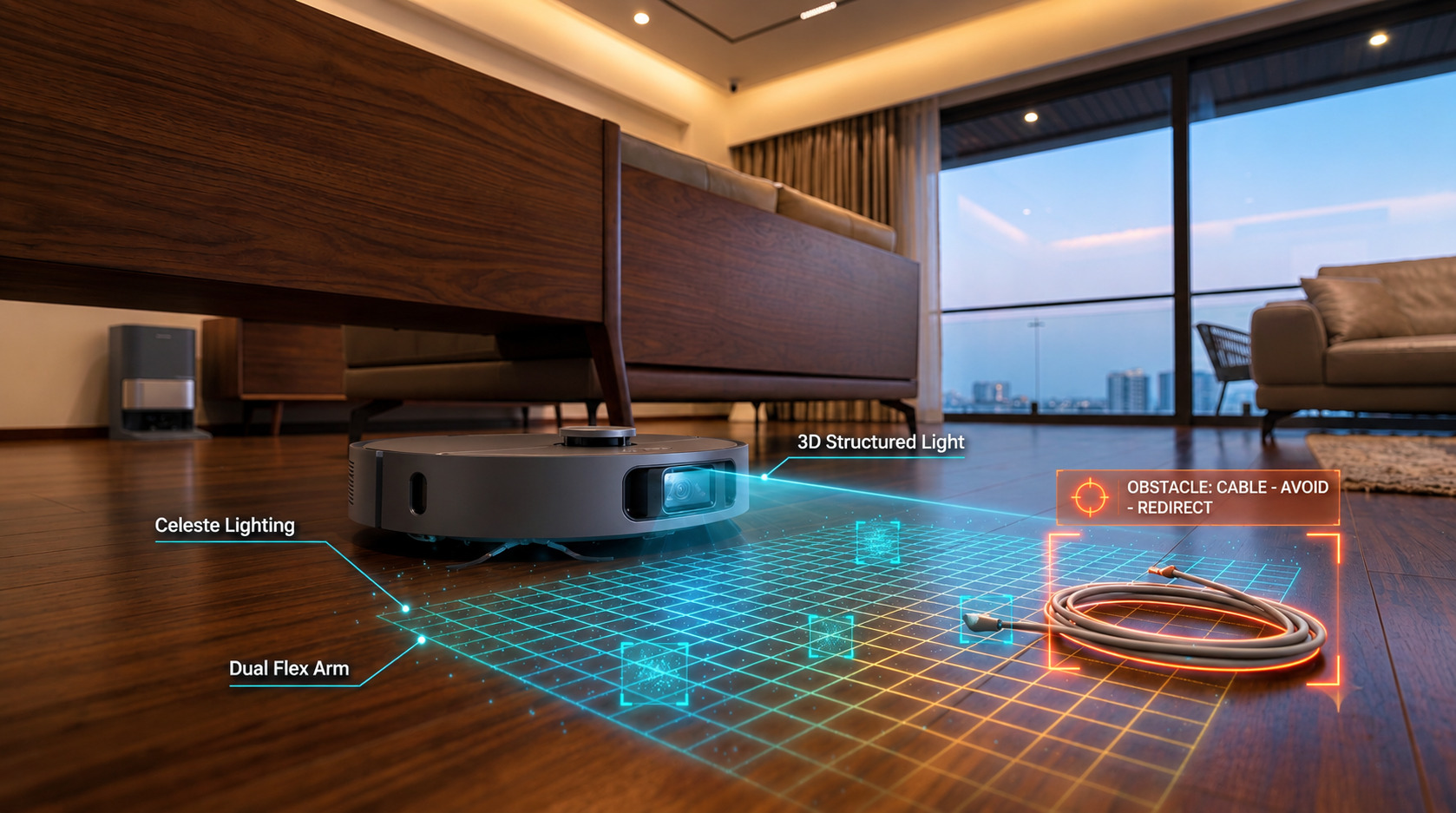
The X60 Ultra Complete's AI cameras and lighting map the floor, flag obstacles like cables and steer around them.
What the AI Cameras Actually Do
Two 120-degree cameras at the front let the robot detect and identify more than 280 types of objects, including items as small as 10mm, according to Dreame. They work with projection technology and 3D structured light, which the company says keeps detection accurate in different lighting and at different distances.
In simple terms, the robot tries to tell apart things to drive around, like a sock, a cable or a pet bowl, from things to clean. That is the job that once left older robots tangled in charger wires.
Seeing Dirt You Can't See
Older robots often used a sensor that measured how dirty the floor was overall. It couldn't tell an obstacle from a stain, so the response was usually a full-room cleaning cycle.
The X60 Ultra Complete's AI OmniDirt Detection uses a light Dreame calls Celeste Lighting to illuminate the floor and make hard-to-spot mess visible to the camera, including pet hair, fine particles and light-coloured spills. The robot then adjusts how it cleans each patch in real time instead of running one routine everywhere.
Cleaning Where Other Robots Get Stuck
The robot is just 7.95cm tall, so it can go under beds, sofas and cabinets. Its laser sensor lifts in open rooms for 360-degree scanning and retracts under low furniture. Two extending arms, called Dual Flex Arm technology, push the side brush and mop pad into corners and along edges, with Dreame claiming up to 100% coverage there. It can also climb single steps up to 4.2cm and double-layer obstacles up to 8cm.
Power and Mopping
Suction is rated at 35,000Pa, paired with a brush system designed to reduce hair tangling. For mopping, the dock washes the pads with 100°C hot water, and the pads spin at 230RPM with 15N of downward pressure. The dock handles chores you'd otherwise do yourself, cutting down how often you have to think about the vacuum at all.
Is It Actually Useful, or Just a Gimmick?
It's worth being careful here. Nearly every number above comes from Dreame's marketing or from launch coverage repeating it. Figures like "280 object types" and "up to 100% coverage" describe best-case conditions, not a living room with a dog, a toy pile and a dim corridor.
Camera-based obstacle avoidance and dirt detection are a real step up from bump-and-turn robots, and the low profile solves an everyday problem. But independent reviews still need to show how often it misjudges cables or socks, whether dirt detection really saves time, and how much camera processing happens on the device versus in the cloud, which matters for privacy.
At ₹1,34,999, it's a premium purchase with a one-year warranty in India. Dreame says it sells through its India website, Amazon India, Croma and select stores, with service in more than 160 cities. Long-term reliability and after-sales support matter as much as the specs.
The smart home isn't fully there yet, but robots like this show where the category is heading: away from fixed routes and toward machines that look at your floor and adjust as they go.