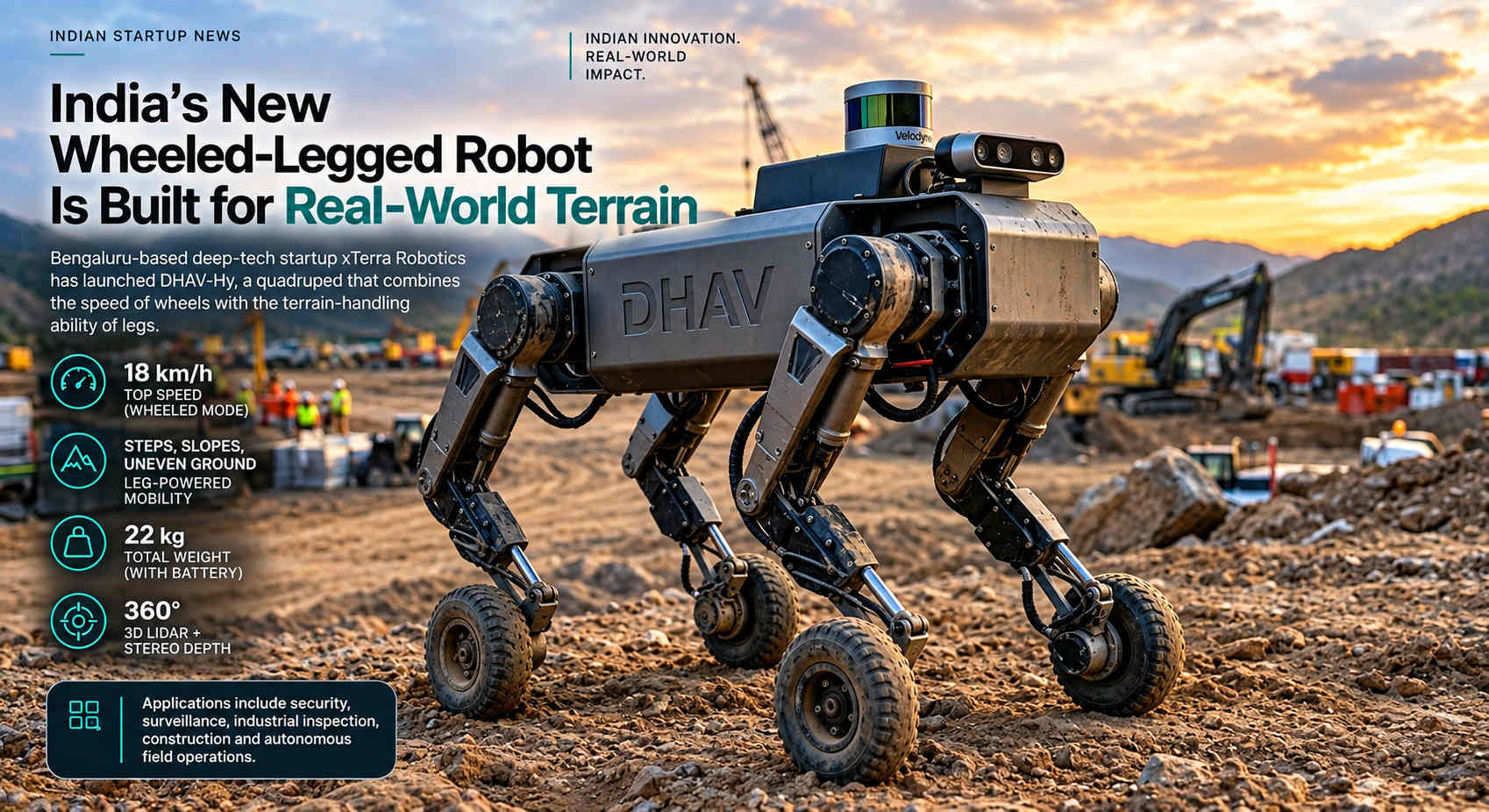
Ask any engineer why robots still struggle in the real world, and stairs will come up within a minute. Wheels are fast and efficient, but they stop at the first step. Legs can go almost anywhere, but they are slow and burn through battery. A Bengaluru startup has just launched a robot that tries to have both.
What DHAV-Hy actually is
DHAV-Hy comes from xTerra Robotics, a deep-tech startup incubated at IIT Kanpur. It is a four-legged robot with a motorised wheel at the end of each leg. On flat ground it rolls. When the surface turns rough, it uses its legs to step, climb and adjust.
Engineers call this design “wheeled-legged”, and researchers have studied it for years. What is new here is that an Indian company has built and launched one, and says it designed and engineered it entirely in India.
DHAV-Hy is the wheeled version of the company’s existing DHAV quadruped platform. xTerra also sells a robot called SVAN M2, which it describes as India’s first commercial quadruped. That description is the company’s own claim.
The numbers, and what they mean
According to launch coverage, the robot reaches about 5 metres per second in wheeled mode, roughly 18 km/h. That is a brisk cycling pace, and much faster than a walking robot of this size manages.
It carries up to 10 kg and weighs around 22 kg including its battery, so it is light enough for one person to lift and move.
These are figures from the company, reported by news outlets. I could not find independent testing, and no price has appeared in the coverage I found. Treat the specifications as claims for now.
Where the “AI” comes in
The headline calls it an AI robot, so it’s worth being precise.
The confirmed hardware includes a 360-degree 3D LiDAR, which is a sensor that fires laser pulses to build a map of the surroundings, and stereo-depth cameras that judge distance the way two human eyes do.
The robot can be driven with an RF joystick or through web-based teleoperation over long distances.
The company also talks about “autonomous field operations” and says developers can build applications on top of the platform.
What is missing is detail. There is no public description of what software runs on it, how much it navigates on its own, or how it was tested.
Today it looks like a capable, sensor-equipped mobile platform. Whether it becomes a genuinely autonomous robot depends on the software built for it.
Who it is for
xTerra is positioning DHAV-Hy for security and surveillance, industrial inspection, construction sites and field operations.
A few examples the company and coverage mention are perimeter monitoring, scouting, and inspecting plants and multi-level buildings.
It is currently being piloted for industrial inspection, and pre-sales conversations are open. The wheeled variant has reportedly been under development for only about three months, which is quick for a hardware product.
The use case makes sense. A factory floor is mostly smooth but has stairs, ramps and cable trunking. A robot that covers the flat stretches quickly and switches to legs at the obstacles could do inspection rounds that a wheeled robot cannot finish.
Home-Grown Hardware, Unanswered Questions
Most quadruped robots sold worldwide come from a handful of foreign companies. An Indian-built alternative could matter for buyers who care about cost, local support, or keeping sensitive data at home.
The company also highlights its in-house compact actuators, the motors that move each joint. Actuators are among the hardest and most expensive parts of a legged robot, so building them locally, if it holds up, is a real technical achievement.
There are open questions, too. How does it handle rain, dust and heat? How long does the battery last? How reliable is it after months of daily use?
Those answers will decide whether DHAV-Hy becomes a working tool or stays a good demo.
For now, it is an early but credible sign that India’s robotics scene is moving from research labs into products.