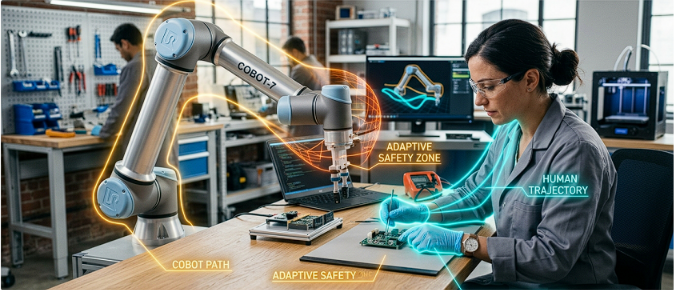
For decades, heavy industrial factory robots were steel giants kept locked behind floor-to-ceiling yellow safety cages equipped with automatic interlock switches
The Collaboration Dilemma: Why Emergency Stops Are Inefficient
Simply mounting emergency stop buttons or laser light curtains around an un-caged robot is not enough for true collaboration
The ISO/TS 15066 Benchmark: Biomechanical Limits for Safe Contact
To establish rigorous international safety limits, the International Organization for Standardization published ISO/TS 15066. Pioneered through research led by Sami Haddadin at the Technical University of Munich, this standard defines the biomechanical thresholds of human pain and injury across 29 distinct body regions.
ISO/TS 15066 establishes four core collaborative operational modes:
-
Safety-Rated Monitored Stop: Pausing motion only when a worker enters the immediate contact zone
-
Hand Guiding: Allowing operators to direct robot arms manually using force torque handles
-
Speed and Separation Monitoring: Continuously scaling robot speed based on real-time distance to human bodies.
-
Power and Force Limiting: Limiting motor torque so that accidental contact forces remain strictly below human pain thresholds, such as maintaining maximum contact force below 150 Newtons for chest contact.
Artificial Intelligence Motion Prediction: Anticipating Human Intention
To prevent collisions before they happen, roboticists at ETH Zurich and Politecnico di Milano integrated deep learning vision models with three-dimensional overhead cameras .
By anticipating whether a technician is reaching for a screwdriver or leaning across a table, the cobot dynamically curves its trajectory around the predicted human path
Control Barrier Functions: Mathematical Safety Guarantees
While deep neural networks predict human movement well, artificial intelligence models can occasionally make errors
Remaining Challenges and Real-World Workplace Limits
Despite safety advances, open challenges remain
Why Safe Human-Robot Sharing Changes the Workplace
Removing safety cages transforms industrial automation from rigid isolation into flexible teamwork