A robot arm can repeat the same motion thousands of times, but “24/7” does not mean “without limits.” A useful example is Doosan Robotics’ published specification for its collaborative robots: the company says they are designed for a maximum running time of 35,000 hours, equivalent to about four years of continuous operation, while warning that actual life varies with the operating environment. The figure is a design specification, not a promise that every robot will run for four years without service.
Continuous Work Still Creates Wear
Industrial robots combine motors, gearboxes, controllers, sensors and end-effectors. Every repeated movement creates mechanical and thermal stress. High payloads, fast cycles, vibration, dust and heat can change how quickly components wear.
This is why robot uptime is better understood as a maintenance problem, not simply a software setting. Preventive maintenance can include inspections, lubrication, calibration, cleaning and replacement of parts according to the manufacturer’s requirements.
For mobile robots, the energy system adds another limit. ABB’s 2026 specification for its AMR P603V, for example, lists expected battery life in charge cycles and gives operating conditions for charging and discharge. It also warns against deep discharge and specifies temperature and electrical limits. In other words, a mobile robot may be mechanically ready to work while its battery becomes the factor that determines availability.
What Happens Before a Failure?
The important engineering question is not only whether a robot fails, but whether the system can detect deterioration early.
In February 2026, ABB described a Robot Diagnosis dashboard in OptiFact that uses motion-related data from robot motors and gearboxes to identify deviations in mechanical behaviour. This is an example of condition monitoring: instead of waiting for a breakdown, maintenance teams can look for signs that a component is behaving differently from its expected state.
Research is also exploring AI-based prediction. A May 2026 study on an ABB IRB 1100 used simulated electrical, mechanical, thermal and vibration signals to create data for fault-detection models. The researchers considered conditions including overheating, misalignment, gear wear and sensor drift. Because the dataset was simulated, the study should be viewed as research into predictive-maintenance methods, not evidence that a factory can automatically predict every real-world failure.
Sensors Can Fail Too
A robot depends on sensors to understand position, temperature, motion and the surrounding process. A damaged, dirty or drifting sensor can produce incorrect information even when the mechanical hardware is healthy. Other problems can come from controllers, wiring, tooling, conveyors or the equipment connected to the robot.
OSHA notes that many robot accidents occur during non-routine activities such as programming, maintenance, testing, setup and adjustment. Its technical guidance also highlights how sensor, control, power and peripheral-equipment failures can lead to unexpected robot behaviour.
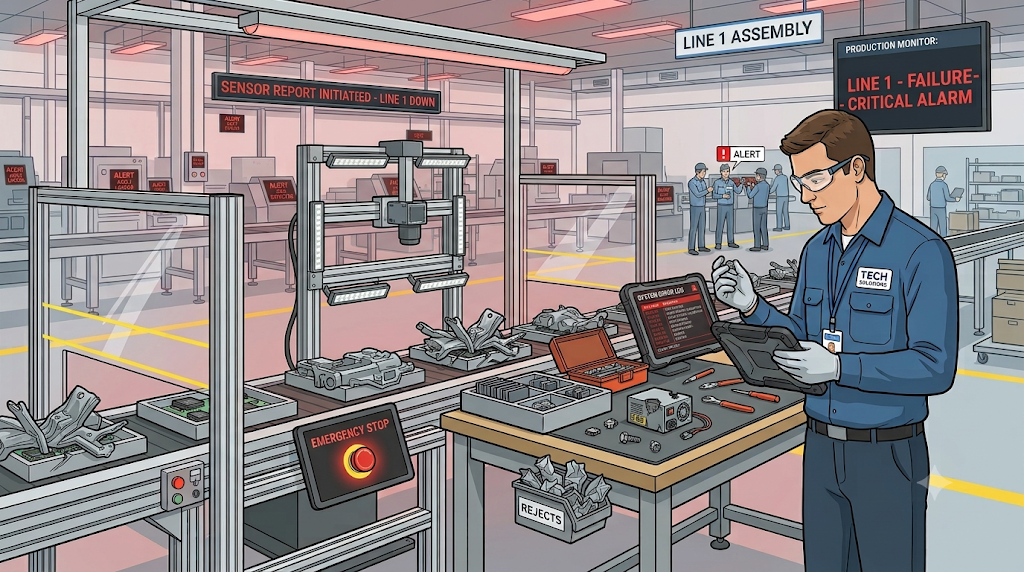
That means a failed robot is not simply a machine that “stops.” A fault can interrupt an entire production cell, trigger quality problems or require a trained technician to diagnose the cause safely.
The Goal Is Not Zero Downtime
Factories therefore aim to reduce unplanned downtime rather than assume it can be eliminated. Monitoring systems, scheduled maintenance, spare parts, diagnostics and trained maintenance teams all form part of the reliability strategy.
The most realistic picture of a 24/7 robot is a machine designed for long operating periods, supported by maintenance and monitoring. Continuous production depends not only on the robot itself, but on batteries, sensors, mechanical components, software, connected equipment and the people who keep the whole system working.