Demos, Practice and Foundation Models Say Yes, With Limits
New robot models can pick up some tasks from a demonstration or from practice, but nearly all the evidence is company-reported, short-horizon and unverified.
For decades, a factory robot did one job because an engineer wrote code for that job. A new task meant new code, often weeks of work. Now several labs say robots can learn tasks from a demonstration or from their own practice. That is partly true, but the evidence varies. Some is academic research, some is company demos, and I found no independent verification of the headline claims. Here is what is real, who is behind it, and what could change.
How the Technology Works
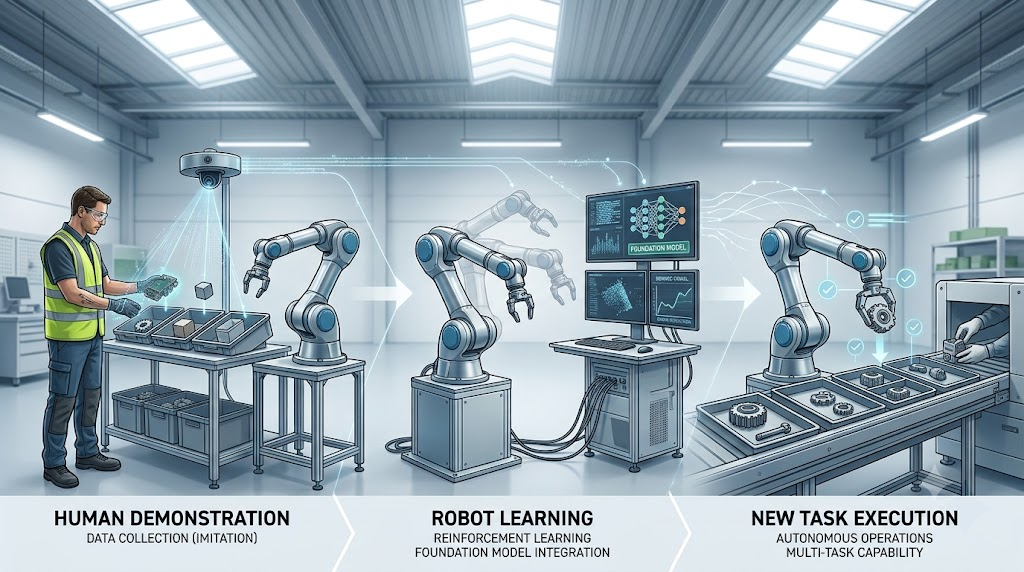
Most of these systems rest on a robot foundation model: a large model trained on robot data from many tasks and bodies so its knowledge transfers. The dominant 2026 design is the vision-language-action model, which adds a motor-command output to a vision-language model. Three learning methods sit on top of it.
Imitation learning copies human demonstrations. It is quick, but errors compound because the robot rarely sees how to recover from its own mistakes. Demonstration prompting is newer: Skild's S1 reportedly uses one video demonstration as a prompt, with no weight updates. Reinforcement learning lets the robot practice and learn from outcomes. Sergey Levine, a Physical Intelligence co-founder, has said imitation gets a robot working quickly, while reinforcement learning is needed to surpass humans. The hard part is credit assignment: working out which actions caused a good or bad result. Practice on real hardware is slow and risky, so Physical Intelligence argues that simulated data alone cannot prepare models for the real world.
Who Is Involved
Physical Intelligence is the most visible player. Its π*0.6 model uses a method called Recap, which combines demonstrations, human corrections and learning from the robot's own experience. Figure reports that its Helix 2.5 completed household tasks in 30 unseen homes without adapting its weights. The GEN-1.5 model, released in August 2026, is said to learn from three-to-twelve-second demonstrations. GR00T N1 is described as an open foundation model for humanoid robots, and Dyna Robotics raised $120 million for a model it calls general-purpose. In academia, one University of California thesis shows a quadruped learning to walk in natural environments purely from real-world experience.
Separating Evidence From Promise
Working products versus demonstrations. Most public material is demonstration. Dyna says its model performs daily tasks at commercial scale, and Physical Intelligence points to partners solving real problems, but both are company statements, and I found no independent audit of uptime or cost. Reliability is the gap: even Physical Intelligence's reliability recipe relies on human interventions to steer robots away from dead ends.
Research prototypes versus commercial systems. The University of California work and open models like GR00T N1 are research. The systems from Physical Intelligence, Figure and the GEN-1.5 developer are company systems whose availability and pricing I could not confirm. Treat them as prototypes until a vendor shows paying customers.
Company claims versus verified results. The 30-home test and one-shot learning are self-reported. An IEEE Spectrum commentator cautioned that for many tasks where a model supposedly learned alone, makers can only say no relevant training data existed "to the best of our knowledge." The GEN-1.5 team itself calls its tasks simple and short-horizon.
Near-term versus long-term. Near-term, the plausible use is repetitive but changing work such as assembly, where the cost of task-specific programming limits automation. Long-term claims are speculation: one market firm forecasts foundation-model control becoming the default industrial path around 2031 and a USD 15–25 billion market by 2036, but it labels the figures indicative.