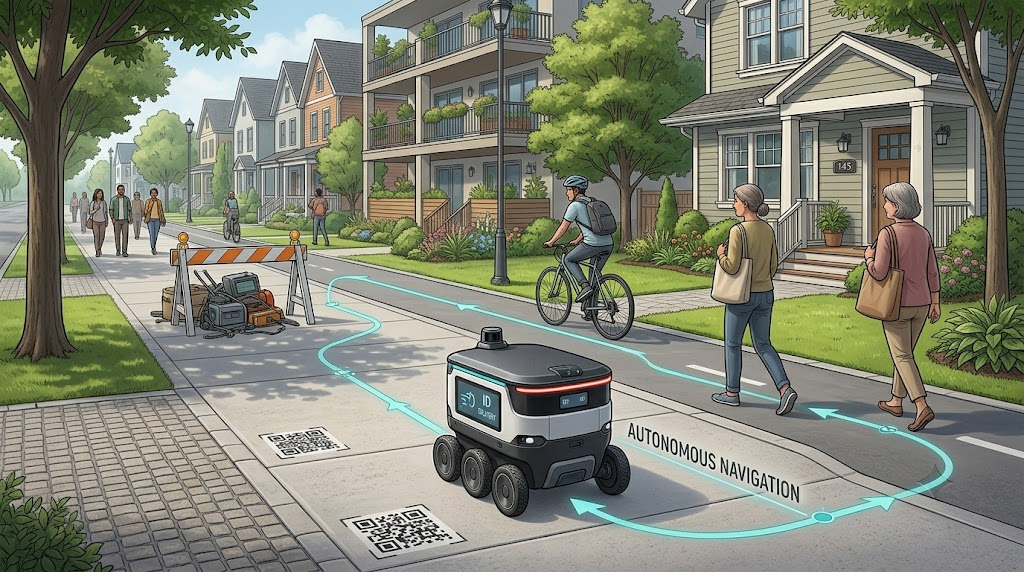
Imagine ordering food and watching a small robot arrive outside your home instead of a delivery rider. That is already happening in several cities. In 2026, delivery-robot companies such as Serve Robotics and Starship Technologies continued expanding commercial operations, showing that autonomous last-mile delivery has moved beyond laboratory demonstrations. But these robots still operate within carefully defined areas and often have humans monitoring the system remotely.
How Delivery Robots Navigate
A delivery robot needs to understand a much less predictable environment than a warehouse robot. It may travel along sidewalks, cross roads, pass pedestrians and encounter bicycles, parked vehicles or temporary obstacles.
To handle this, robots combine cameras, radar, LiDAR and other sensors with maps and positioning systems. Computer-vision software helps identify people and objects, while navigation software calculates a safe route. If something suddenly blocks the path, the robot can slow down, stop or choose another route.
Starship Technologies says its robots use cameras, sensors, radar and machine learning for navigation. The company reports that its robots have completed millions of deliveries across hundreds of cities, campuses and industrial sites.
From Restaurant to Doorstep
The process usually begins with an order placed through a delivery platform. Software sends the delivery information to the robot fleet, assigns a suitable robot and determines the route.
Serve Robotics is one example of this model. In August 2026, Serve announced a partnership with Grubhub, initially bringing robot delivery to Chicago, Los Angeles and Alexandria, Virginia. The company also reported more than 2,000 robots deployed across the United States.
At the destination, the customer typically receives an app notification and unlocks the robot's storage compartment to collect the order. This means the robot can handle most of the journey while the customer performs the final handoff.
Why the Last Mile Is Difficult
Sidewalks are not designed like controlled factory floors. Pedestrians can suddenly change direction, construction can block paths and vehicles may occupy areas where robots normally travel. Poor weather, darkness, glare and dirty sensors can also make perception more difficult.
There is another challenge: public space. A delivery robot must share sidewalks with pedestrians, including people using wheelchairs, bicycles and mobility aids. Cities therefore need rules covering where robots can operate, how fast they can travel and how they should behave around people.
These issues are already visible in real deployments. Some cities have reported concerns about robots blocking sidewalks or becoming involved in minor incidents, showing that technical performance is only part of the problem.
Humans May Still Be Needed
“Autonomous” does not always mean completely independent. Many delivery systems use remote operators who can monitor multiple robots and assist when a machine encounters an unusual situation.
This creates a practical middle ground: the robot performs routine navigation while humans handle exceptions. The economics depend on how many deliveries each robot can complete and how much human supervision, maintenance, charging and fleet infrastructure are required.
For India, the technology faces an additional challenge. Sidewalk conditions, traffic patterns and pedestrian behaviour vary considerably between cities. India is already testing autonomous logistics technologies in other forms, including drone delivery trials, but widespread sidewalk delivery robots would require suitable infrastructure, operating rules and reliable navigation.
Autonomous delivery robots can therefore handle real deliveries today, but they are not yet universal replacements for human couriers. Their strongest opportunity is likely in defined environments where routes, regulations and operating conditions can be controlled.