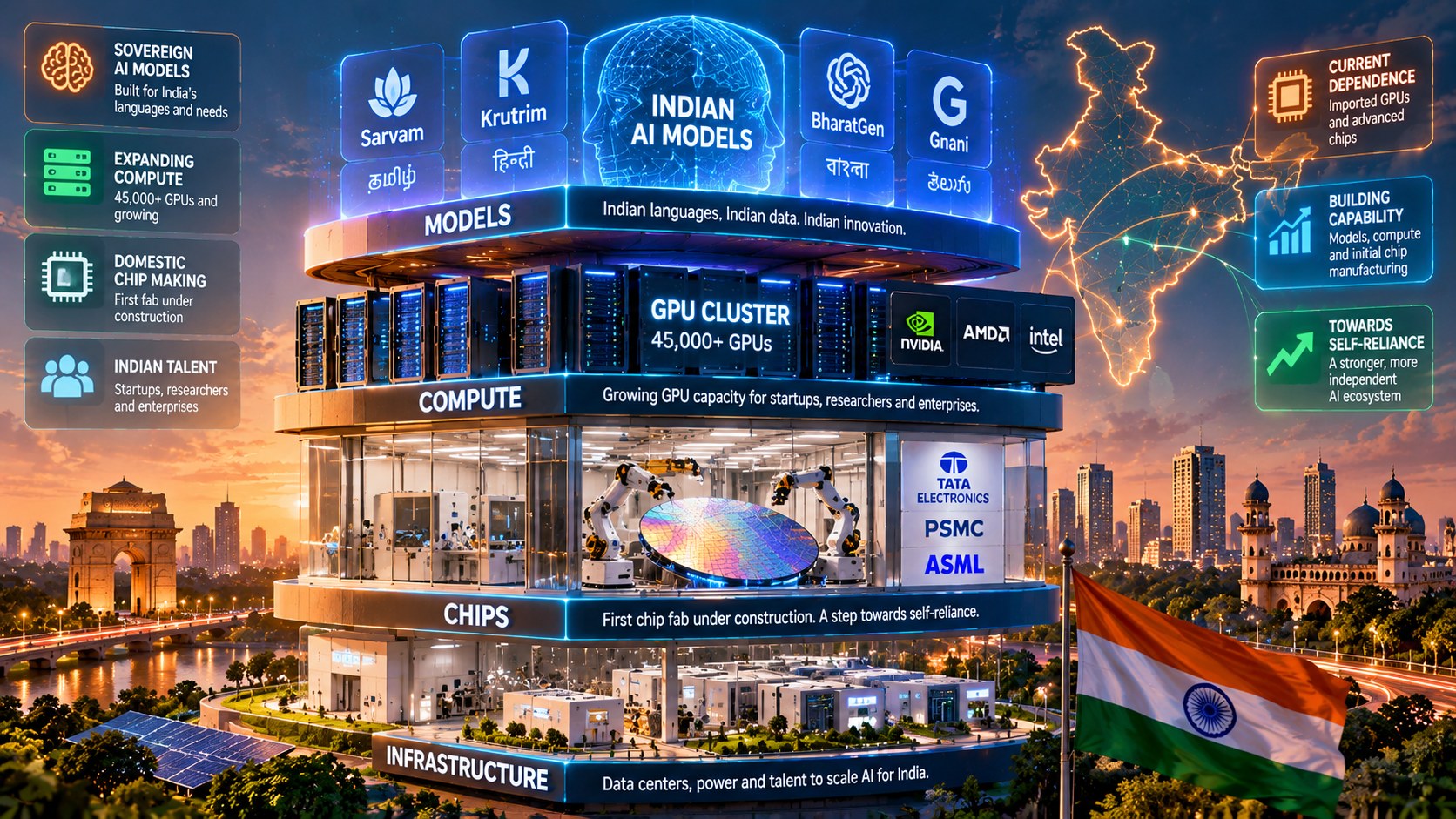
Can India build its own AI stack? The honest answer is: parts of it, yes, already. Other parts, not for years. India now has real sovereign language models, a fast-growing pool of GPUs, and its first chip factories under construction. But every one of those pieces still leans on hardware or tools bought from outside the country. Is that dependence, or just how every country builds AI right now? That's the real question behind the headline.
The Models: Real, But Small Next to the Big Labs
The clearest win is Sarvam AI, a Bengaluru startup the government picked to build India's first homegrown large language model under the IndiaAI Mission. In February 2026, Sarvam released two models for free. One has 30 billion parameters. The other, called Indus, has 105 billion. Both are open source, with the code and weights posted on Hugging Face for anyone to use. These are not demos. They're shipped, working products. Ola's Krutrim has its own models too, and BharatGen and Gnani came out of the same government program.
But size matters, and it's worth saying plainly. Sarvam's biggest model trained on a few thousand GPUs over a few months. OpenAI and Google train on clusters roughly ten times bigger. So these are real, working Indian models. They're not proof India has caught up with the biggest labs in the world.
The Compute: Growing Fast, Still Bought From Abroad
India's national pool of GPUs has grown a lot. It started with a goal of 10,000 GPUs in 2024. It passed 34,000 by early 2026. By June, it crossed roughly 45,000, rented out to startups and researchers at a subsidized rate of about 65 rupees per GPU-hour. The government is now considering a new fund worth 15,000 to 20,000 crore rupees to keep this growing. This is a real, working program, not just a plan on paper.
What it isn't is self-sufficient. Every one of those GPUs is imported, mostly from Nvidia. India has no domestic AI chip in production, and no advanced chip factory either. Building GPUs and using them to train AI models are two very different steps. Right now, India controls the second step, not the first.
The Chips: Under Construction, Still Years Away
This is the part furthest from done. Tata Electronics, working with Taiwan's PSMC and using tools from ASML, is building India's first chip factory in Dholera, Gujarat. It will make chips ranging from 28 to 110 nanometers, which is roughly a decade or more behind the chips used in today's best AI hardware. By mid-2026, the cleanroom shell was past the halfway mark. But a Bloomberg report from July said the first test wafers will actually use the older 90-nanometer process, not 28-nanometer as originally planned, a more cautious first step. India's IT minister has also said commercial production now starts mid-2028, later than the end-2026 date first promised. Meanwhile, Micron and Kaynes already ship packaged memory chips from India, but that's assembly and testing, a much earlier step than designing and building an AI chip from scratch.
So it's fair to say India is building real chip-making capacity. It's not fair to say India is close to making its own AI chips. Those are two different claims, and government statements sometimes blur the line, as the shifting node and timeline show.
Why It Helps to Split the Stack Into Layers
Models, compute, and chips are three separate layers, not one. A country can lead in one layer while still depending fully on imports for another. That's exactly where India stands today. Sarvam's models run on GPUs India didn't design, using power and infrastructure India does control, trained with public money on a compute pool built almost entirely from foreign hardware.
This kind of layered dependence isn't unique to India. Almost every country outside a handful of chip-making nations imports its AI hardware. What sets India apart is that it decided to build its own models and its own compute access anyway, instead of just renting access to foreign AI models, which is what most countries do by default.
What Could Change
In the near term, expect more sovereign models at Sarvam's scale, wider access to the subsidized GPU pool, and steady construction at Dholera. None of that changes the chip-import picture anytime soon. The government's own goal is for India to be able to design and manufacture chips for 70 to 75 percent of its domestic needs by 2029. That's a target, not something already achieved.
The bigger bet is this: owning your models and your compute access, even on imported chips, gives you more control over your AI future than just renting someone else's models. Whether that pays off depends on two things: can Sarvam and its peers eventually train at a scale that competes with the big labs, and will Dholera ship AI-ready chips on schedule. Right now, both are plans with real progress, not finished facts.