Can AI Tutors Give Students Outside India's Top Schools and Colleges Better Education?
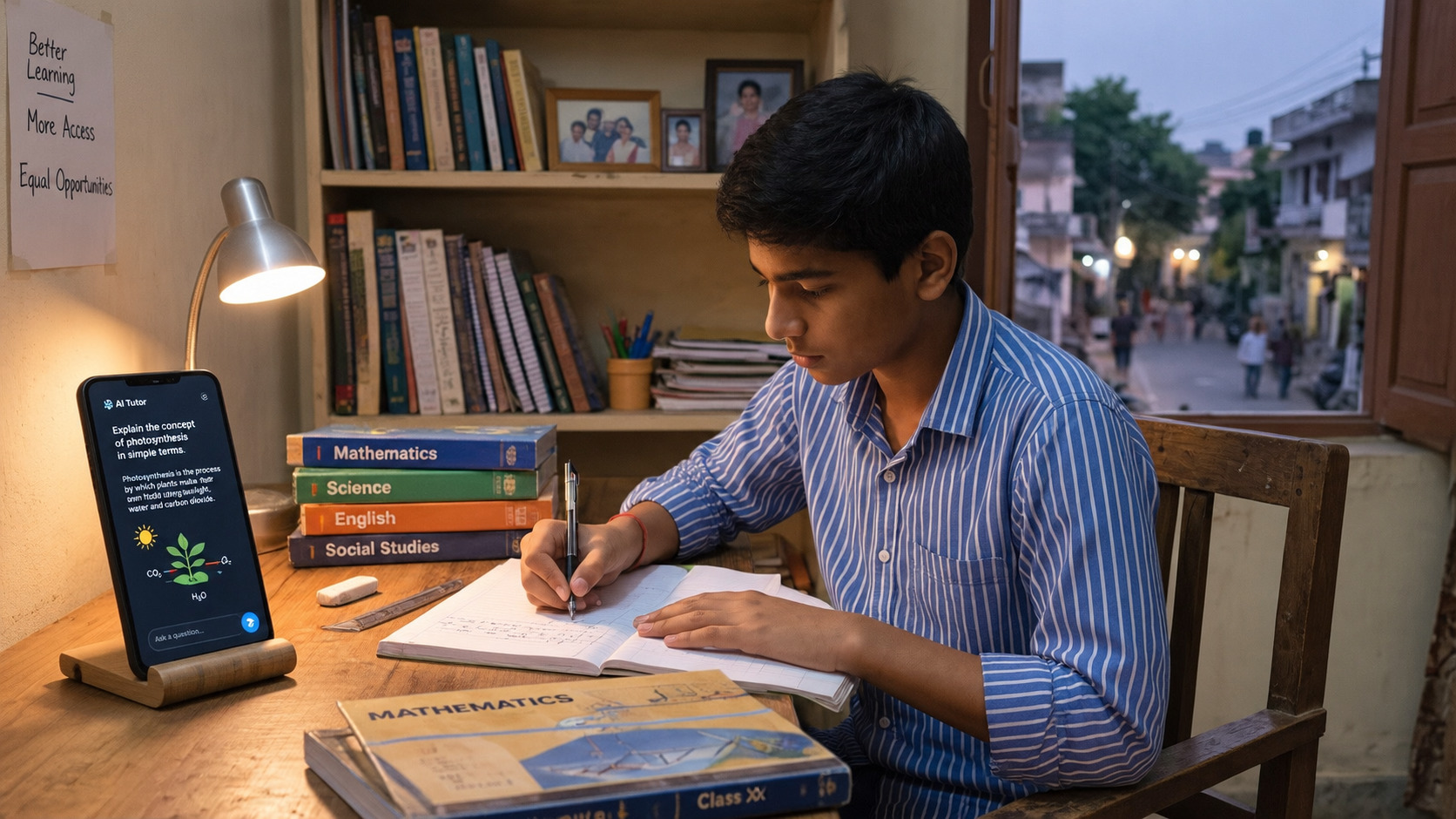
A Class 9 teacher in rural Tamil Nadu recently told researchers that students used to wait for someone from the city to come and guide them; now, in her words, they carry the guide in their pockets. It’s a nice line, and it captures the pitch behind a wave of Indian AI-tutoring startups: that a chatbot on a cheap phone can do what an expensive city tutor used to. The harder question is whether the evidence backs that up, or whether it’s mostly a good story riding on genuinely bad access to teaching.
The gap these tools are actually built for
India’s private tutoring market is estimated at more than $30 billion, but it’s concentrated where paying families already are. Coaching for board and entrance exams is scarce or unaffordable across most Tier 2 and Tier 3 towns, which is the opening AI-tutoring startups are chasing. Indore-based Arivihan, for instance, prices its AI tutoring platform at roughly Rs 300 a month — a fraction of typical coaching-class fees — specifically targeting students outside major cities. The pitch is straightforward: an AI that answers doubts instantly, at any hour, doesn’t need a teacher physically present, and can, in theory, reach a student in a village as easily as one in Delhi.
What the research actually says
The optimistic story has real evidence behind it, but with a catch. A randomised controlled trial across nine public secondary schools in Edo State, Nigeria, found that students in a six-week after-school programme using GPT-4 in teacher-supervised pairs, with prompts built to encourage reasoning rather than shortcuts, made large gains in English and performed better on year-end exams. A separate study estimated AI-tutor access lifting test performance by about 0.23 standard deviations overall. The catch: a widely cited PNAS study on Nigerian high-school maths found the opposite when the guardrails were removed — students using generative AI without structure or supervision saw learning harm, not gains, because it became easier to get an answer than to work one out. The takeaway isn’t that AI tutoring works or doesn’t; it’s that it works when built like tutoring, with structure and monitoring, and backfires when it’s just an answer machine.
The bottleneck isn’t the chatbot — it’s the phone plan and the language
This is where India’s own numbers complicate the story. The Economic Survey 2025–26 found that 89.1% of rural teenagers aged 14 to 16 now have a smartphone at home — access is no longer the constraint it once was. But the same survey noted that nearly three in four rural youth mostly use that smartphone for social media, not learning, meaning ownership hasn’t yet translated into better outcomes. National telecom survey data adds that only about 42% of India’s internet users are rural, despite rural India holding roughly two-thirds of the population, and rural download speeds still lag urban ones. An AI tutor that assumes steady bandwidth and a student who already uses one productively will miss much of who it’s supposedly built for.
Language is the other real barrier, and one AI is arguably better positioned to solve than any earlier edtech wave. Bhashini, the government’s translation and speech-recognition platform covering India’s 22 scheduled languages, is increasingly being built into classroom tools — Intel recently partnered with it to run offline multilingual transcription on classroom laptops, aimed at semi-urban and rural schools with unreliable internet. For a student taught in Telugu or Odia but tested in English, that’s a genuinely new kind of help, not just a cheaper version of an old one.
A conditional yes, not an automatic one
The honest answer is that AI tutors can extend real teaching capacity to students who currently have none — but only where they’re paired with connectivity, some structure, and a language they understand, not just dropped into a phone and left alone. CBSE and NCERT are already building AI literacy into the curriculum from 2026–27, under a committee led by IIT Madras’s Karthik Raman, precisely because the gap between a well-designed AI tutor and an unsupervised chatbot is large enough to decide whether this closes the education divide or just moves it online.