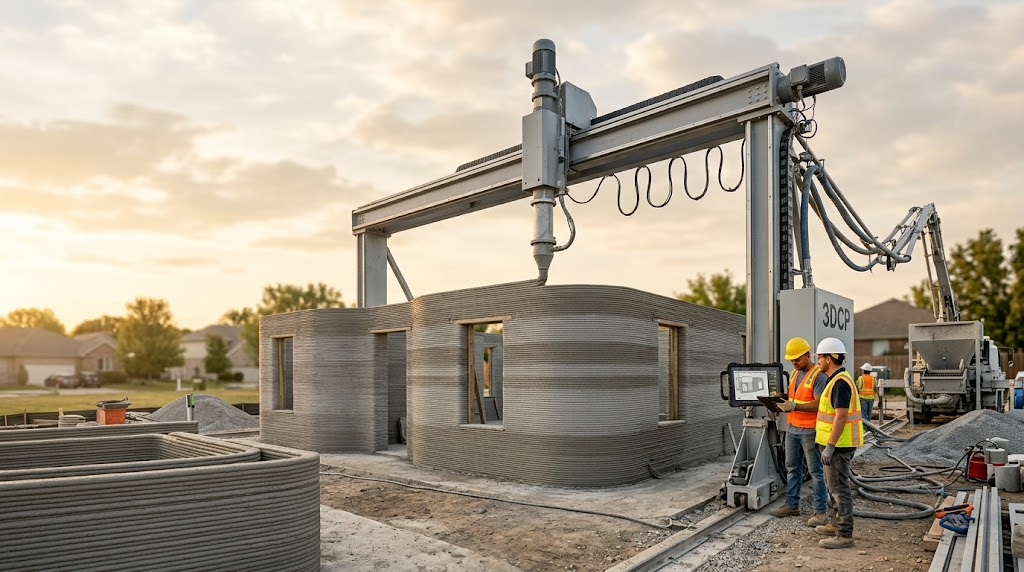
Robots Can Now Print a House's Walls in Days. Printing the Whole Home Is Another Story
In 2026, concrete-printing robots finished real homes in Kansas, California and Japan, and the first dedicated building standard cleared approval. Cost claims and long-term durability are still unproven.
Yes, partly. A 3D-printing robot can now lay the concrete walls of a house in days, and several permitted homes went up this year. But the printer does not build the roof, pipes, wiring or finishes. Human crews still do that. So the real question is how much of a house a robot can build, and whether the result passes code and holds its value. A new standard answered part of that in 2026. Some headline claims still need care.
How a Printer Turns Concrete Into Walls
A gantry or robotic arm follows a digital plan and pushes a cement-based mix through a nozzle, one layer on top of another. In Topeka, Kansas, builder Trident Homes mixes materials on site and sends them through a hose to the printer, which places them where the design needs them. Window and door openings are part of the print path. The rough walls are then chiseled, smoothed with pumice and given a finish coat by hand.
Where Printed Homes Actually Went Up in 2026
Trident Homes began printing on Feb. 24, and the walls were finished in 12 days. In Sacramento, crews were printing the city's first 3D-printed house by early May. In Japan, a startup completed "Stealth House," the country's first 3D-printed two-story home.
The industry is also scaling up. Serendix said in June that its printing business had moved from research into mass production, and it says a compact structure can go up in under 24 hours. Titan America launched xForm3D in June, a printable concrete meant to reduce the need for traditional formwork. Tokyo's city government highlighted Serendix's technology in August as one way to make urban housing more affordable.
Strength, Codes and the Arrival of ICC 1150
A printed wall is only as strong as the bond between its layers. Until recently, building codes had no direct answer for that. Most North American projects won approval through "alternative means and methods" rules, where builders must prove the method meets the intent of the code. ICC-ES later wrote acceptance criteria, known as AC509, covering structural strength, fire safety and durability.
The bigger step came in 2026. The International Code Council published ICC 1150, the first standard for 3D-printed concrete walls, in March. ANSI approved it on July 15. It covers material qualification, structural design for gravity, wind and limited seismic loads, reinforcement detailing and quality checks on site.
This does not make printed homes automatically legal everywhere. Local governments still decide what to adopt, and approvals vary by place.
Savings Claims Versus Proven Results
Cost is where the numbers need the most care. Trident Homes' founder puts printed construction near $170 per square foot, against $225 or more for a traditional build. That figure comes from the builder, and he notes it varies with location and other factors. In Sacramento, a robotics engineer said printed walls resist fire and termites, which could eventually lower insurance costs. That is a hope, not a result yet.
Analysts in Japan are blunter. They say the risks compared with conventional building remain substantial, including thin long-term durability data, uncertain resale values and cautious insurers. A house built in 2026 simply has no decades of track record yet.
What Comes Next
In the near term, watch how many local governments adopt ICC 1150 and whether insurers and lenders follow. Over the longer run, the test is how these homes age. Cracking, moisture and resale prices will take years to show up. Printing also covers only the shell, so savings depend on how much of the total build the walls represent.