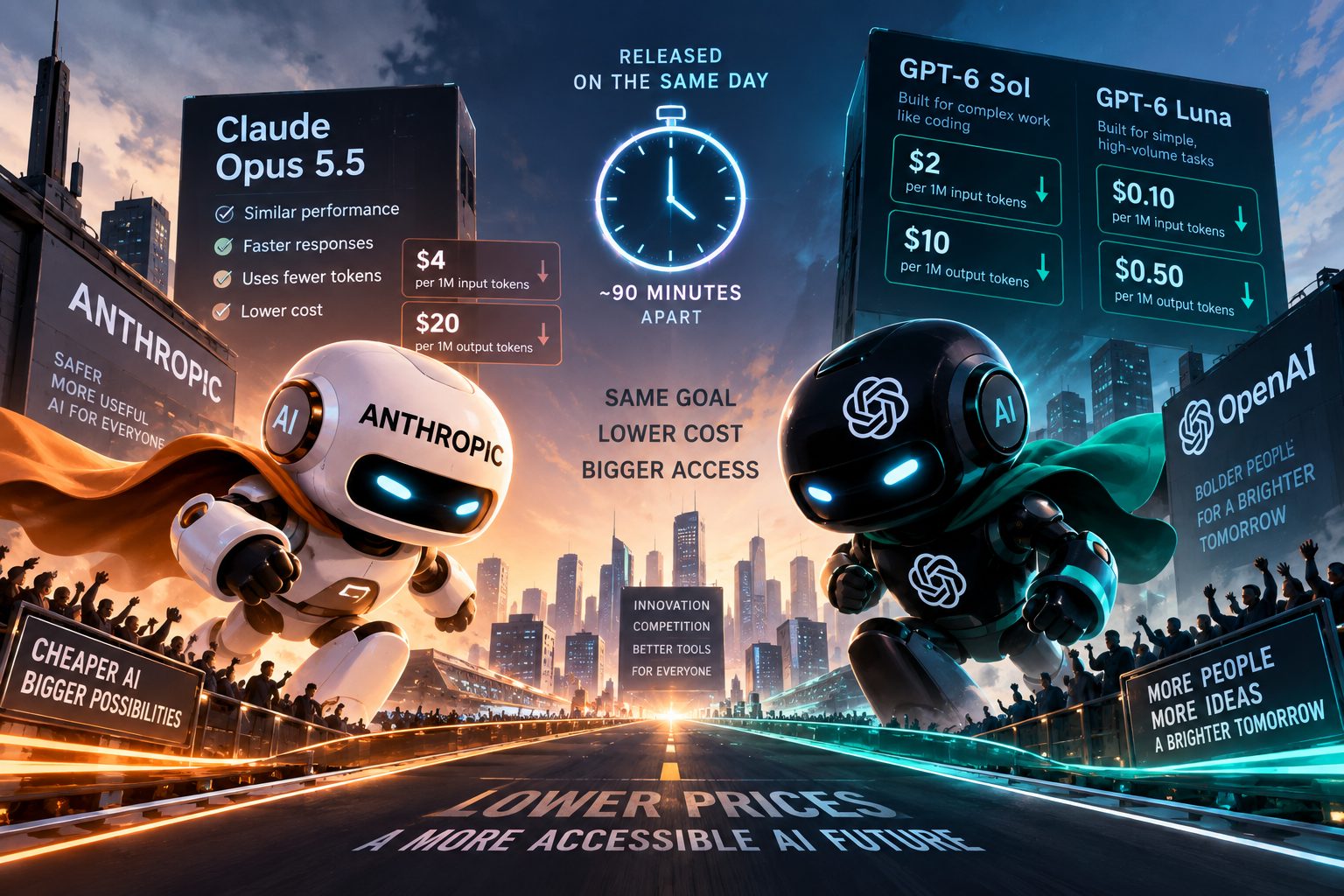
On September 22, 2026, Anthropic released Claude Opus 5.5. About 90 minutes later, OpenAI released two new models of its own: GPT-6 Sol and GPT-6 Luna. Neither company was trying to set a new record for how smart their AI is. Both were trying to do the same thing: make their AI cheaper to run.
This wasn't really a coincidence. Chinese companies keep releasing free, powerful AI models, and that's putting pressure on both Anthropic and OpenAI. Price has become one of the biggest battles in AI this year.
What actually changed
Claude Opus 5.5 is Anthropic's first model in a new 5.5 line. Anthropic says it performs about as well as its higher-tier Fable 5.1 model on most tasks. On top of that, a typical task now costs about 40% less to run than it did on the older Opus 5. Part of that comes from a straight price cut. Part of it comes from the model being faster and using fewer tokens (the small chunks of text AI models are billed by), which saves money on its own. Looking just at the listed price: Opus 5.5 costs $4 per million input tokens and $20 per million output tokens. That's down from $5 and $25 for Opus 5, a 20% cut. Cache reads, which is what you get charged when the model reuses something it already processed, like in a long coding session, dropped 60%, from $0.50 to $0.20 per million tokens.
OpenAI answered less than two hours later. GPT-6 Sol and GPT-6 Luna both launched at half the price of the GPT-5.6 models they replace. Sol is built for harder work like coding. It now costs $2 per million input tokens and $10 per million output tokens, down from $4 and $20. Luna is built for simpler, high-volume jobs, like summarizing documents or pulling out specific details. It costs just 10 cents per million input tokens and 50 cents per million output tokens, which is far cheaper again. One thing worth pointing out: Sol and Luna are not OpenAI's top model. That's still GPT-6 Astra, which came out earlier in September. Sol and Luna sit below it, built to bring some of what Astra can do to cheaper, faster options.
Why this is happening now
Anthropic and OpenAI are both competing with free, open-weight AI models from Chinese labs like DeepSeek, Alibaba's Qwen team, and Moonshot AI. This same week, Xiaomi released its own model, MiMo-V2.6, which is now one of the strongest free AI models out there. When a free option is genuinely good, it's harder to charge people a high price unless your paid model is clearly better or clearly cheaper than before.
Anthropic backs up its efficiency claim with some numbers. The company says Opus 5.5 produces answers more than 30% faster than Opus 5, and it usually needs fewer tokens to finish a task. That's what adds up to the 40% real-world savings, on top of the lower sticker price.
An odd moment for a price war
These releases came just days after Anthropic's CEO, Dario Amodei, publicly asked the AI industry to "pace the frontier." In plain terms, he wants companies to slow down the race to build more and more powerful models, because of safety concerns. Anthropic calls Opus 5.5 its first release since that statement. The company says outside groups, including Frontier Design and METR, tested the model, and that it scored better than any recent Claude model on Anthropic's own internal safety check.
That's an odd contrast worth pointing out directly. A company can ask the whole industry to slow down on raw power, while still shipping a new model quickly, as long as that new model is sold as being about cost and safety rather than raw power. Whether that's a real difference or just a convenient one is a fair question. People will disagree on it.
What this means if you're actually using these tools
If you build things using Claude or GPT, this is good news. You get similar or better output for a lot less money. That's especially true for simple, high-volume tasks, where GPT-6 Luna's pricing looks built to undercut everyone else. Anthropic is also expected to release Sonnet and Haiku versions of the 5.5 family in the coming weeks, which would bring the same kind of price cuts to the rest of its lineup.
The bigger picture here is that free, open-weight models are now shaping how much the paid AI labs can charge, almost as much as the labs' own judgment of what their models are worth. That's a real change from a year ago, when prices for top AI models mostly went up, not down. If this keeps happening, expect the next price drop to come from wherever the next strong, free model shows up, not just from Anthropic or OpenAI's own plans.