Drone Range Explained: Why the Advertised Distance Is Not Your Safe Flying Distance
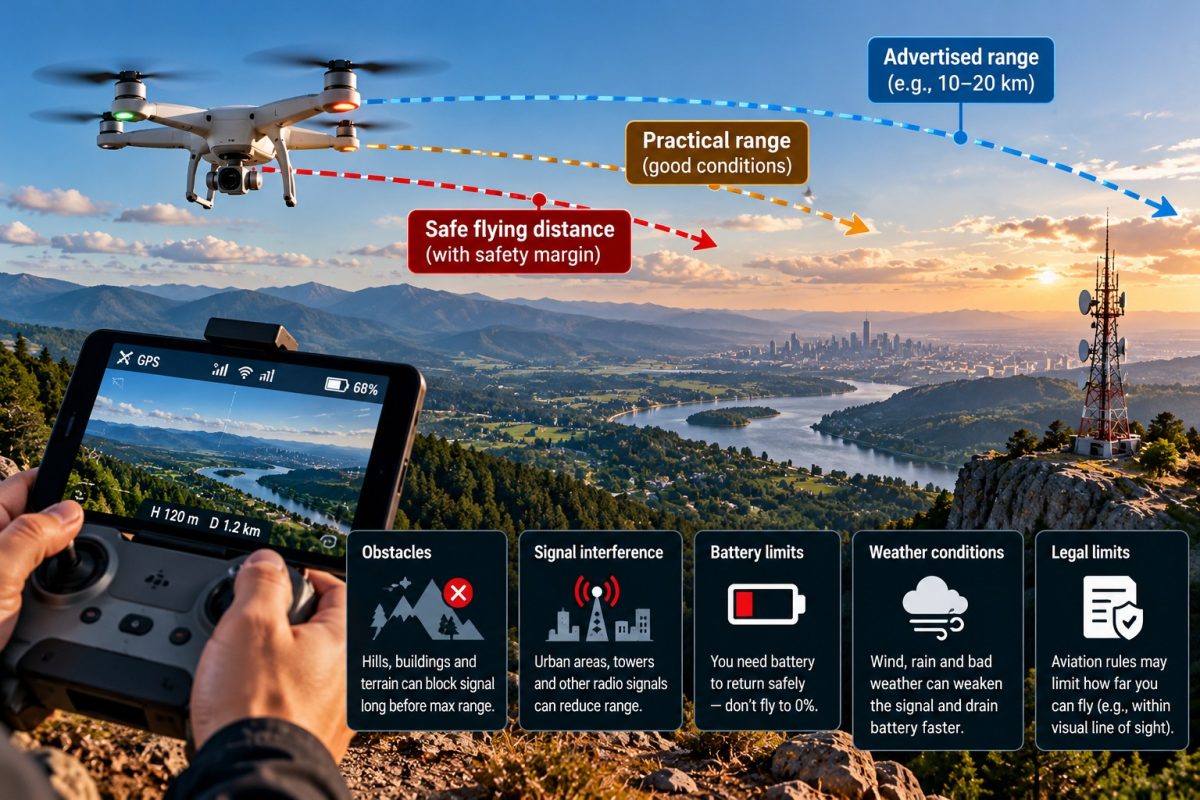
The advertised range is the farthest a drone's radio link can reach in a best-case test. It is not how far you can fly safely, legally or with enough battery to return. Your real limit is whichever of four things runs out first: the radio link, the law, the battery or your own line of sight.
What the advertised number actually measures
The DJI Mini 4 Pro lists a maximum transmission distance of 20 km under the FCC standard and 10 km under CE. DJI says this is measured outdoors, unobstructed and free of interference. The figure describes only how far the video and control link can reach. It says nothing about battery life, legal limits or whether you can still see the aircraft.
Why one drone has two ranges
Radio range depends partly on how much power the transmitter is allowed to use. DJI's specifications for the Mini 4 Pro list transmit power on 2.4 GHz of under 33 dBm for FCC and under 20 dBm for CE. On 5.8 GHz the limits are under 33 dBm for FCC and under 14 dBm for CE.
In practice, the same model is certified to different power limits in different regions, so its range claim changes with the rules of the market. Which setting applies to a drone used in India depends on how the unit was sold and configured. Treat the 20 km figure as unlikely to apply unless you have confirmed your unit's region.
How the link behaves in real conditions
The controller and drone exchange video and commands by radio, using DJI's O4 transmission system on the 2.4 GHz and 5.8 GHz bands. Signals at these frequencies work best with a clear path between the two antennas. Buildings, hills and trees weaken or block the signal. Other devices on the same bands, such as Wi-Fi routers, add noise that the receiver must separate from the drone's signal.
DJI's own table shows the effect:
- Strong interference in an urban landscape: roughly 1.5–4 km.
- Medium interference in suburbs: about 4–10 km.
- Low interference: about 10–20 km.
- Path obstructed by buildings: about 0–0.5 km.
- Path obstructed by trees: about 0.5–3 km.
DJI notes these figures were tested to the FCC standard, so a unit limited to CE power should expect less.
Manufacturer claims versus independent evidence
Every figure above comes from the manufacturer. I found no rigorous independent lab test of the Mini 4 Pro's range. Pilot forum posts report link loss in cities well below the headline numbers, but these are anecdotes recorded in different conditions. Use them only as a reminder that results vary, not as measurements.
Four limits that decide your safe distance
- The radio link. The environment, not the box, sets this, as shown above.
- The law. India's Drone Rules, 2021 define the green zone as airspace up to 400 feet (120 m), and up to 200 feet in the band 8–12 km from an operational airport's perimeter. Government material also says most operations are limited to visual line of sight. A small drone becomes hard to see long before 10 km.
- The battery. Every kilometre out is a kilometre back, and wind or climbing can raise consumption. Planning for the return trip roughly halves your usable outward distance.
- Your line of sight. If you cannot see the drone, you cannot judge obstacles, other aircraft or its orientation.
A realistic example
A hobbyist on the edge of a town reads "10 km" on the box and flies toward a lake, with a low hill in between. At about 1.2 km the video feed stutters, because the hill is blocking the signal. The drone is also well outside comfortable sight distance, and the battery is already around half used. If the link drops completely, the drone's failsafe takes over, and what it does depends on a setting the pilot may not have checked.
The 10 km figure was never wrong. It described a flat, empty, interference-free test site, not that hill.
Availability in India
DJI does not officially sell in India. The import of ready-built foreign drones has been blocked since a DGFT notification of 9 February 2022, while components remain freely importable. That source is a law-firm summary, so confirm the current position on the DGFT website before publishing.
Useful takeaway
Set your own limit instead of using the maximum. DJI staff point pilots to the maximum distance setting in the DJI Fly app, which lets you cap how far the drone can go. A sensible personal rule is to stay where you can clearly see the drone, and turn back well before the signal weakens. That rule is a practical suggestion, not a regulation.