On 11 September 2026 the FAA posted a draft environmental assessment for Zipline covering up to 220,000 deliveries a day across five Texas metro areas, supported by 220 charging stations and 4,400 pickup kiosks, according to DroneXL's reading of the filing. It is a ceiling for planning, not today's volume. A month earlier, Amazon's drone tracker recorded a package released from about 13 feet that landed in a customer's swimming pool in Richmond, Texas. The two items together show the gap between drone delivery's ambition and its details.
The flight is the solved part
Flying a small aircraft along a planned route is now routine for the large operators. Wing said in September 2026 that it makes thousands of deliveries to homes each day, and Walmart reported passing one million drone deliveries in May 2026, a total it shares with Zipline and Wing. Zipline opened in Houston on 29 April 2026 after starting in Dallas-Fort Worth in August 2025.
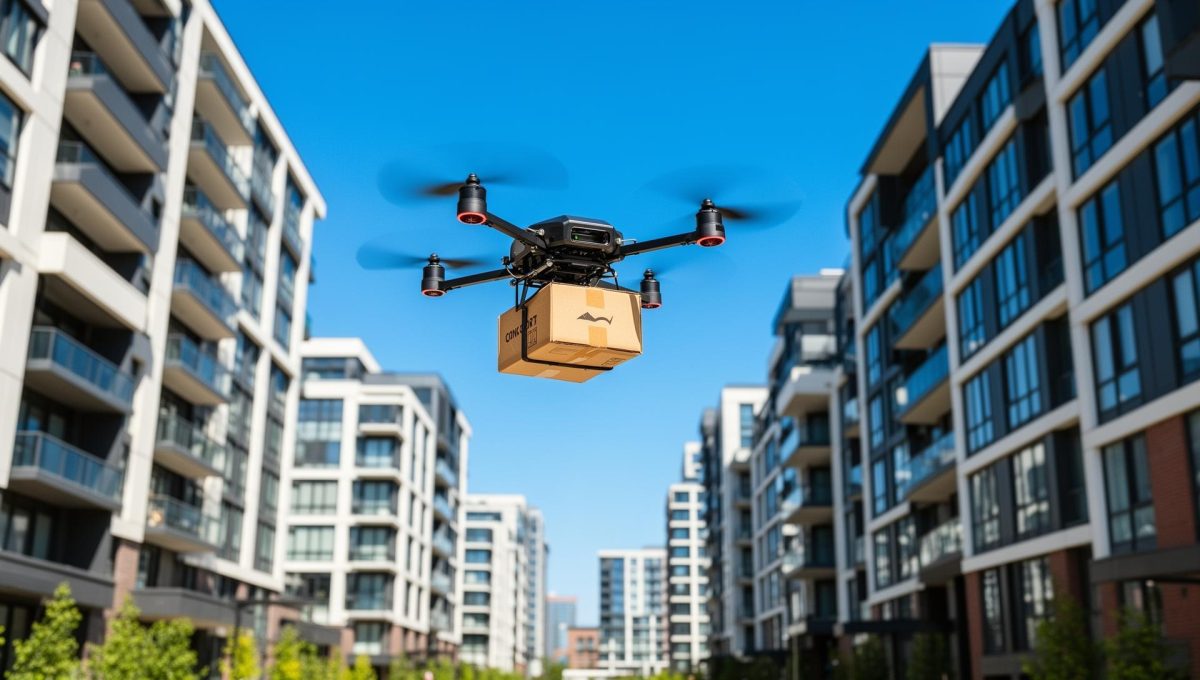
The difficult part is what happens when the drone arrives. A 2026 explainer from UAV Coach lists the main ways to hand over a package: land and unload, lower it on a cable, lower a powered delivery unit on a tether, or release it with its own parachute. Each choice trades something. Landing needs clear space, which a crowded street may not have. Lowering a package keeps the drone in the air, but it must keep station in wind. Dropping from a height is simple and lightweight but risks the package, as the pool incident shows.
Amazon's MK30, according to DroneXL, weighs 83 pounds, drops its package from about 13 feet and carries no parachute. DroneXL's tracker also lists a precautionary landing on a lawn in Waco in September 2026 and an emergency landing on a residential sidewalk in Tolleson, Arizona, in October 2025. Amazon has not said what triggered the Waco landing, and no injuries were reported.
Weather is a daily constraint
A local television report from Papillion, Nebraska, in August 2026 said Amazon's drones deliver hundreds of packages a day but cannot fly in all weather. After seeing wind blow packages away, Amazon changed its packaging so the weight settles on the ground without rolling from the drop spot, a regional manager said, and the company will not fly in very strong winds. A police lieutenant in the town said Amazon stopped deliveries in an area when police asked for it to be cleared for a drone mapping job.
Economics and the doorstep
Delivery needs more than aircraft. Zipline's Texas filing counts pickup kiosks, which suggests every deployment needs ground infrastructure. India's Skye Air solves the last step differently: a drone delivers to a receiving port, and a rover then carries the package to the customer, according to a February 2026 report. The company says it has completed about 3.6 million deliveries in two and a half years, and The Ken reported in 2026 that Skye Air completes more than 6,000 a day in Gurugram. A trade site reported in 2025 that its drones average 4 kilograms and carry up to 10 kilograms.
Demand matters as much as engineering. The Ken's analysis found drone delivery economics are sensitive to volume and more likely to struggle in quick commerce, while mid-mile uses, such as moving parcels between hubs or medical samples between clinics and labs, have seen more adoption. Bengaluru's Airbound began flying diagnostic samples over a four-kilometre corridor in January 2026.
What is in use, and what is not
In practice: suburban delivery of light packages in the US, India's urban and mid-mile routes, and medical sample runs.
Experimental or planned: the 220,000-a-day Texas ceiling, dense urban delivery to flats and balconies, and heavier payloads.
The constraint that matters most: the last 50 feet. Weather, safe landing spots, people and pets nearby, and a place for the parcel to go all vary house by house, and every failure becomes a visible incident.
The sensible reading of 2026 is that drone delivery works at scale in places with open space, simple routes and steady demand. Making it work for every doorstep is a different problem, and an unsolved one.