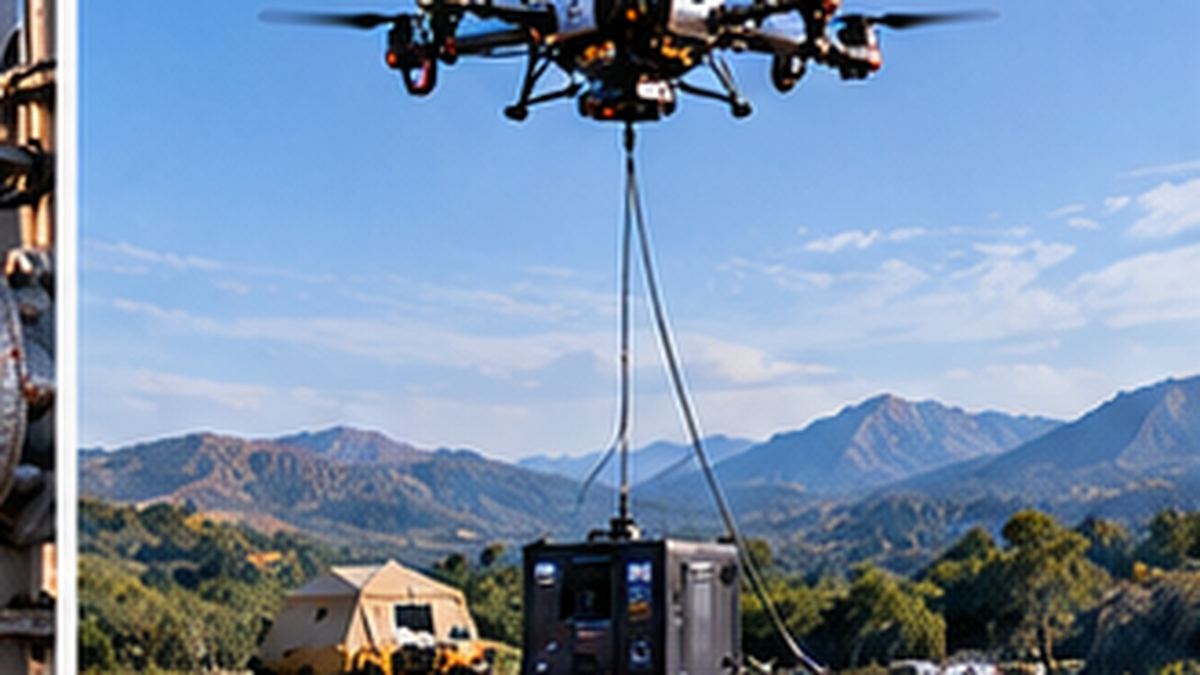
A cable changes the endurance equation
A normal multirotor carries almost all of its energy onboard. That makes it mobile, but it also makes endurance a battery problem. A tethered drone changes the equation by sending power up a cable from a ground station. The aircraft can still carry cameras, thermal sensors, communications equipment and computing hardware, but the ground system supplies the energy needed to keep the motors turning.
BEL’s current product description shows how the architecture is intended to work. The company describes its Tethered UAV as a portable “virtual telescopic mast” for surveillance and monitoring. It combines a high-bandwidth optical-fibre communications link with automatic cable winding and release, so the tether can manage changing altitude without simply hanging loose. BEL also lists a continuous-operation cycle of up to six hours followed by a 30-minute break, plus automatic return-to-home behaviour if power or communications fail.
What the tether actually carries
The benefits are straightforward. A drone hovering tens or hundreds of metres above a site can provide a persistent camera view without the repeated launch-land-recharge cycle of a battery aircraft. That makes tethered platforms attractive for perimeter surveillance, ports, airfields, public events, temporary communications and infrastructure monitoring. The tether can also carry data, which reduces reliance on a separate wireless link and can provide a more controlled communications path.
The technology has a price. The cable adds mass, drag and mechanical constraints, and the aircraft cannot simply fly away from the ground station. Tether tension becomes part of the flight-control problem, especially when the ground unit is mobile or the wind changes. A 2025 study on nonlinear model-predictive control for tethered aerial vehicles specifically treated the coupled aircraft-and-tether dynamics as a control challenge. Ground equipment also needs reliable mains, generator, battery or hybrid power, depending on the mission.
Where tethered drones are already useful
The market is moving beyond prototypes. In India, the Ministry of Home Affairs published updated qualitative requirements for tethered UAVs in 2025, while BEL continues to market the category. Aerial IQ has also publicly announced DGCA type certification for a tethered system designed for 24-hour continuous operation. Such developments show that persistent drones are becoming a procurement category rather than merely an experimental concept.
Commercial usefulness is therefore already real in applications where the aircraft needs to remain near one location. A tethered drone is unlikely to replace a free-flying inspection or delivery aircraft, but it can replace a temporary mast, observation tower or repeated battery-swapping operation. The central insight is simple: when the mission values time aloft more than geographic freedom, a cable can be an advantage rather than a limitation.
The trade-off: endurance versus freedom
A particularly interesting development is the convergence of tethered aircraft with communications payloads. Because the cable can carry both power and data, a persistent drone can become a high viewpoint for a radio repeater, temporary network node or sensor cluster. The ground station can also be mobile, allowing the aircraft to act as a temporary mast at an incident site. The trade-off is that the tether defines the operating area, so the system is strongest when the mission has a fixed or slowly moving centre. In that sense, tethered drones are not trying to win the endurance race against fixed-wing aircraft; they are turning a rotorcraft into a rapidly deployable elevated infrastructure asset.
What to watch next is the combination of tethered endurance with automated launch and recovery. If the ground station can deploy the aircraft, manage cable tension, diagnose faults and recover the drone without a crew standing beside it, the system becomes a genuine remote infrastructure node. That is a more meaningful milestone than simply increasing the number of hours on a specification sheet.