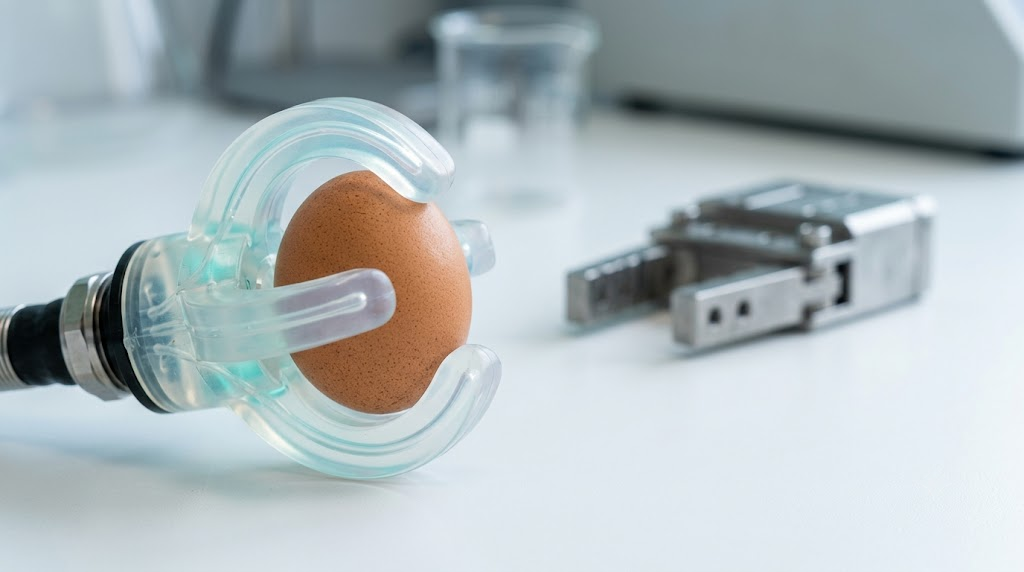
A rigid metal gripper can damage an object if it applies too much force. A soft robotic gripper, by contrast, uses flexible materials that deform around an object, helping distribute contact forces and accommodate different shapes. This makes soft robotics promising for handling eggs, fruit, vegetables and other delicate products. However, laboratory demonstrations do not automatically translate into reliable, high-speed industrial operation.
A 2025 review in Advanced Robotics examines how soft grippers could improve fragile-food handling while highlighting the challenge of maintaining both product safety and production speed. The technology is promising, but its practical value depends on the application, operating conditions and long-term reliability.
Flexible Materials Do Part of the Work
In a soft gripper, the material itself helps accommodate differences in an object's shape and surface. Flexible fingers can bend around irregular objects instead of relying entirely on precisely controlled rigid contact points. This can reduce concentrated pressure and make handling more forgiving when products vary in size.
A 2025 study published by SCITEPRESS compared three thermoplastic polyurethane (TPU) gripper designs: Straight, Constant Curve and Beak. The researchers fabricated the designs using two material hardness levels, 60A and 95A, and assessed their mechanical performance using a universal testing machine and practical tests. The Beak design made with 60A TPU showed promising force-displacement performance for delicate handling, while the harder material was more rigid.
These findings illustrate how both material properties and finger geometry influence gripper performance. However, the reported results should not be treated as proof that one design will work best for every fruit or industrial task. The study's published summary does not provide enough detail to establish broad performance across different operating conditions.
Compliant Gripping: Shape Helps Guide Contact
Soft grippers can also adapt to objects in cluttered environments. Their flexible fingers may conform to surrounding shapes and enter gaps that are difficult for rigid grippers to access. This could be useful when picking individual products from crowded bins or handling items with inconsistent orientations.
Some designs rely on mechanical compliance, while others combine flexibility with adjustable stiffness, force sensors or tactile feedback. These additional features can help a robot detect contact and adjust its grip rather than relying only on a predetermined movement.
A 2026 paper in Nature Communications presented a five-finger soft gripper combining vision, tactile and curvature sensing for fruit harvesting. Its 13 sensors helped the system assess objects and the gripper's own bending state. The researchers demonstrated the system on several fruits and conducted a greenhouse strawberry-picking demonstration. The reported results are encouraging, but they describe a research prototype tested in controlled experimental conditions, not proof of dependable performance across commercial farms.
Delicate Handling Beyond the Laboratory
Food processing is one potential application for soft robotics. Products such as tomatoes, strawberries, tofu and oysters can be damaged by excessive gripping force or sudden movement. A suitably designed gripper may help reduce damage while supporting automated picking, sorting and packaging.
However, handling speed matters as much as softness. When a robot accelerates or stops quickly, the forces acting on the product can increase the risk of damage. A gripper that performs gently at low speed may not provide the same results on a fast production line.
The 2025 Advanced Robotics review identifies high-speed, damage-free handling as an important engineering challenge. It discusses approaches such as combining soft and rigid components and designing grippers that support objects across a larger contact area. These approaches may help balance gentle contact with stable handling, although their suitability depends on the product and production requirements.
The Engineering Challenges
Modeling and control. Soft materials deform continuously, making their movements more difficult to predict than those of rigid mechanisms. Engineers must account for changing shapes, applied forces and interactions with objects. Reliable control becomes especially important when a gripper must move quickly without damaging its contents.
Sensing. A robot needs to know when it has contacted an object and whether its grip is secure. Flexible materials can make it difficult to integrate sensors without affecting the gripper's movement or durability. Tactile and force feedback can help, but sensors must remain accurate during repeated use.
Durability. Repeated bending, material fatigue, wear and exposure to moisture or cleaning chemicals can reduce performance. A gripper that works well in a short experiment may require redesign before it can withstand continuous industrial operation.
Manufacturing and cost. Soft grippers must be produced consistently, maintained easily and integrated with existing robotic systems. Material variation, complex fabrication and repairs can affect their total cost. For manufacturers, the relevant question is not just whether a gripper can handle a fragile object, but whether it can do so reliably and economically at the required production rate.
What Comes Next?
Soft robotics offers an alternative to rigid gripping for tasks where product damage is a concern. The most useful systems may combine flexible contact surfaces with rigid support structures, sensing and carefully designed control.
Before widespread adoption, these systems need testing over repeated operating cycles and across different products, speeds and environmental conditions. Important measures include damage rates, grip reliability, handling speed, maintenance requirements and total operating costs.
Soft robots are not automatically better than metal grippers in every situation. Their advantage lies in applications where adaptability and gentle contact matter most. Demonstrating that they can deliver these benefits consistently outside the laboratory will determine how widely they are adopted in food processing, agriculture and other industries.