From Lobbies to Skyscraper Glass: How Robots Are Learning to Clean Big Buildings
Autonomous scrubbers are moving into mainstream facility cleaning, while facade robots remain few and human-supervised. Navigation around people and unclear economics are the main limits.
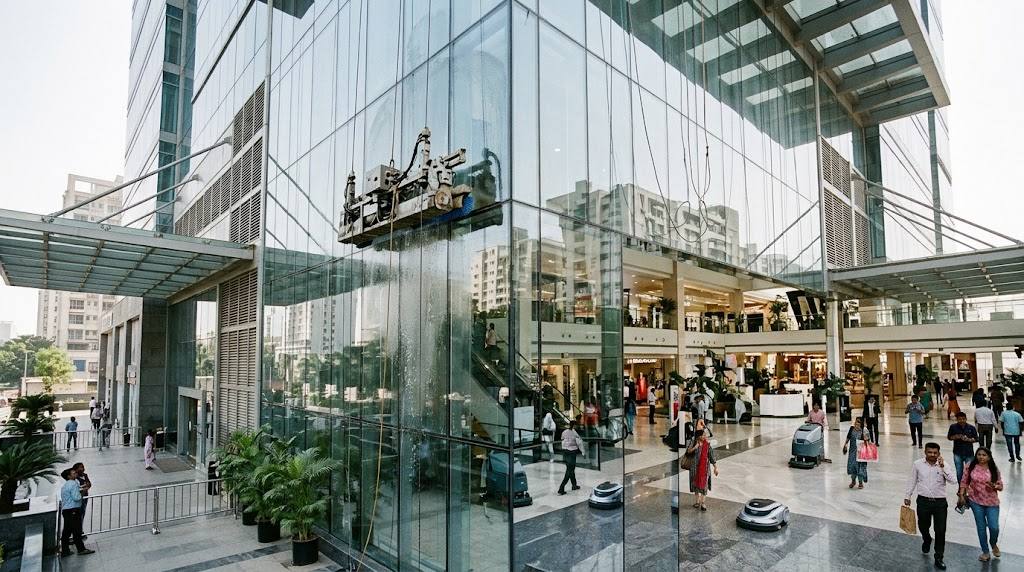
Large buildings are a natural fit for cleaning robots: huge floors, repetitive routes and a persistent labor shortage. In 2026, floor-care robots are getting easier to deploy, and facade robots are working on a few towers. The business case still depends on vendor numbers.
Floor Care Gets Easier to Deploy
Tennant, a major floor-care maker, launched the compact X2 ROVR SCRUB scrubber in May 2026 for high-traffic spaces with limited room, according to a market-research press release syndicated on October 30. The same release says its P1 VAC, launched in October 2026, is its first autonomous robotic vacuum for soft floors, supporting a goal of a US$250 million robotics business by 2028. An April 2026 industry blog says Brain Corp’s BrainOS Clean 2.0 with SelfPath AI, introduced in March, removes manual route training and cuts deployment time by more than three times. That is Brain Corp’s claim as reported by the blog.
Until now, many machines used teach-and-repeat. An Orion Star buyer’s guide describes it as an operator driving the route once and the robot copying it. The same guide says docking workstations let robots recharge, refill water and discharge dirty water on their own, and lists the Avidbots Neo 2 at up to 3,900 square meters per hour of theoretical productivity.
Navigating Occupied Spaces
People are the hard part. An accepted 2026 IROS paper says safe and socially compliant navigation remains a fundamental challenge for robots in human-populated environments, and notes that popular obstacle-avoidance methods such as ORCA treat people as ordinary moving obstacles. A peer-reviewed article from EPFL argues that the EN ISO 13482 safety standard for personal care robots lacks requirements to protect pedestrians and bystanders in public spaces, where crowds, social norms and misbehavior all affect safety.
Facade Robots
Facade work is smaller but visible. The Robot Report described Skyline Robotics’ Ozmo, a KUKA robot arm on a building’s cradle, deployed in August 2024 at a 45-story Manhattan tower, with the company claiming it cleans three times faster than traditional methods. Uncrewed Systems Technology notes that crews in advanced countries are typically three people, and that wind gusts require stabilizing the platform to prevent collisions with the facade. The robot uses cameras and LiDAR to locate itself relative to the glass, and the cradle has weight limits.
A 2026 WhichBot guide says facade robots are sold as a service, priced by facade area and schedule, with one certified rooftop operator in place of a suspended crew. It also says three-quarters of U.S. window cleaners are over 40, so the guide frames automation as filling a shortage. Those are the guide’s statements, and Ozmo still has a human supervisor.
The Economics
Costs vary widely. A Sharebot article lists autonomous scrubbers at $35,000 to $80,000 and rentals at $800 to $2,500 per month, and cites Avidbots clients reporting 60 to 70% lower floor-care labor costs. Both claims come from a robot-rental marketing blog. Kärcher dealer prices posted by GrabARobot on August 14, 2026 range from $12,999 for the KIRA CV 50 to $87,117 for the KIRA BR 200, with a docking station that raises the deployed price of one model to $59,630.
Orion Star says return on investment depends on the gap between fully loaded manual labor cost and the robot’s total cost of ownership, and estimates annual operating costs of $4,000 to $7,500 for a well-maintained scrubber. The industry blog cautions that vendors publish performance metrics, not ROI. I found no independent study measuring payback.