Walking the Whole Network: How Robots Could Keep Railway Tracks Safe
Measurement trains cover long distances, while smaller in-track robots reach places and times they cannot. Most repair work is still done by people, and signal, access and possession limits shape what robots can do.
Railways are long, old and hard to inspect. A 2023 review by Cranfield University and Network Rail researchers notes that Britain alone has about 20,000 miles of track, 30,000 bridges and 2,500 stations, some almost 200 years old. It also cites earlier figures showing that only 28% of track inspection and repair involved robotic or autonomous systems, even though track faults caused 17% of train delays and 33.1% of passenger train cancellations. Robots are starting to fill the gap, though much of the 2026 evidence is still in trials.
A 2026 Test Case in Japan
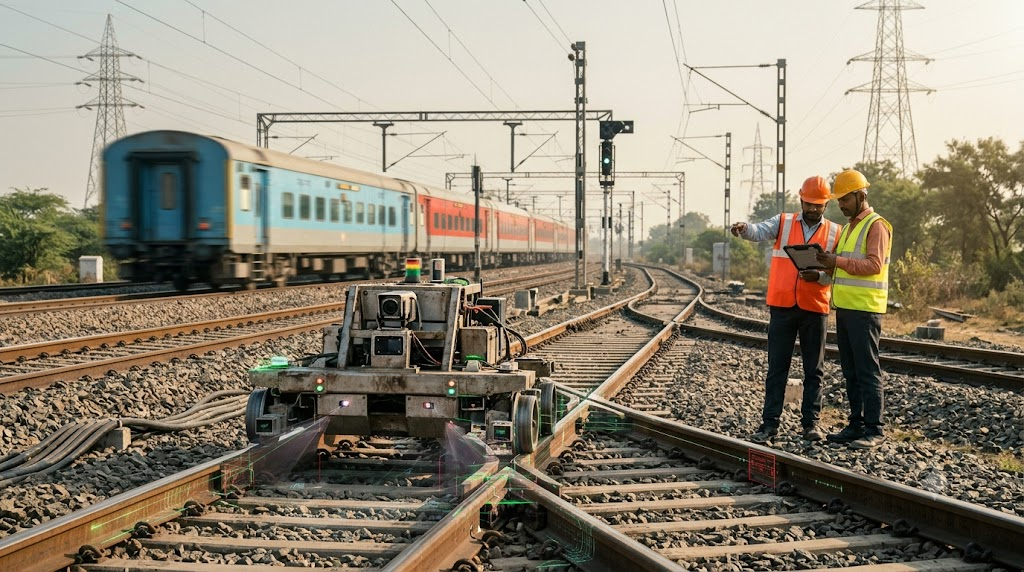
The clearest recent development is from East Japan Railway (JR East). A May 2026 press release says the company has been developing an autonomous in-track robot with Preferred Robotics since April 2024, has completed proof-of-concept tests on six lines, plans to build a practical prototype by the end of October 2026 and to start running tests, mainly on conventional lines, from November. The robot streams video to staff in real time. AI helps detect obstacles near the track, but staff at a remote location make the final judgment about anything that could affect train operation.
The company’s stated aims are inspection after heavy rain or earthquakes without sending staff into dangerous areas, and ending foot patrols where workers could meet wild animals such as bears. Longer term, it wants to use the video and 3D point-cloud data for asset management and to add a drone launch function. The rail news site Tetsudo.com reports a prototype about 0.8 m long, 1.2 m wide and 1.8 m high, weighing about 100 kg, with a top speed of 15 km/h on 1,067 mm gauge track and roughly three hours of battery life. It carries a visible-light camera, LiDAR and GNSS, and sends data over LTE.
Measuring Defects
Track faults need different sensors. The Cranfield and Network Rail review lists laser vision for rail wear and geometry, ultrasonic sensors for surface and internal defects, LiDAR for clearance and vegetation, eddy-current and EMAT sensors for internal flaws, and ground-penetrating radar for ballast fouling. It describes Network Rail’s New Measurement Train, which can run at up to 125 mph and records almost 10 terabytes of data per 440 miles, but is costly to run and needs track possession.
One vendor, Oxmaint, says its track-guided robots run at 20 to 80 km/h and reach 10 to 20 times the coverage of walking teams, with laser geometry accuracy of ±0.5 mm. Those are company claims. A separate arXiv preprint takes another route, detecting track component failures from existing track-circuit data without adding any sensors.
Rail-Side Robots and Repair
Inspection robots are ahead of repair robots. The review reports that robots are rarely used for repair tasks. Its case study, the Robotic Inspection and Repair System from Cranfield and Network Rail, combines a rail trolley, a Warthog ground vehicle and a UR10e arm, and was tested at Northampton and Lamport Heritage Railway. A 2024 ScienceDirect paper describes another vehicle validated on a heritage railway with an ultrasonic inspection kit.
Other rail-side work is also being automated. Railway Gazette reports that JR East uses AI on data from its East-i measuring train to inspect overhead wires, expecting about 10% less manual work, and Tom’s Hardware has described a truck-mounted robot clearing branches near the tracks, which JR East pursued because of labor shortages. A vendor, iFactory, says a Chinese catenary maintenance robot entered trial on the Shuohuang heavy-haul railway in March 2025, with 90%-plus defect recognition accuracy, a vendor claim.
Why Large Networks Are Hard
The review lists challenges. Track is uneven, robots need access points to get on it, and platforms, overhead equipment and leftover material can block them. Remote lines may have weak signals, which complicates control and data transfer, and tunnels and overhead equipment degrade GPS. Power and data storage are limits too. Time is the other constraint. In the UK, the review says, the gap between the last train and the start of work averages around 50 minutes on AC-electrified routes, and 25 to 100 minutes can separate the end of work from the first train.