Soft Fruit, Hard Problem: Why Strawberries Push Harvesting Robots to Their Limits
A strawberry has to be found, judged, gripped and detached without a bruise, often while leaves hide it. In 2026 robots are working on all four steps, but commercial machines remain slower than skilled human pickers.
A harvesting robot has to do four things at once. It must find a berry, decide if it is ripe, grip it gently and remove it without damage, often in a tangle of leaves. Growers still have a strong reason to try. Dogtooth Technologies, which raised more than £14 million in July 2026, says horticultural producers face rising labor costs and trouble hiring seasonal staff .
Finding the Fruit
Detection is the first test. A Washington State University (WSU) system uses a two-stage AI pipeline that detects fruit, estimates ripeness and classifies whether each berry is fully visible or hidden behind leaves or stems. In reported results, it reached 80.5% mean average precision in strawberry detection and 93.2% accuracy in telling occluded from visible fruit. Those numbers show detection is usable but far from perfect.
Judging Ripeness
Color is the obvious cue, but it is not the only one. A Cornell and West Virginia University gripper uses multiple sensors to measure a fruit’s size, shape, color and firmness before deciding whether to pick it. Cornell professor Rob Shepherd said color reliably shows when strawberries are ripe, and that the team’s stiffness measurements also estimated picking time accurately. The approach could also suit crops where ripeness is hard to see, such as avocados and pineapples.
A Grip That Cannot Bruise
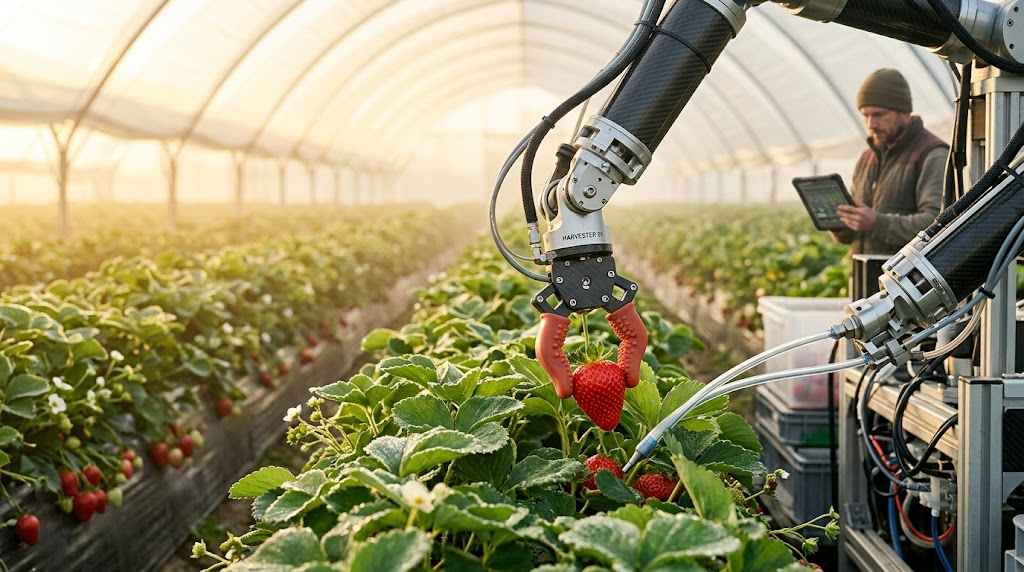
Gripping is where damage happens. The Cornell gripper uses two fiber-optic sensors that measure curvature and pressure, so it can estimate shape and adjust its grip. Once it holds the fruit, a planetary gear rotates the gripper to detach the berry without pulling. The WVU version also detects slippage during handling.
The published work is still a research prototype. In the Nature Communications paper, the authors say they developed separate control algorithms for the gripper and the arm. They manually triggered the gripper’s control code when the robot reached each waypoint. They then tested real picking on a greenhouse strawberry plant, so this is not yet a fully autonomous field system.
Strawberries Hidden Under Leaves
Occlusion is the problem that separates strawberries from many other crops. WSU’s answer is a fan that blows air through tubes near the grippers to part leaves without harming the plant. In field trials in Huizhou, China, the robot picked nearly three of every four ripe strawberries using the fan, a 16% improvement over trials without it. Each berry took about 20 seconds to identify and harvest. A separate report puts the picking rate at 58.1% without the fan and 73.9% with it.
From Lab to Field: Commercial Reality in 2026
Commercial machines exist, but their economics are mixed. Dogtooth’s two-arm robot averages 12.5 kg per hour, which is lower than manual labor, though it can run around the clock. It still needs an operator to move it between rows and handle crates. The company says each robot costs £30,000, pays back in about two years on average, and that 50 units would be commercially available in 2026. Those are company figures.
Other claims are unproven. Israeli startup DailyRobotics says its harvester picks 2 to 3 times faster than humans and planned its first California customer deployment for April 2026. That speed figure comes from the company, so independent results would be needed to confirm it.
The business side is also fragile. A robot directory lists Tortuga AgTech’s Model F as retired, with Oishii having acquired its IP, assets and engineering team .