In February 2026, NEO Battery Materials reported that a drone fitted with its silicon-anode cells flew for 59.2 minutes, against 29.9 minutes on a mass-produced battery under equivalent test conditions. A 98 per cent gain is large, but it is the company's own result, from a test with one Korean manufacturer's surveillance drone. It captures the state of the drone battery problem: progress is real, claims are loud, and independent confirmation is thin.
Why flight time stays short
A multirotor drone holds itself up by pushing air downwards at all times, so it burns power even when it is only hovering. A 2024 review preprint on hydrogen drones notes that multirotors typically need around 10 grams of lift per watt, which limits how much battery weight they can carry, and that lithium batteries hold roughly 130 to 200 watt-hours per kilogram. An August 2026 review puts the resulting endurance of small lithium-powered platforms at roughly 10 to 40 minutes.
Adding more battery does not fix this. Each extra kilogram of cells must itself be lifted, which is why endurance falls quickly as payload rises.
Better batteries: silicon anodes
The nearest-term change is a better lithium-ion cell. Silicon anodes store more lithium than the graphite used in standard cells. Amprius, a California maker, announced in September 2025 that its SiCore cells increased flight endurance by 90 per cent in a Nordic Wing surveillance drone compared with graphite cells, extending mission time to up to four hours. On 2 September 2026 it introduced a second-generation cell rated at 500 watt-hours per kilogram at a 1C discharge rate, which it expects to make commercially available in the fourth quarter of 2026. Another firm, E-magy, says its 12 amp-hour silicon cells reach 300 watt-hours per kilogram.
All of these are company figures. Silicon cells are also not yet standard: the same Amprius reporting says not all of its roughly 25 products meet US defence supply-chain rules.
Hydrogen: far more endurance, far more complexity
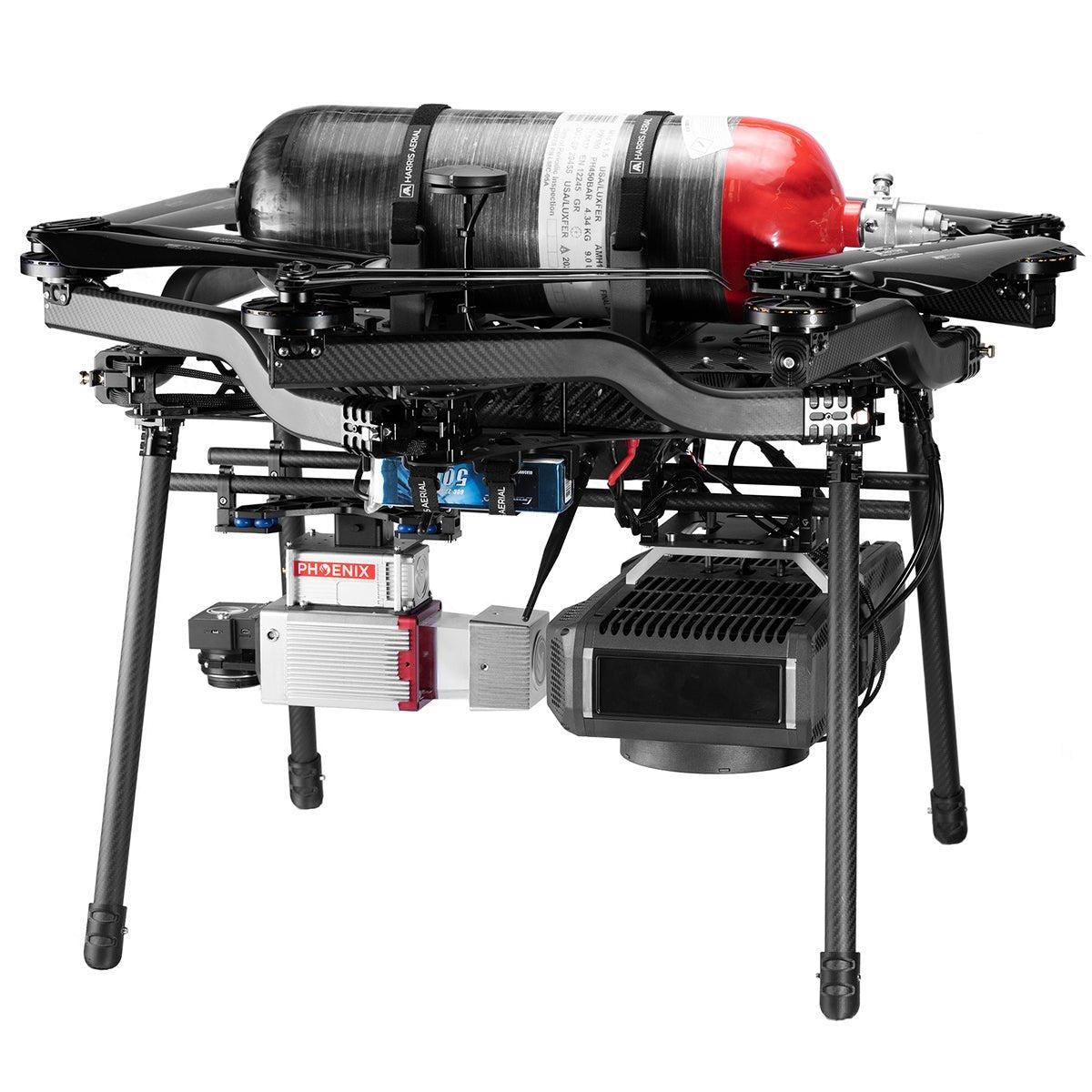
A fuel cell turns hydrogen into electricity, so range depends on tank size, not battery mass. The August 2026 review reports that Intelligent Energy's 800-watt fuel cell on a MetaVista platform set a Guinness World Record of 727 minutes, under controlled conditions. A 2021 study with a 200-watt fuel cell on a mini drone found endurance doubled compared with batteries alone, using actual flight data.
The trade-offs are weight and cost. A 2020 modelling study of a 25-kilogram multirotor found a hybrid fuel-cell system would add 43 minutes, a 76 per cent increase, but only if the energy system weighed more than a threshold of 7.3 kilograms, and it put system cost at about 12 times that of lithium-polymer batteries. That cost figure is dated, but it shows why hydrogen suits large drones with long missions, not small ones.
Hybrids pair a fuel cell with a small buffer battery. Eanan, a company showing at an industry expo in September 2026, describes a 25-kilogram hydrogen multicopter that flies more than 90 minutes with a payload, with a battery handling power peaks. The company says it is in advanced testing and validation and claims two to four times the flight time of comparable lithium-ion drones.
What is in use, and what is experimental
In practice: conventional lithium batteries on nearly all small drones; silicon-anode cells shipping from pilot lines to some drone makers and, according to Amprius, to Matternet and Nokia.
Experimental or early: hydrogen multicopters in advanced testing, and 500 Wh/kg cells awaiting commercial availability.
The constraint that stays: physics. Hovering is expensive, and flight time rises with energy density but never escapes the weight penalty of carrying the energy. The practical alternative is design: fixed-wing and hybrid aircraft stay up longer than multirotors because wings do the lifting.
For most small drones, the realistic near-term improvement is a better lithium cell that adds some minutes. Hours-long endurance with a multirotor requires hydrogen or a different aircraft design, and at a price and complexity that only some missions justify.