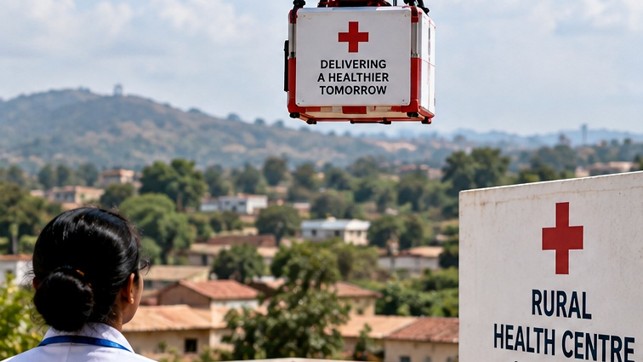
A drone can cross a city much faster than a delivery van. But that does not mean every parcel should be delivered by air.
The difficult part is not simply flying a package from point A to point B. It is doing that safely and repeatedly, in changing weather, around people and buildings, while keeping the economics workable.
India's drone industry is now discovering where aerial delivery makes sense—and where the technology still has work to do.
The technology can already fly useful routes
India has moved beyond purely theoretical drone delivery. FedEx and IIT Madras completed India's first intra-city drone delivery flight trials in Bengaluru in April 2026. The trial connected Electronic City Phase II with a site near Bengaluru International Airport and tested the potential of aerial mid-mile logistics in urban airspace.
Companies are also building dedicated drone-delivery infrastructure. Skye Air, for example, describes a system built around drone hubs, automated landing stations and ground-based last-mile delivery.
That last point is important. A successful drone delivery network is not simply a fleet of aircraft. It is an entire system.
Battery and payload create a difficult trade-off
Every delivery drone has limited energy. Carrying a heavier package requires more power. Flying farther requires more energy. Carrying extra battery increases weight.
This creates a basic engineering compromise: more payload means more energy required, which can mean shorter range.
Weather makes the calculation harder. Strong winds can increase energy consumption. Rain can affect aircraft systems and sensors. Heat can influence battery performance. A demonstration can be scheduled around favourable weather; a commercial service needs to be reliable even when conditions are less than ideal.
The hardest part may be the last 100 metres
Suppose a drone successfully travels 15 kilometres to a residential neighbourhood. Where does it leave the parcel? A delivery van can stop outside a house. A drone needs a safe landing or hand-off point.
There may be trees, electrical wires, buildings, balconies, vehicles and people. This is why drone-delivery companies are experimenting with dedicated landing infrastructure.
In other words, the solution to drone delivery may not be drone-only delivery. It may be a combination of air and ground logistics.
Medical and specialised deliveries make more sense first
Not every parcel has the same value. If a drone can save significant time transporting a medical sample, medicine or urgent supply, the economics can be easier to justify.
That is why healthcare has become an important area for Indian drone-delivery experiments. Companies such as TechEagle are developing autonomous BVLOS aircraft and logistics systems for cargo movement and other missions.
These applications are different from promising that every online-shopping package will soon arrive by drone. The strongest early markets are likely to be deliveries where time is more valuable than the cost of the flight.
Regulation and public acceptance remain crucial
A drone carrying a medical sample between controlled locations is easier to manage than hundreds of aircraft flying over densely populated neighbourhoods.
People need confidence that drones will not fall, collide, create unacceptable noise or compromise privacy. Operators also need reliable communications, emergency procedures, monitoring systems and airspace coordination.
What needs to change?
The next stage is not simply about making drones faster. The industry needs longer and more predictable endurance, improved weather tolerance, reliable navigation, safe automated landing, efficient fleet management and clear operating frameworks for more complex missions.
It also needs infrastructure: charging stations, battery systems, landing points, communications networks and software capable of coordinating multiple aircraft.
From demonstration to daily operation
This is the central challenge for India's drone-delivery industry. A successful flight proves that a drone can deliver a package. A functioning delivery network requires thousands of successful flights.
Those flights have to work in different weather, deal with unexpected situations, maintain safe separation from other aircraft and complete the final hand-off reliably.
India's drone industry has demonstrated that aerial delivery is possible. The next question is more demanding: Can it become safe, reliable and economical enough to become ordinary? That is the step that will determine whether drone delivery remains an impressive technology demonstration—or becomes a normal part of India's logistics network.