A battery is more than a fuel tank
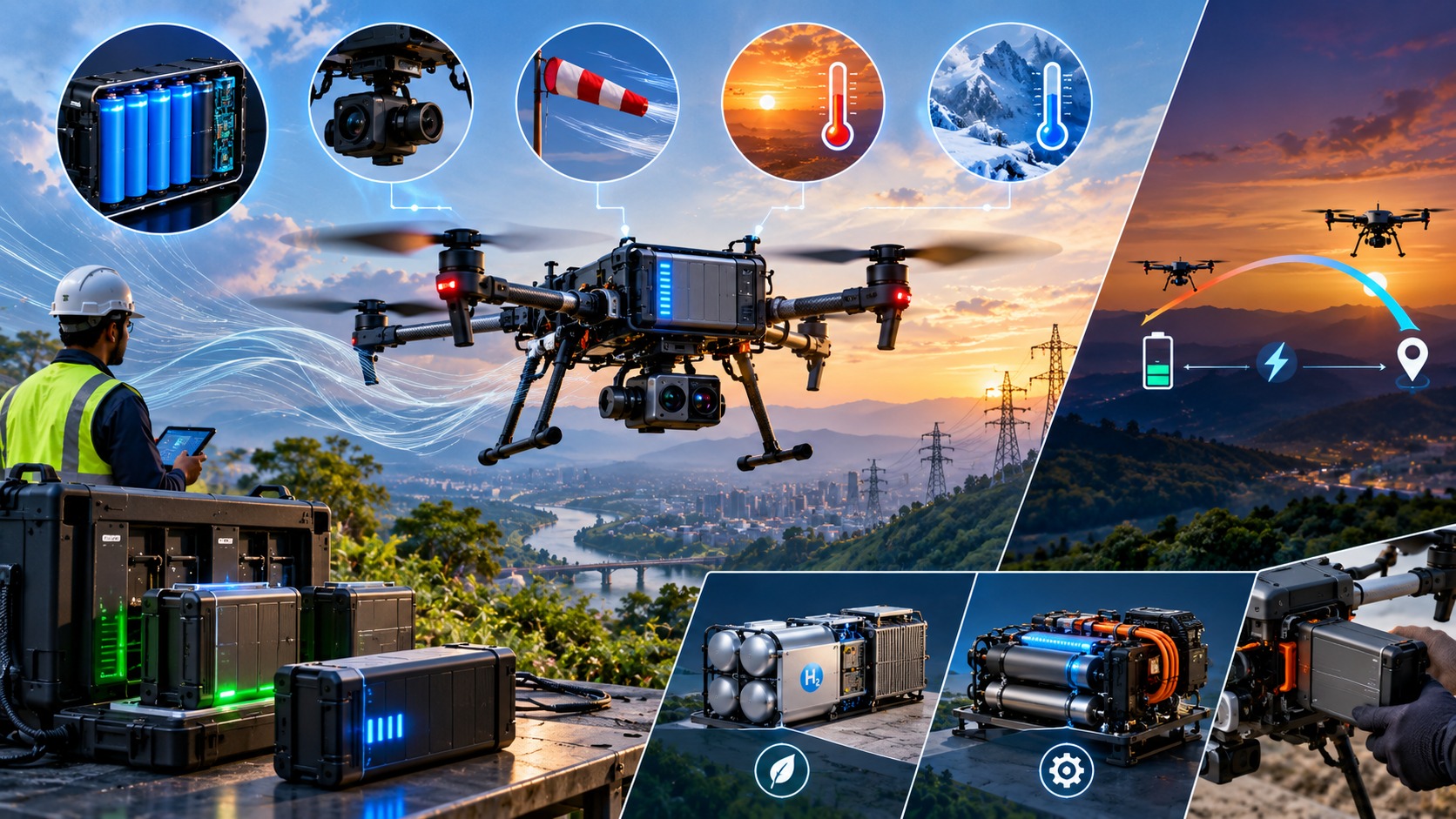
For an electric drone, the battery is both its energy store and one of the heaviest components it must carry. Most small and medium electric UAVs use lithium-based batteries because they can deliver substantial power without adding as much mass as many older battery chemistries. But the energy available from a battery is still limited, and that limitation becomes obvious when a mission needs more time, more distance or more payload.
A recent 2026 scoping review identifies battery energy density as a primary constraint on drone operations and flight endurance. [6]
Payload, wind and range all compete for the same energy
A drone carrying a thermal camera, LiDAR, delivery package or other equipment has less energy available for flight than an otherwise identical aircraft with a lighter payload. Hovering and aggressive manoeuvring are also power-hungry because the motors must continuously produce thrust.
Wind adds another layer. A headwind can force a multirotor to work harder to maintain ground progress, while gusts require continual changes in motor output to hold position and attitude. This means a flight plan based only on distance can be misleading. A route that looks easy on a map may demand much more energy in strong or changing wind.
This creates the range-versus-power trade-off. A drone can spend more energy to fly faster, carry more equipment or fight environmental conditions, but every extra demand reduces the margin available for the return journey. Professional operations therefore need a reserve rather than planning to use the battery down to zero.
Temperature and charging time are operational problems
Lithium batteries do not perform identically at every temperature. Cold conditions can reduce available discharge capacity, while high temperatures can accelerate degradation and increase thermal-management demands. NASA testing of lithium-based UAV battery systems found flight times were reduced at low temperatures, while more recent UAV battery research continues to examine temperature, state of charge and battery ageing as important variables. [1]
Charging creates a second bottleneck. A battery may be ready for another flight only after it has cooled, been charged and passed whatever inspection or battery-health checks the operation requires. Faster charging can reduce turnaround time, but charging itself produces heat and repeated high-rate cycling can affect battery life. For a fleet operator, the question is therefore not simply “How long can one battery fly?” but “How many useful missions can the entire battery pool support in a day?”
Why hydrogen and hybrid systems are being explored
A 2025 review examines energy-management technologies for hydrogen fuel-cell UAVs and their potential to extend flight endurance. [3]
Hybrid systems try to combine the strengths of both. A 2025 peer-reviewed study on hybrid UAV powerplants combines batteries and fuel cells to improve autonomy compared with battery-only systems. [3] A fuel cell can provide relatively steady power while a battery supplies short bursts required during take-off, climbing or rapid manoeuvres. These systems are more complex than a battery-only drone, and their practical value depends on aircraft size, mission profile, storage requirements, cost and infrastructure.
India's Department of Science & Technology also supports hydrogen and fuel-cell research, although that broader national research programme should not be confused with widespread hydrogen-powered drone deployment. [5]
Battery swapping may solve time, not energy density
Research reviews describe manual and automated swapping approaches, including drone docks designed to reduce turnaround time. [4]
Swapping does not make the drone fly farther on one battery. It changes the operating model: a fleet can keep aircraft working while batteries are charged separately. That can be useful for mapping, inspection or repeated short missions where a base or charging station is practical.
The bigger lesson is that there is no single battery breakthrough that removes every endurance constraint. Better cells can improve energy density; better thermal management can protect performance; swapping can reduce downtime; and hydrogen or hybrid systems may extend endurance for selected aircraft. But payload, weather, safety reserves, charging infrastructure and mission requirements will continue to determine how much useful time a drone can spend in the air.