Buying it abroad does not make it legal to fly in India
As of November 2026, you may see a drone at a lower price in the US, Dubai, Singapore or another country and think about bringing it home in your suitcase. But there are two separate questions: can the drone be legally brought into India, and can it legally be operated after arrival? A foreign purchase receipt does not automatically answer either question.
India’s import policy generally prohibits importing drones in completely built-up (CBU), semi-knocked-down (SKD) or completely knocked-down (CKD) form, with limited exceptions that require the relevant government authorisation. The policy allows import of drone components, but that does not mean a complete drone can be carried in as ordinary personal baggage. [1][2]
So, do not buy first and hope to sort it out at the airport. Before paying overseas, get written guidance for the exact drone model and your circumstances from the relevant Indian authorities or a qualified customs professional.
1. Understand India’s restriction on importing complete drones
The Directorate General of Foreign Trade (DGFT) set this import policy through Notification No. 54/2015-2020 dated 9 February 2022. The official notification states that imports of drones in completely built-up (CBU), semi-knocked-down (SKD) or completely-knocked-down (CKD) form under HS Code 8806 are prohibited, with specified exceptions for research and development, defence and security purposes subject to DGFT authorisation. It states that import of drone components is free. [1]
This is important for ordinary buyers. A drone bought from a foreign retailer is still a complete drone when it enters India. Calling it a personal gift, opening the box, removing the battery or carrying it in checked baggage does not, by itself, turn it into an allowed import.
The Ministry of Civil Aviation has also publicly clarified that the import restriction applies to complete drones in CBU, SKD and CKD form. [2] The exact treatment of a particular shipment or passenger case can depend on the facts and current customs directions, so obtain an official written decision rather than relying on online anecdotes.
2. Airport customs: declare it; do not try to hide it
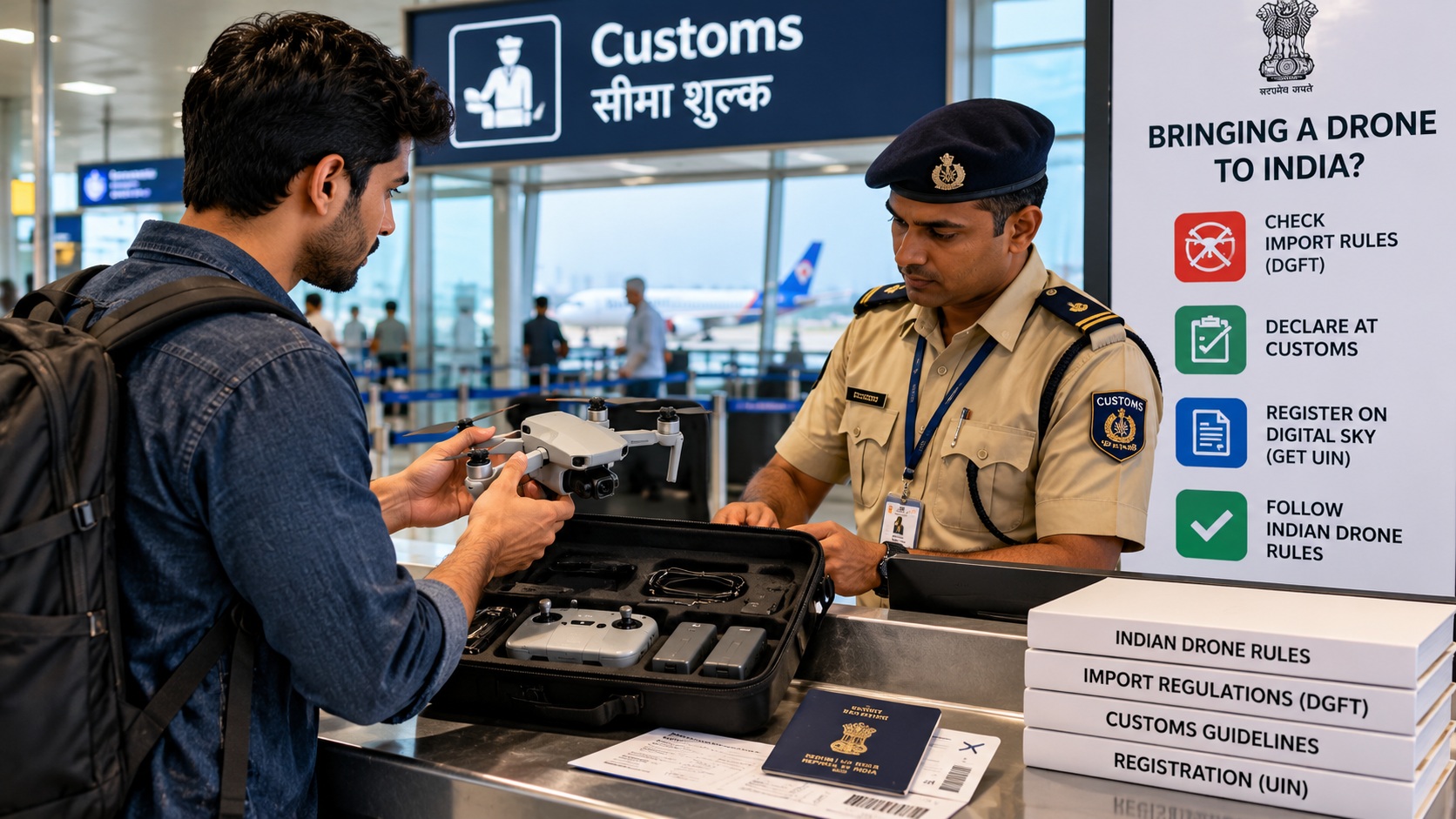
Do not assume that a drone will pass through the green channel just because it is for personal use or falls within your baggage allowance. Customs rules and import-policy restrictions are separate issues: paying customs duty, if applicable, does not automatically legalise an otherwise prohibited import.
CBIC Notification No. 14/2026-Customs (N.T.), dated 1 February 2026, introduced the Baggage Rules, 2026, which took effect on 2 February 2026 and replaced the 2016 rules. The new rules cover passenger baggage, personal effects, temporary imports and certain re-import cases. They do not state that every complete drone is automatically exempt from the separate DGFT import policy. Ask Customs to confirm how the rules apply to your exact situation before travelling. [3]
If you are already travelling with a drone, approach Customs and make a full and accurate declaration. Provide the invoice, model and serial number, proof of prior ownership if relevant, and any written permissions or approvals. Do not conceal it, misdescribe it or discard packaging to avoid questions. A declaration is not a guarantee that Customs will release the drone; the applicable import policy still has to be satisfied. [1][3]
For passenger baggage procedures, use the CBIC Baggage Rules, 2026 notification itself rather than an older summary page. The rules include provisions for temporary import by tourists and re-import of certain personal effects, but whether a particular drone qualifies must be confirmed with Customs and does not automatically override DGFT import policy. [3]
3. Check radio requirements separately: ETA is not an import permit
Drones use radio equipment to communicate with their controllers, so radio-frequency compliance may also need to be checked. However, do not assume that the standard WPC Equipment Type Approval (ETA) self-declaration route applies to drones: the Department of Telecommunications’ current ETA service page specifically lists drones among the product types excluded from that route. Ask DoT/WPC what, if any, separate authorisation applies to the exact model and radio configuration. [4]
Do not confuse radio-equipment compliance with permission to import a complete drone. DGFT import policy governs whether the complete drone may be imported; any separate DoT/WPC requirement is an additional issue, not a substitute for DGFT authorisation. [1][4]
If a seller says, “It has CE or FCC certification, so India will allow it,” ask for the Indian regulatory and import-policy basis in writing. Overseas certifications do not automatically override Indian import restrictions or applicable Indian radio-equipment requirements.
4. Even if it reaches India, can you register and fly it?
Import clearance and permission to operate are different steps. The Drone Rules, 2021 establish requirements for drone registration and Unique Identification Numbers (UIN), subject to specified exemptions. They also set out the framework for type certification and remote-pilot requirements. [5]
As of October 2026, before planning to fly, check whether the exact model is eligible for operation under India’s applicable rules and whether it has the required Indian type certification or falls within a valid exemption. Do not assume that a model legally sold overseas is automatically approved for operation in India.
Where a UIN is required, the aircraft’s details must meet the applicable registration process. A foreign serial number or overseas registration is not automatically an Indian UIN. Check the Digital Sky portal and DGCA requirements as they stand on the date you plan to operate the aircraft. [5][6]
You must also check the airspace map before each flight and comply with the applicable restrictions, pilot requirements, visual-line-of-sight rules and other operational conditions. A green-zone location does not remove every other safety or legal obligation. [5][6]
5. What if you already own the drone and are travelling to India?
This situation needs careful treatment. A drone you already own and have used overseas is not necessarily treated the same way as a new purchase, temporary import for a specific purpose, or a drone being brought into India for permanent use. But do not assume that personal ownership creates an automatic exemption from import restrictions.
Before travelling, contact Indian Customs and DGFT with the exact model, serial number, country of purchase, proof of prior ownership, reason for travel and whether the drone will leave India again. Ask what declaration, temporary admission, re-export or other documentation is required. Keep the written response with your travel documents.
If you are carrying a drone out of India and plan to bring the same unit back, ask Customs about the appropriate export or re-import documentation before departure. The Baggage Rules, 2026 contain provisions for re-import and temporary import in specified circumstances; confirm that the process applies to your specific drone and circumstances. [3]
6. Airline battery rules are a separate issue
Even when Customs and import questions are resolved, airline rules still apply to the aircraft and its lithium batteries. Check the operating airline’s latest policy for the drone’s weight, battery watt-hour (Wh) rating, spare-battery limits, cabin baggage and checked baggage.
For example, Air India’s published guidance says drone carriage depends on drone weight and battery arrangements; it requires batteries to be removed from checked-in drones and carried in cabin baggage in the stated cases, and imposes restrictions on batteries above specified capacities. Policies can change, and other airlines may differ. [7]
Never pack spare lithium batteries loosely or place them in checked baggage if the airline requires cabin carriage. Protect battery terminals against short circuits, keep batteries undamaged and follow the airline’s instructions. Airline acceptance does not mean Customs has approved the import.
7. A safer checklist before buying a drone overseas
Identify the exact model, variant, serial number and country of purchase.
Check the current DGFT import policy for complete drones and whether a specific authorised exception applies.
Get written guidance from Indian Customs before travelling or arranging shipment.
Check whether WPC ETA is required for the exact wireless model and frequency configuration.
Verify whether the model can meet Indian DGCA type-certification and UIN requirements before operation.
Check current Digital Sky airspace and operational rules for the place and purpose of the planned flight.
Confirm the airline’s current drone and lithium-battery rules separately.
Keep the invoice, proof of ownership, serial-number photographs and every official approval or written clarification.
A practical example: the overseas discount that is not really a saving
Imagine you find a camera drone overseas for ₹20,000 less than the Indian price. You buy it, pack it in your suitcase and arrive at an Indian airport expecting to pay any applicable duty and walk out. If the complete drone is covered by the import prohibition and you do not qualify for an authorised exception, the low purchase price may turn into detention, confiscation or other customs complications.
The smarter move is to check the import position before paying. If the exact model cannot be lawfully imported or cannot meet Indian operating requirements, the overseas discount is not a real saving.
The bottom line
Can you use a drone bought abroad in India? Not automatically. India restricts imports of complete drones, and a foreign purchase does not bypass customs, WPC or DGCA requirements. Even after lawful entry, the aircraft must meet the applicable Indian operating rules before you fly it.
Check the exact model and your travel situation with DGFT, Customs, WPC and DGCA before buying. Keep the approvals in writing, declare the drone honestly and verify the airline’s battery policy. A little checking before purchase is much easier than dealing with a drone held at the airport.