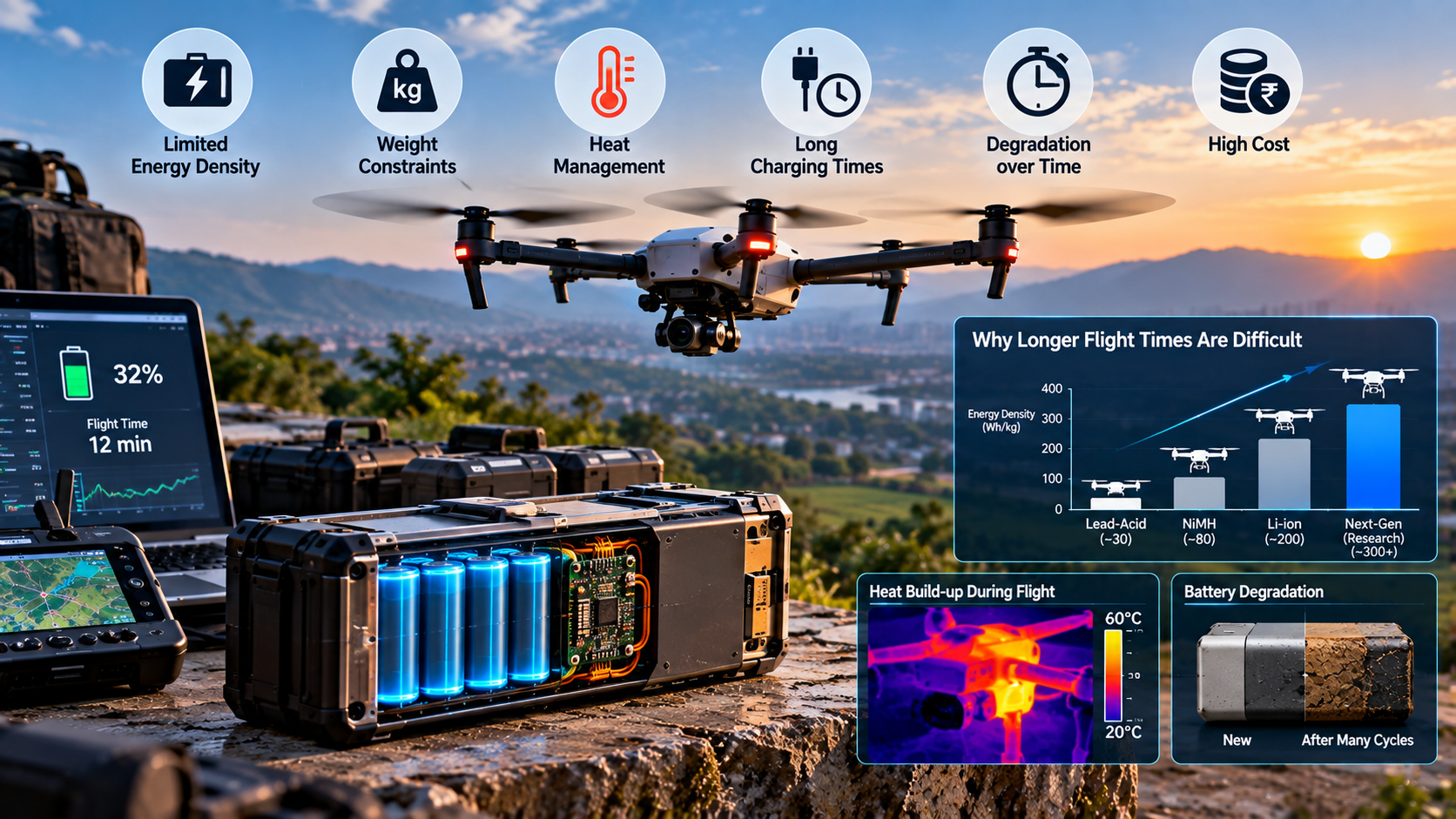
The endurance problem is fundamentally an energy-density problem
A drone needs energy to produce lift, overcome aerodynamic drag, run avionics and operate its payload. For an electric multirotor, much of that energy is spent continuously just staying in the air. Adding more battery gives the motors more energy, but the extra battery also adds mass that the aircraft must lift.
That creates a feedback loop: more stored energy can mean more takeoff weight, which increases power demand, which consumes some of the added energy. This is why a larger battery does not translate into a proportional increase in flight time. Recent UAV reviews continue to identify battery energy density as a central constraint on endurance, while noting that real-world flight time also depends on the mission profile and environmental conditions.
Why lithium batteries dominate despite the limitation
Lithium-ion and lithium-polymer batteries remain attractive because they combine useful energy density with high power output, relatively low mass and mature manufacturing. Li-Po packs are particularly suited to aircraft that need high discharge rates during takeoff, hovering and manoeuvring.
The compromise is that batteries store a finite amount of energy per kilogram. Recent technical reviews place common Li-Po systems roughly in the 150–250 Wh/kg range, while optimized lithium-ion systems can reach higher figures depending on chemistry and design. Those numbers are pack- and system-dependent, so they should not be treated as a universal specification for every drone.
For a multirotor, power capability matters as much as stored energy. A battery that looks impressive in Wh/kg may not deliver the current required by the motors without excessive voltage sag or heat. Designers therefore balance energy density against power density, thermal management, cycle life, cost and safety.
Payload is effectively a range tax
Every camera, thermal sensor, spotlight, loudspeaker, delivery mechanism or computing unit has a mass. The drone must generate additional lift to carry it, and that requires additional power. Payload can also change the aircraft’s aerodynamics and balance.
This is why professional drones are often specified around a mission payload rather than an empty-airframe flight time. A manufacturer’s headline endurance number is usually measured in controlled conditions. In field operations, the usable window is shorter because the aircraft must reserve energy for return, landing, weather changes and unexpected manoeuvres.
The practical question is therefore not “How many minutes can the drone fly?” but “How many useful minutes can it fly while carrying the equipment the mission actually needs?” That distinction is especially important for inspection, mapping and search-and-rescue aircraft.
Wind can turn a battery calculation into an operational calculation
Wind affects endurance in two ways. A drone flying into a strong headwind has to generate more thrust or spend more time covering the same ground. Gusts and turbulence can also cause continual control corrections. Hovering in moving air is not the same energy problem as hovering in still air.
Recent UAV energy-efficiency research has found that wind speed, turbulence and ambient temperature can substantially change power demand and operating time. This is one reason mission planners use environmental margins rather than relying on a laboratory flight-time figure.
For long-range missions, wind direction matters too. A route that is easy on the outbound leg can become difficult on the return. The battery reserve must be planned around the worst reasonable part of the mission, not simply the average wind.
Temperature quietly changes what the battery can deliver
Lithium batteries are sensitive to temperature because their electrochemical reactions change as the cells get colder or hotter. In cold conditions, internal resistance rises and available power can fall. The FAA notes that cold weather can reduce lithium-polymer battery capacity and affect flight duration. Extreme heat creates a different problem: high temperatures accelerate degradation and can increase thermal-management demands.
For drone operators, the result is practical rather than theoretical. A battery that performs well on a mild test day may provide a smaller usable margin in winter, high heat or after a demanding flight. Battery pre-conditioning, thermal monitoring and appropriate operating limits can reduce some of these effects, but they consume equipment weight or energy of their own.
Charging is the hidden half of the endurance equation
A drone that flies for 30 or 40 minutes may need substantially longer to recharge, depending on the battery, charger, state of charge and safety limits. For a single aircraft, that creates downtime. For a professional operation, it creates a logistics problem: how many batteries are needed, how quickly can they be charged, and where can charging safely occur?
Battery swapping is one of the simplest answers because it separates flight time from charging time. Instead of waiting for the same pack to recharge, an operator can land, install a charged pack and put the used pack on a charger. NIST has described a first-responder UAS system in which quick battery swaps extended operations beyond the vehicle’s estimated single-battery endurance.
The trade-off is that the operator now has to carry more battery inventory, chargers and sometimes transport or storage equipment. Swapping is therefore a way to improve operational availability, not a way to increase the energy stored in one battery.
Hybrid systems trade simplicity for endurance
A hybrid drone combines an energy source such as an internal-combustion engine or fuel cell with electrical propulsion and, often, a battery. The battery can handle short high-power demands, while the generator supplies sustained energy. This architecture can be attractive for missions where a battery-only system would be forced to carry too much stored energy.
The price is complexity. A hybrid system adds a generator or fuel-cell stack, fuel or reactant storage, power electronics, cooling and controls. Those components have mass, and the aircraft must be designed around them. A hybrid is therefore not automatically better; it becomes interesting when the extra system mass is outweighed by the endurance gained.
Hydrogen fuel cells: more energy, more logistics
Hydrogen fuel cells are one of the most discussed alternatives for long-endurance UAVs. A fuel cell converts hydrogen’s chemical energy into electricity, with water and heat as products in a hydrogen-air PEM system. NASA and the U.S. Department of Energy have supported UAV fuel-cell research for decades, and DOE has reported demonstrations in which hydrogen fuel cells extended UAV endurance substantially beyond battery-only systems.
The key catch is storage. Hydrogen itself is highly energy-dense by mass, but the aircraft does not carry hydrogen alone: it needs tanks, regulators, valves, fuel-cell hardware and associated structure. A peer-reviewed UAV propulsion study available through the U.S. Department of Energy’s OSTI system found that hydrogen storage can significantly increase system mass and cost even when fuel-cell systems become attractive for longer endurance missions.
That makes hydrogen particularly interesting for aircraft where long endurance is worth the added infrastructure. It is less straightforward for small consumer drones that need low cost, compact packaging and simple field charging.
The real trade-off: power versus range
Battery-only systems remain compelling because they are simple, responsive and easy to integrate. Fuel cells and hybrids can improve endurance, but they may have different transient-power characteristics, so a battery buffer is often useful for high-power events. The result is a systems-engineering problem rather than a single-technology contest.
The same principle applies to charging. Fast charging can increase operational availability, but it can raise heat and accelerate battery wear if the pack and charging system are not designed for it. Carrying several packs avoids waiting, but increases logistics weight. A larger battery can extend a flight, but it also adds lift demand. Every apparent fix shifts the trade-off somewhere else.
What is likely to change next
Near-term progress is likely to come from several improvements working together: better lithium chemistries, more efficient motors and propellers, improved thermal management, smarter battery-management systems, automated battery swapping, and more capable hybrid powertrains. Research into solid-state and other high-energy-density chemistries may eventually change the underlying energy-density ceiling, but commercial availability, cost, safety and manufacturing remain important constraints.
Hydrogen and other fuel-cell systems will continue to make sense for selected long-endurance missions where refuelling logistics can be organized. Battery-only systems will remain attractive where simplicity, low maintenance and high peak power matter more than maximum endurance.
The deeper lesson is that drone endurance is not a battery problem in isolation. It is a vehicle-design problem. The best system is the one that balances stored energy, power delivery, payload, weather, safety reserves and turnaround time for the actual mission.