On 5 June 2026, two human kidneys flew across part of Virginia on a drone, in flights of about 15 minutes that went beyond the operators' line of sight. The organs had been donated for research after being judged unsuitable for transplant. Biopsies were taken before and after each flight, and the team, from NASA Langley, the transplant network UNOS and the tissue bank LifeNet Health, reported preliminary findings of no evidence that the flights harmed the kidneys. It was a feasibility study, not a medical service. But it shows what the industry means when it says BVLOS.
What BVLOS means
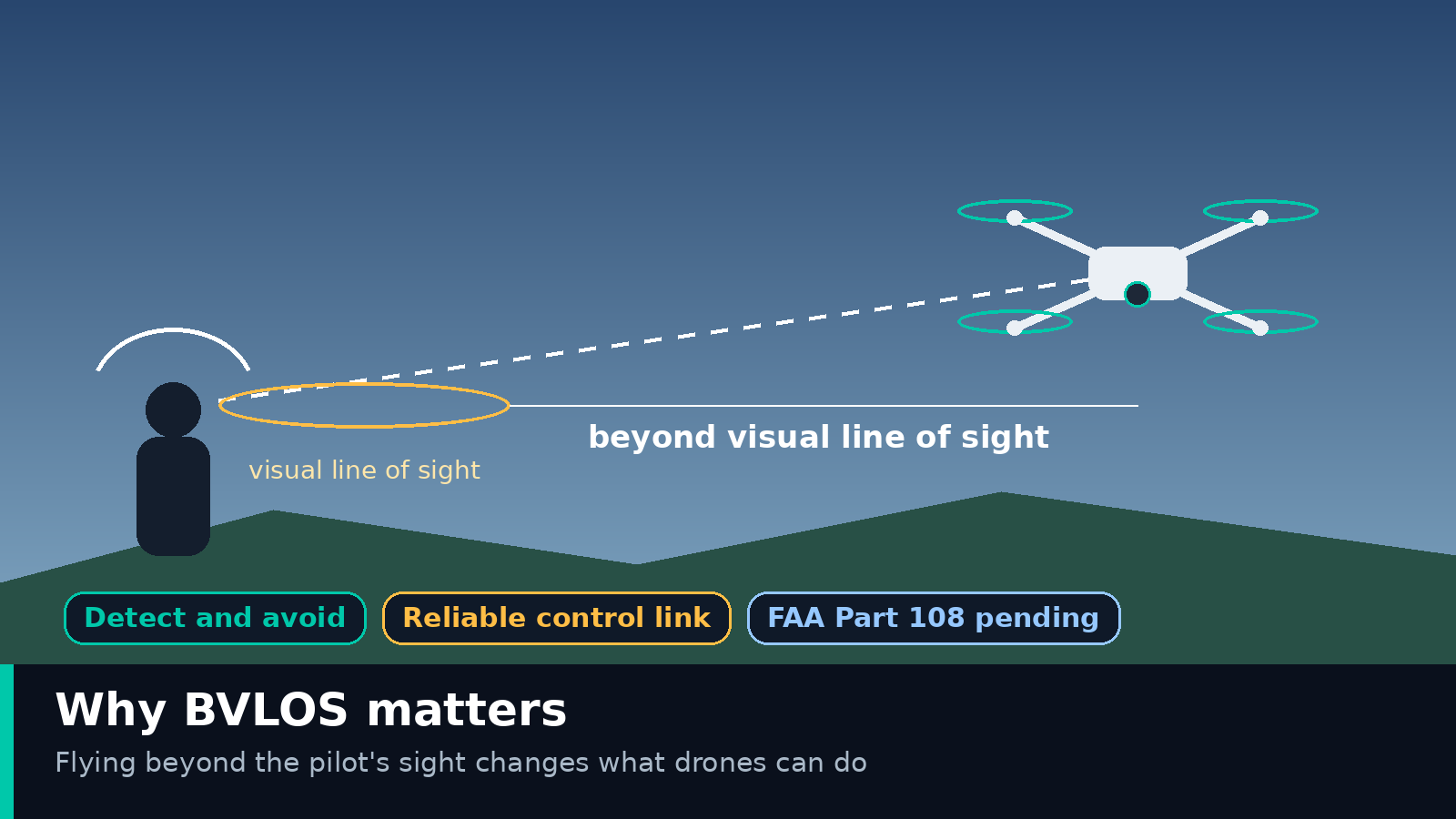
BVLOS stands for beyond visual line of sight. Standard drone rules, such as the FAA's Part 107, assume the remote pilot can see the aircraft. To fly further, an operator in the United States needs a waiver or exemption and must show, among other things, how the drone will detect and avoid other aircraft, according to a February 2026 US Government Accountability Office review. Each approval is negotiated individually, which is slow and hard to repeat.
Why it changes the economics
A drone that must stay in sight needs a person standing near it, and the person's attention is tied to one aircraft. That caps the useful range and the number of flights per worker. BVLOS removes both limits in principle. A pipeline, a power line or a rail corridor can be surveyed in one flight instead of many. A delivery route can run beyond a neighbourhood. One operator can supervise several aircraft that fly automatically.
Hard numbers on the savings are mostly company estimates, so they are left out here. The logic, though, is simple: the main cost of a drone job is often the crew, not the aircraft.
What makes it safe enough
Seeing and avoiding is the central problem. The GAO review lists the options for small drones. ADS-B receivers pick up crewed aircraft that broadcast their GPS position. Cameras, acoustic sensors or ground radar can find aircraft that do not broadcast. Waivers have mostly relied on ADS-B, which stakeholders told GAO is more effective than the alternatives, though combining technologies can be safer but adds weight.
Three other ingredients are needed. A reliable command link, via cellular, radio or satellite, so the operator stays in control at distance. Shared digital flight plans through UTM systems, so drones do not conflict with each other. And contingency behaviour, such as automatic return or landing when the link fails. The kidney study monitored temperature, pressure and altitude throughout the flights.
Where the regulation stands
In the United States, the FAA proposed Part 108 in August 2025 to create a standard route to routine BVLOS under an operator-level approval. A June 2025 executive order set a deadline of 1 February 2026 for the final rule. That date passed. The rule reached the White House regulatory office on 10 July 2026, and an FAA official told an industry conference in September that the agency hopes to publish by the end of the year, after handling about 4,000 comments. Until then, the waiver route remains the legal path. One thing to be cautious about: some websites claim the rule has already been finalised. As of early October 2026, the sources checked for this article say it has not.
The Indian angle
India is working toward a similar milestone. Civil Aviation Minister Kinjarapu Rammohan Naidu told an Andhra Pradesh industry round table that a refined certification framework, including BVLOS certification, would be in place by the end of this year. India's regulator, DGCA, has also supported BVLOS trials to help shape the framework. Industry representatives at the same event asked for risk-based certification, dedicated test environments and clear operating protocols. The minister's statement is a plan, not a rule.
The verdict
BVLOS is already happening under waivers, at small scale, with heavy paperwork. What the industry is waiting for is permission that does not have to be renewed flight by flight, and detect-and-avoid standards that regulators trust. The technology for most of it exists. The unresolved part is agreeing on what counts as safe enough when nobody on the ground can see the aircraft.