On 28 September 2026, a coalition of states and Harris County, Texas, led by New York's attorney general, asked the US Court of Appeals for the Second Circuit to review how the FAA approved drone package delivery nationwide. The petition targets the agency's Final Programmatic Environmental Assessment, with its Finding of No Significant Impact and Record of Decision, dated 28 July 2026. The petition says the FAA announced the assessment in the Federal Register on 30 July. The case is at an early stage and changes no current flight. But it shows that who decides what flies over your house is now a live question.
What the law says about the space above you
The starting point in US law is a 1946 Supreme Court case, United States v. Causby, in which a North Carolina chicken farmer sued over military aircraft flying low over his farm. A Congressional Research Service analysis of delivery drones explains the result: federal courts rejected absolute ownership of the sky above land, and found that landowners own the airspace in its "immediate reaches". Above that lies navigable airspace, which is the public's. The analysis concludes it seems unlikely that a property owner or homeowners' association could outright ban all drone flights over its property.
The 2026 fight over delivery routes
Residents of Richardson, Texas, have complained about noise from Amazon's drones. According to a September 2026 PickDrones report, which draws on GeekWire, one resident counted 52 passes over her home on what she called a slow day, even though the FAA's exclusive control of airspace leaves cities without authority over flight paths or noise limits. The same report says Amazon presented the council in March 2026 with three fixes: a higher cruise altitude, routing outbound flights over commercial land before homes, and a no-fly zone over a nearby church.
Officials' messages conflict. A Detroit News report syndicated on 3 August 2026 quoted the city of Ferndale's website saying local governments cannot ban flights, set no-fly zones or regulate aircraft noise because Amazon flies under an FAA air carrier certificate. Yet an FAA regional office told a resident that complaints about privacy, trespass or public nuisance belong with local law enforcement.
The Detroit News report also notes that Amazon's FAA exemption lets it fly beyond a pilot's visual line of sight without human observers.
What towns can still do
Cities mostly say they can only pass the complaints along. According to the Detroit News, Ferndale's community development director advised residents to contact Amazon or the FAA and said the city is consulting its lawyers about options. Auburn Hills posted that it has no regulatory power but has met the FAA and Amazon about residents' concerns.
India set up a map first
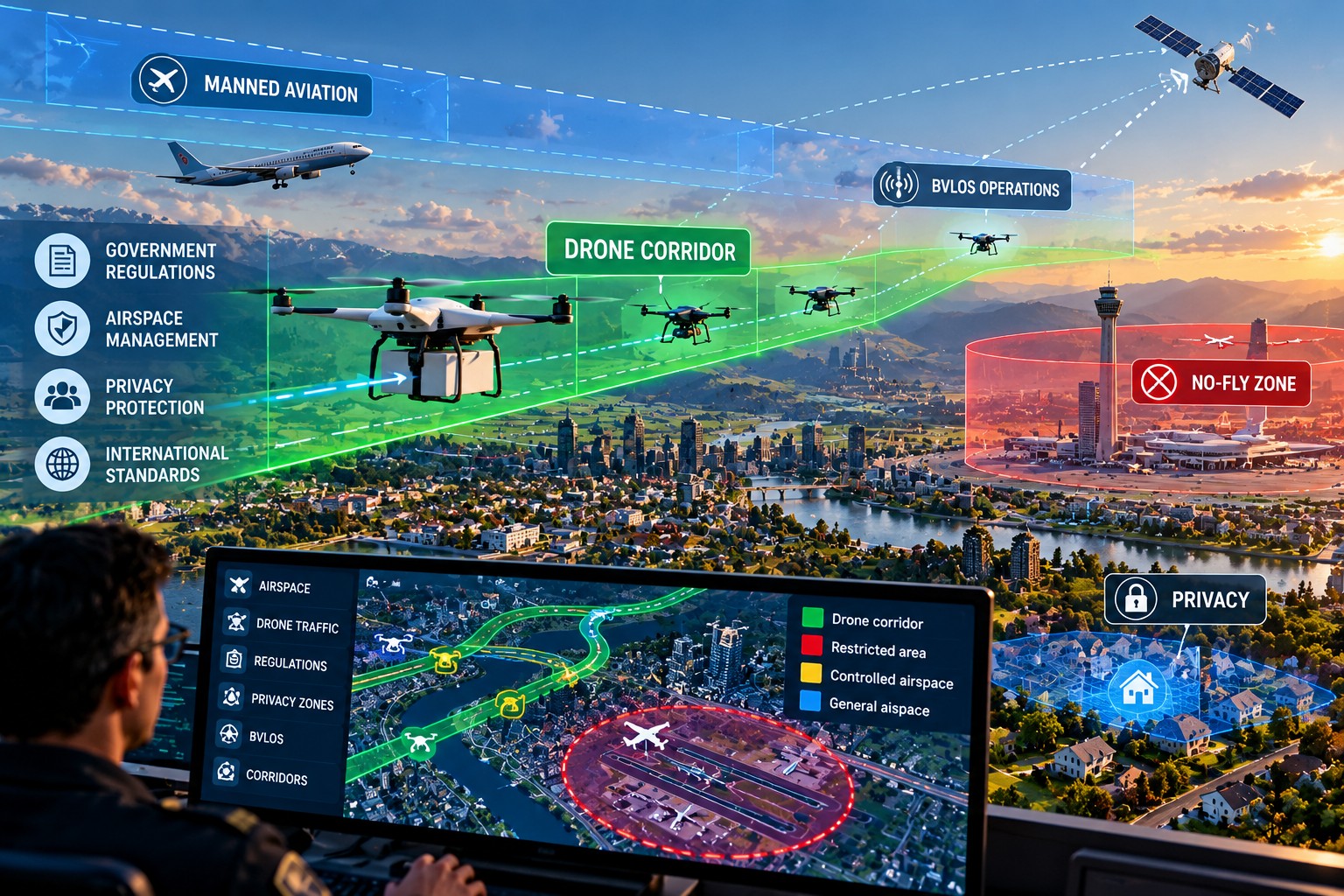
India built its rules around the Digital Sky platform. Under the Drone Rules 2021, as summarised by The Quint, an interactive airspace map shows green, yellow and red zones. A green zone is airspace up to 400 feet (120 metres) that has not been designated red or yellow, and no permission is needed to fly there. The Quint's summary says the yellow zone around airports was reduced from 45 kilometres to 12 kilometres from the airport perimeter. The rules said drone corridors would be developed for cargo deliveries, and that safety features such as "No Permission, No Takeoff", real-time tracking and geofencing would be notified later.
What is settled, and what is not
Settled: federal authority over flight in the US, and a landowner's rights only in the immediate reaches above the property.
Contested: how far cities can go on noise, privacy and hub placement, and the states' challenge to the FAA's delivery review.
The constraint that matters most: consent. Technology can place a drone at 400 feet and route it over commercial land, but it cannot make residents agree to the sound. Operators who raise altitudes and reroute, as Amazon proposed in Richardson, are conceding that noise is a community question even where the law treats it as a federal one.