Who Controls the Sky When Thousands of Drones Fly? Dallas Offers a First Answer
In Dallas–Fort Worth, delivery drones from competing companies share the same low-level airspace without anyone phoning anyone. Since 2024, the FAA has let operators including Wing and Zipline fly beyond visual line of sight there while exchanging flight plans through software instead of a human controller. It is a regional trial, but it is the closest thing the United States has to working air traffic management for drones.
What a UTM system actually does
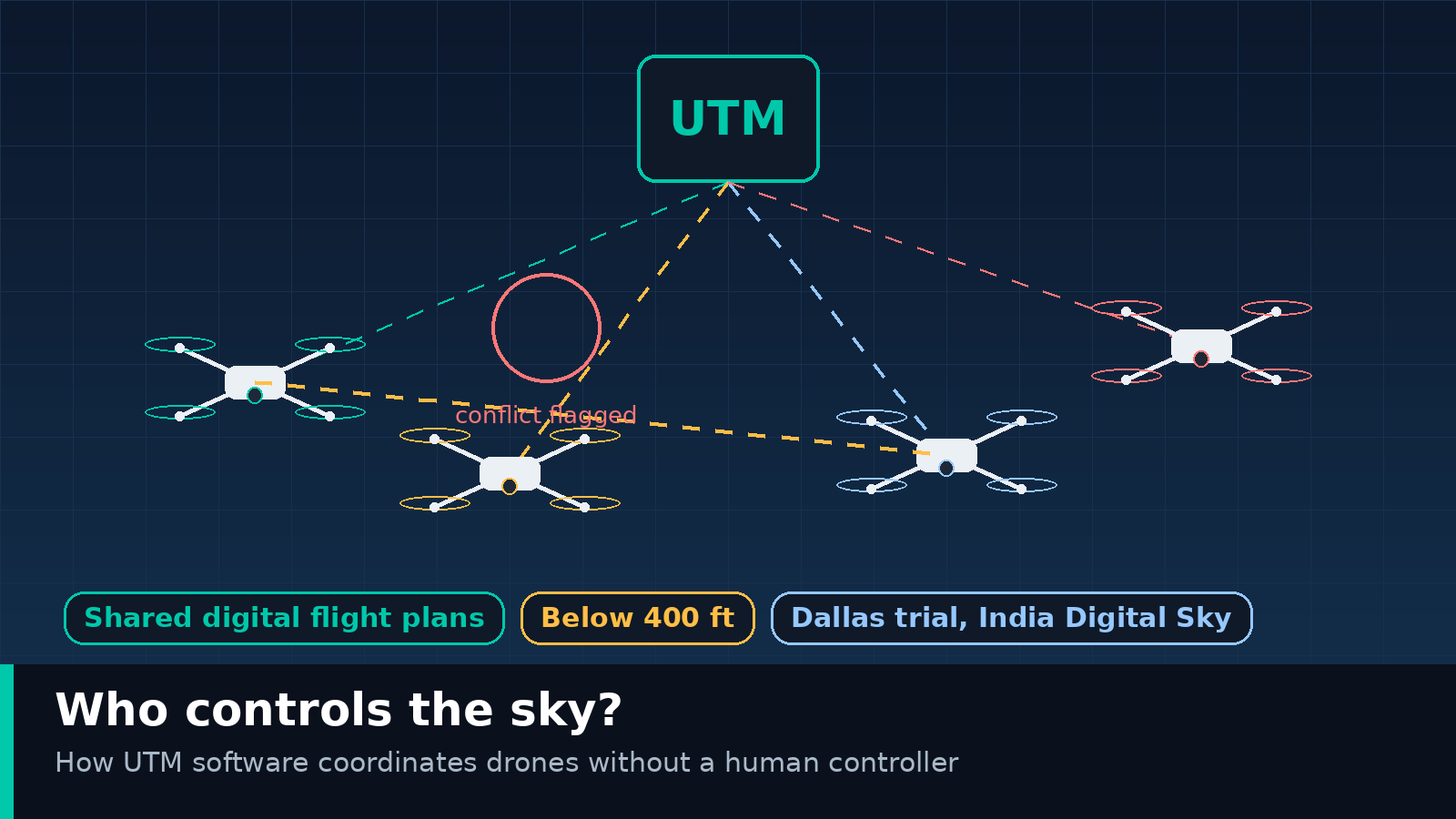
UTM stands for UAS traffic management. It is not air traffic control. Under the Dallas arrangement the operators manage their own flights, with FAA safety oversight. Each company files its intended routes digitally and shares them with other authorised users, and the software flags conflicts before aircraft leave the ground. All flights stay below 400 feet and away from crewed aircraft.
The system was tested for a long time first. According to an FAA blog post reported by Dallas Innovates in August 2024, Wing and Zipline began testing UTM in early 2023, at first through simulations, and flew thousands of flights in separated airspace before the FAA authorised shared-airspace operations. The agency expects the experience to inform rules that allow wide-scale BVLOS flying without special permission each time.
The gap UTM does not close
UTM coordinates cooperative drones. It does not by itself keep a drone away from a helicopter that is not sharing its position. A February 2026 report from the US Government Accountability Office explains the problem. Existing waivers mostly rely on ADS-B, a broadcast in which aircraft transmit their GPS position, which stakeholders told GAO works better than sensors or radar. Aircraft that do not broadcast can be detected by cameras, acoustic sensors or ground radar, but extra equipment adds weight.
GAO found that the FAA wants a new technology allowing two-way communication between drones and other aircraft, and that it has not yet set specific actions, roles or technical milestones to get there. Congress has asked for an integrated plan by May 2027. The scale matters: the GAO report cites FAA forecasts that the commercial drone fleet would pass one million by the end of 2025 and reach 1.18 million by 2029.
The rule that sets the pace
The FAA proposed its Part 108 BVLOS rule in August 2025 and received roughly 4,000 public comments. The final rule has been with the White House regulatory office since 10 July 2026, and an FAA official told a September industry conference, The Flight Brief reported, that the agency hopes to publish by the end of 2026. That is a target, not a date. Industry reporting says a contested point is whether drones would get presumptive right of way over crewed aircraft that are not broadcasting. Until the rule takes effect, BVLOS flying needs a waiver or exemption.
India's different starting point
India took a platform-first route. The Digital Sky Platform, which, as quoted by International Airport Review, the civil aviation ministry described as the first national UTM implementing "no permission, no take-off", is meant to stop any drone without a digital permit from taking off. The National UTM Policy Framework of October 2021 makes the regulator, DGCA, the owner of Digital Sky and allows it to approve private UTM service providers and personnel. The framework also covers connecting UTM with conventional air traffic management.
The hard part is live operation, not permission. At the AP Drone Industry CEO Round Table, held in August 2026 at Orvakal Drone City and hosted by Drone Federation India and the Andhra Pradesh government, industry representatives asked for stronger UTM and live-tracking capability and better mechanisms for flights in restricted and red zones.
Will cities cope?
Nobody has yet shown a city with thousands of drones in the air at once. What exists is a regional deployment with a handful of operators, a government audit saying the next layer of technology is unplanned, and a US rule that is nearly finished but not in force. UTM looks like the right architecture. Its limits will show when the number of aircraft, and the number of non-cooperating ones, grows.