Beneath the Surface: How Robots Are Helping Rebuild Coral Reefs, and Where They Fall Short
Robots are speeding up coral planting, nursery work and reef monitoring. Survival in warming water remains the hard part, and automation does not replace climate action.
Yes, robots can help restore coral reefs, but they are tools for scaling up human-led work, not a cure. In 2026, systems in Australia and Florida are being tested for planting, nursery tasks and monitoring. The tough question is whether the corals they place survive.
Planting Coral at Scale
Divers still do most coral reseeding by hand. A 2025 preprint on AI-driven dispensing of coral reseeding devices says this human-dependent workflow limits scalability and efficiency. The Australian Institute of Marine Science (AIMS) is developing the Deployment Guidance System (DGS) to change that. AIMS says the system selects promising sites with a computer model built from ecologists’ knowledge, then uses cameras and real-time AI to guide the release of seeding devices from a vessel. It also geo-tags each deployment site, so human teams can return later and place devices themselves.
Interesting Engineering reports that testing is limited to crewed vessels for now, and that AIMS hopes future versions will run from autonomous surface vessels. In a separate AIMS report, participants in the 2025–26 program deployed 44,608 seeding devices on three reefs off Cairns and in the Keppel Islands, with up to 10 young corals on each device. AIMS lists bad weather, unexpected early coral spawning and delays in finalizing some automated technology among the challenges.
Costs are a developer’s estimate. In Smithsonian Magazine, DGS lead Benjamin Moshirian says each system could deploy about a million coral seedlings over its lifetime at roughly US$1 per seedling.
Robots in the Nursery
Robots also help before corals reach the sea. In Western Australia, Coral Maker is working with Autodesk and Universal Robots on collaborative robots, according to a June 2026 International Federation of Robotics case study. The robots handle repetitive propagation steps, such as picking up coral and placing it on a spot of glue. A 2025 AI marine-robotics survey describes another system, the Coral Growout Robotic Assessment System, which uses robotic imaging to detect and count millions of baby corals in hatchery tanks.
Watching Reefs Without Divers
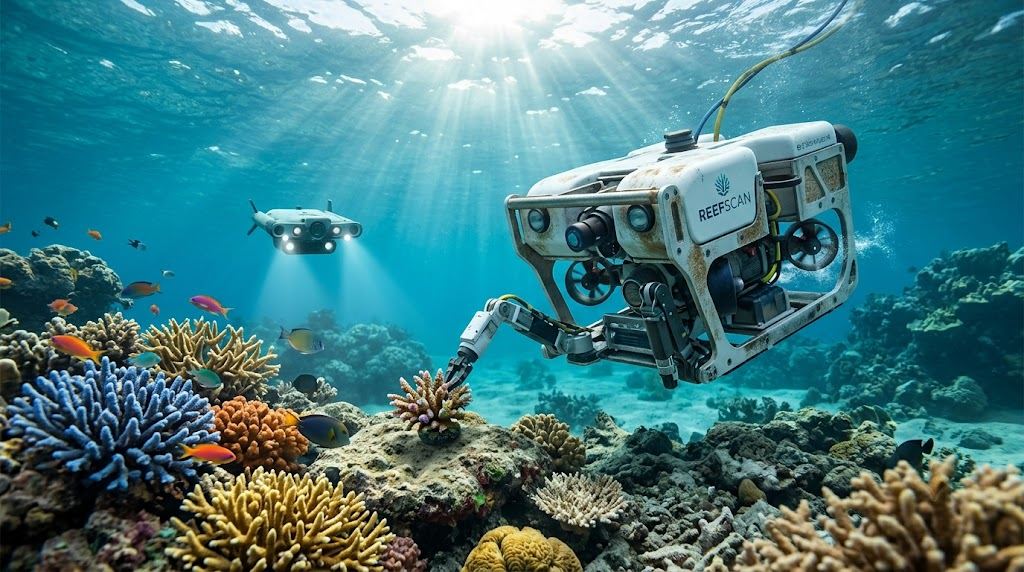
Monitoring is another strength. A University of Florida team led by Md Jahidul Islam is building underwater robots that navigate reef waters using cameras and sonar. According to an April 2026 report, the robots are used at active restoration sites in Southeast Florida and reduce the need for divers to track changes manually, which matters when ocean conditions make diving difficult.
Why Planting Is Not the Same as Restoring
Getting corals into the water is only half the job. A Scientific Reports study of seeded corals on Great Barrier Reef sites found that survival depended on matching species to suitable microhabitats. At Moore Reef, about 18 months after deployment, 14% (±4%) of individual settlement tabs for one species still had a surviving coral. A 2026 Coral Reefs study of seeding on turbid nearshore reefs says key knowledge gaps still limit how widely seeding can be applied, and that survival depends on device design, the number of spat before deployment and the deployment environment.
Climate remains the biggest risk. The Smithsonian article warns that millions of seeded corals could be lost in a single bleaching event, and it notes the need for corals equipped to survive harsher conditions. The AI-dispensing preprint also lists low genetic diversity as a limit of seeding.
What to Watch
The next test is whether automated deployment improves long-term survival, not just the number of corals planted. That will take years of follow-up monitoring, which is where reef-scanning robots may prove as valuable as planting ones.