How obstacle sensing works
Most consumer drones sense obstacles with a mix of cameras and, on some models, infrared or time-of-flight sensors. Vision systems use two or more cameras to compare what each sees. Because the cameras sit a known distance apart, the software can estimate how far away a textured object is, in the same way that two eyes judge depth. The flight controller then brakes or steers when something lies in the path. This depends on visible texture, enough light and enough time to react, and each of those conditions can fail.
What commonly slips through
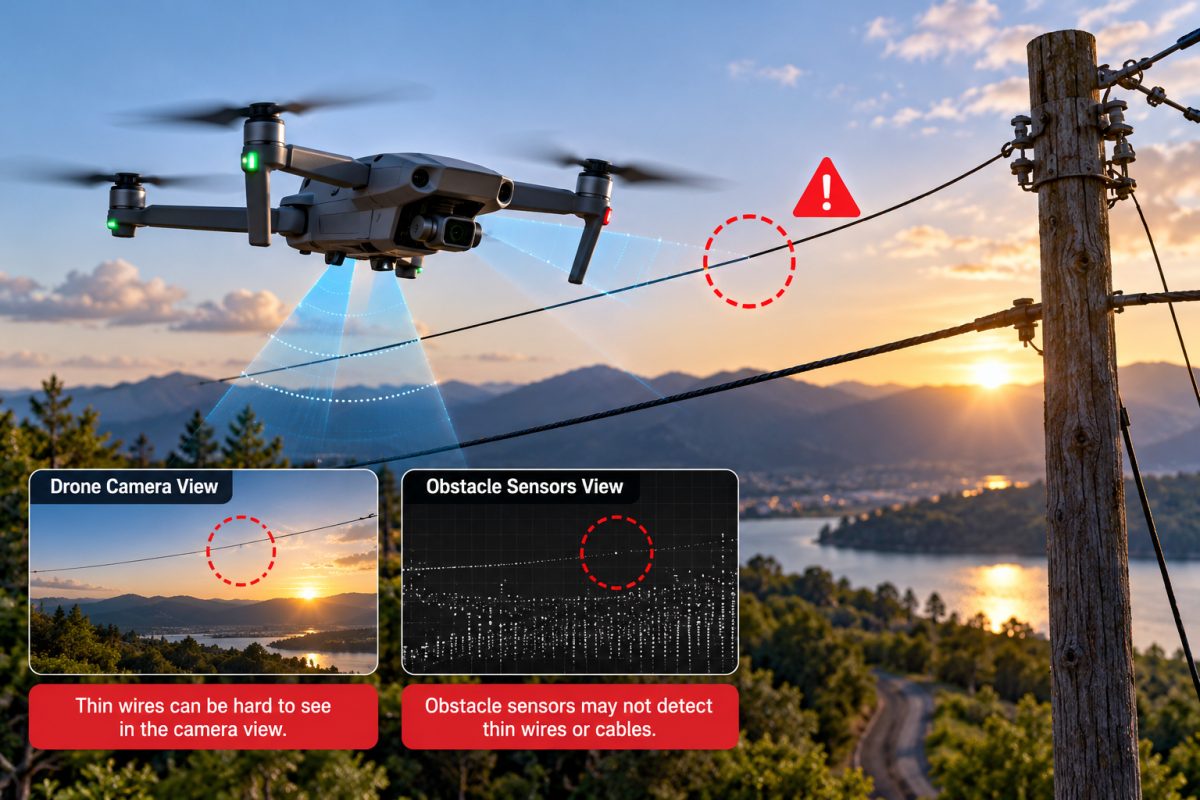
Thin wires and cables are the classic miss, because a power line a centimetre wide may cover less than a pixel at the distance where the drone needs to start braking. Glass and mirrors are difficult too, since a clear window has no texture to match and reflects the sky. Bare twigs and fine branches are irregular and low in contrast, so a drone can fly into a tree it appeared to be avoiding. Plain white walls, still water and shiny surfaces give vision systems little to lock onto. Official safety reporting shows these are not hypothetical. A report published by the UK aviation safety programme CHIRP describes a small DJI drone that hit fine branches its sensors had not detected.
Conditions and settings that switch protection off
Vision-based avoidance usually has a minimum light requirement, so dusk, shade and night reduce performance or disable it. Many drones have no sensors on the sides or above, so sideways or upward flight is unprotected. Speed matters because the drone needs distance to stop, and at sport speed or in strong wind that distance may not exist. Some flight modes reduce avoidance to a warning or turn it off, and tracking and manual modes often behave differently from normal flight. The manual lists each of these limits for your model.
Why marketing wording can mislead
Terms such as "omnidirectional" describe sensor coverage, not a guarantee. Manufacturers describe avoidance as an assistance feature, and independent reviews and pilot reports repeatedly show detection gaps for thin and low-contrast objects. A feature that works well in a demo over open ground may not work at dusk beside an electric cable.
A realistic example
Sunita films a temple courtyard in the evening, with a drone that has forward and downward sensors only. She flies sideways along a wall, and a thin overhead cable crosses the path. Neither the light nor the sensor direction helps, and the drone hits the cable. The aircraft worked as designed. The protection she assumed was never there.
What to do instead
Read the manual's list of limitations for your sensors. Walk the area first and look for wires, glass and branches. Fly slowly near obstacles and in dim light, keep the drone in line of sight, and keep a margin from anything you cannot see clearly.
Technical detail: why detection fails in predictable ways
Stereo vision estimates depth from the small shift of an object between two camera images, called disparity. The shift shrinks with distance, so far-away or thin objects produce very small and noisy measurements. A cable may be narrower than the pixel size at the distance where braking must begin, so it blends into the background. Systems based on infrared or time-of-flight sensors have their own limits, since glass can pass or reflect the beam, and bright sunlight can overwhelm it. Processing time and braking distance add another constraint, because the aircraft needs a fixed distance to stop at a given speed and wind. The trade-off in design is between sensor coverage, weight, cost and battery draw. Adding sensors to every side makes the drone heavier and more expensive, which is why many models protect only some directions. Know which directions your aircraft covers, and plan flight paths that keep it flying where its sensors point.
Takeaway: Obstacle avoidance helps, but you remain the collision-avoidance system. Fly as if it will miss what is hardest to see.