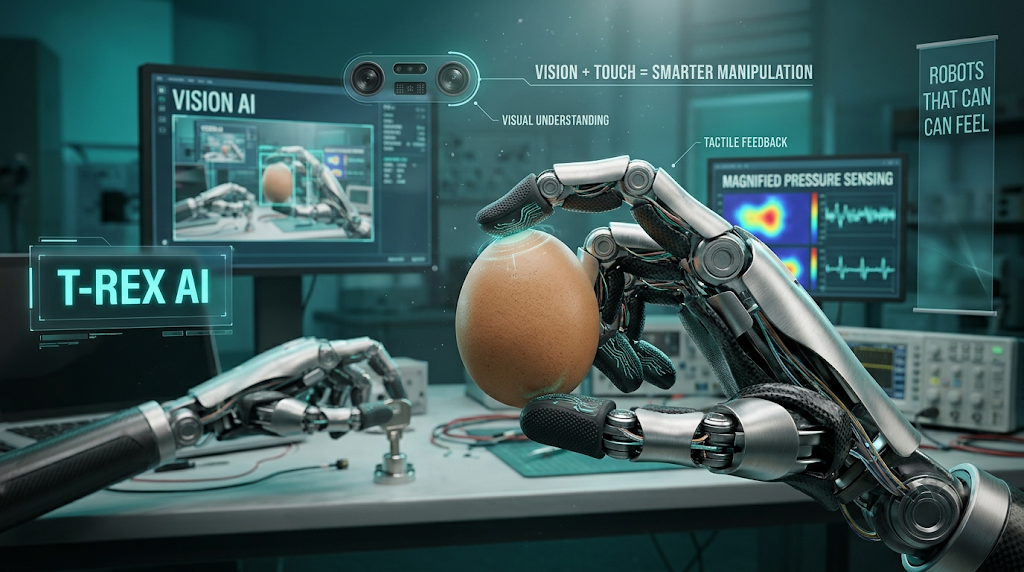
Imagine holding an egg in your hand. You know how much pressure to use so it does not break. Your fingers help you feel how tightly you are holding it. But most robots cannot do this.
On November 5, 2026, Panasonic introduced a new AI system called T-Rex. It helps robots feel objects using small touch sensors on their fingers. The technology is still being tested in a lab.
A New Way to Help Robots Feel
Panasonic worked with researchers from UC Berkeley, Stanford, NVIDIA and other research groups to develop T-Rex.
The name T-Rex stands for Tactile-Reactive Dexterous Manipulation. In simple words, it means helping robots use their hands carefully by feeling what they touch.
The team plans to share its research at the Conference on Robot Learning in Austin from November 9 to 12, 2026.
How Does T-Rex Work?
Think about picking up a glass of water. Your eyes help you find the glass, while your fingers tell you how tightly to hold it.
T-Rex works in a similar way. The robot uses cameras to see objects and small sensors on its fingertips to feel them.
The AI uses what it sees to plan movements about five times every second. Its touch system checks the fingers about 20 times every second.
This helps the robot quickly change its grip if an object starts slipping. It does not need to wait for the camera system to make every small change.
The robot has two arms and two hands with five fingers each. All ten fingertips have touch sensors.
To teach the robot, researchers used videos of people doing different tasks. They also trained it using more than 7,700 examples of robot movements.
What Can the Robot Do?
The researchers tested T-Rex on 12 different tasks. These included turning a book page, moving an egg from one hand to another and screwing in a light bulb.
Each task was tested 16 times. T-Rex received an average score of 65%, while the best of the other methods scored 35%.
The researchers also tested what happened when they turned off the touch system. In a smaller test with six tasks, the score dropped to 42%.
This shows that touch helped the robot perform better. But the robot still made mistakes, and not every task was completed perfectly.
What Problems Does It Still Have?
T-Rex is an exciting step, but it is not perfect.
Sometimes, objects slip from the robot's fingers. The robot may also press too hard when holding soft or delicate objects.
The researchers tested the system on only one type of robot. We still do not know if it will work equally well on other robots.
Some outside researchers also pointed out that the number of tests was small. More testing is needed to understand how well the system really works.
The team has shared its computer code and some training data online. This allows other researchers to try the technology and check the results.
How Can This Help in the Future?
Panasonic hopes this technology can help robots work in factories and handle delicate objects without damaging them.
For example, a robot with a good sense of touch could pick up small machine parts, hold glass objects or carefully place items during assembly.
However, Panasonic has not announced when T-Rex will become a product or how much it might cost.
For now, T-Rex is still a research project. But it shows how touch could make robots more useful in everyday work.
Robots can already see and move. Now, researchers are teaching them how to feel what they hold.