Imagine a robot moving boxes inside a busy warehouse. It works beside machines and helps people with repeated tasks. But can such robots become a successful business?
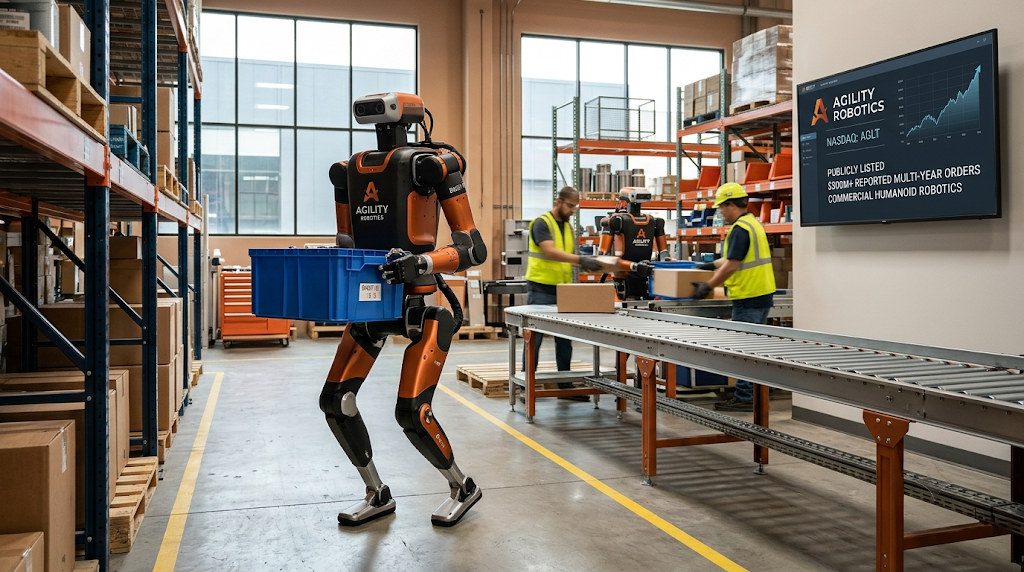
On November 5, 2026, Agility Robotics began trading on Nasdaq under the symbol AGLT. The company makes Digit, a two-legged humanoid robot. Its stock market debut marks a business milestone, but it also raises questions about costs and real-world performance.
Agility Robotics Enters the Stock Market
Agility became a public company after completing a merger with Churchill Capital Corp XI.
According to its November 5 announcement, the deal and related funding raised about $465 million before expenses. The company also reported more than $300 million in multi-year orders for its newer Digit 5 robot.
These numbers sound impressive, but they need careful reading.
The orders depend on agreed conditions. They are not money Agility has already earned.
Becoming a public company gives Agility access to investors, but it does not guarantee business success. The company must still turn customer orders into delivered robots and show that those robots can work reliably at a reasonable cost.
How Does the Digit Robot Work?
According to Agility Robotics' official Digit 5 product information, the robot has two legs, two arms and sensors that help it detect objects around it. Its software uses this information to help control its movements.
It can walk through warehouses, pick up storage containers and place them on conveyor belts.
Agility introduced Digit 5 in September 2026. The newer robot is designed to handle more industrial tasks and work closer to people.
However, these improvements must still prove themselves during regular customer operations.
A successful demonstration is useful, but working safely every day is a much harder test.
What Makes Agility Different?
Agility reports commercial deployments with companies including GXO, Schaeffler and Toyota Motor Manufacturing Canada.
According to the company, Digit has moved more than 100,000 storage containers at a GXO warehouse.
That is an important difference from robots shown only in demonstrations.
Still, real-world operation does not automatically mean a profitable business.
An August 27, 2026 Reuters investigation examined the difficulties humanoid robots face in factory work. These include performing tasks reliably and adapting to changing surroundings.
Traditional industrial robot arms may also be cheaper and faster for certain jobs.
This raises an important question: when does a walking robot offer better value than an ordinary machine?
Can Humanoid Robots Make Money?
Agility says its RoboFab factory in Oregon is designed to produce up to 10,000 robots annually. However, this is planned capacity, not actual production.
A November 5, 2026 Ars Technica report examined Agility's financial filings. It explained that customers could pay about $8,500 per month for a robot subscription, plus a separate deployment fee.
These are estimated business terms, not confirmed prices for every customer.
This creates an important challenge. A robot must save enough money to cover its fees, maintenance and operating costs.
For example, a warehouse could compare the cost of renting Digit with the cost of existing machines and workers.
A walking robot may offer more flexibility, but that does not automatically make it the cheaper option.
The real test is whether Digit can provide reliable service at a price customers can afford.
What Happens Next for Digit?
According to Agility's November 5 announcement, early Digit 5 customer access is expected in the first half of 2027. Wider availability is targeted for the end of 2027.
These dates are company expectations, not guaranteed deliveries.
Agility must still improve reliability, expand production and prove that customers receive lasting value.
Its stock market debut is an important business milestone. But the future of Digit will depend on how well the robots perform in everyday workplaces.