A robot can unload boxes very fast. But what happens if it stops working in the middle of the day? The boxes are still inside the truck, and workers must finish the job.
On November 3, 2026, Boston Dynamics introduced Stretch Gen 2, a new version of its warehouse robot. This time, the company focused on making the robot more reliable and easier to repair.
A Robot That Already Works in Warehouses
Stretch is not a new idea. It has already been used in real warehouses.
In January 2023, DHL started using Stretch to unload boxes from trucks. The company said the robot worked faster than people in some tests.
In May 2025, DHL shared plans to add more than 1,000 Stretch robots by 2030. However, this does not mean all those robots are already working.
Boston Dynamics says it studied over 100,000 hours of robot work and millions of boxes. This helped the company find problems and improve the new model.
How Does Stretch Gen 2 Work?
Imagine a truck full of cardboard boxes.
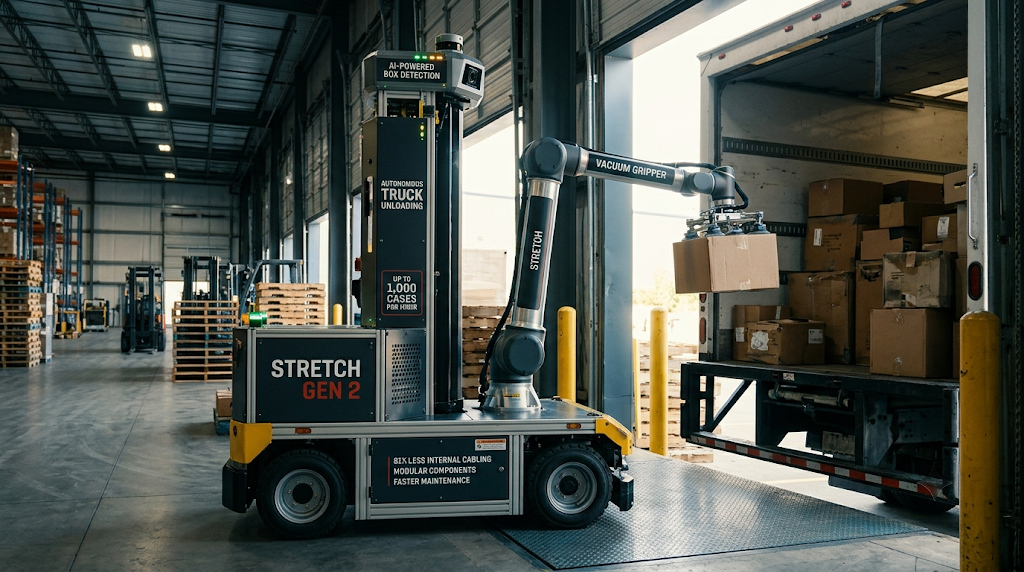
Stretch moves into the truck using its wheels. It has cameras that help it find the boxes. Its robotic arm picks up each box and moves it out of the truck.
The robot also has a new computer system. This helps it find boxes and plan its movements.
The company says it can improve the robot through software updates without changing its parts.
Why Is the New Robot Better?
The biggest change is not just about speed. It is about keeping the robot working for longer.
The older robot had many wires inside it. These wires could make repairs difficult.
Boston Dynamics says it removed 81% of the internal wiring in Gen 2. Fewer wires may mean fewer problems.
The robot also has improved joints that can turn more freely. This helps its arm move without hitting certain limits.
Another important change is repair time.
The company says workers can now replace the robot's driving system in about one hour. Earlier, this could take a full day.
These improvements could help warehouses save time when something goes wrong.
How Fast Can It Unload Boxes?
Boston Dynamics says Stretch Gen 2 can unload up to 1,000 boxes in one hour.
But this does not mean it will always reach that speed. Heavy boxes or boxes placed in difficult positions can slow it down.
For comparison, the first Stretch robot was introduced with a claim of up to 800 boxes per hour. In 2025, DHL reportedly reached up to 700 boxes per hour.
The company also says the new robot can work across two shifts on its battery and reach 90% charge in about 75 minutes.
These are company figures. More results from real warehouses are needed.
What Does This Mean for Warehouses?
Warehouses need robots that can work every day without stopping too often.
A robot that breaks down can delay deliveries and create more work for people.
Stretch Gen 2 tries to solve this problem by making repairs faster and reducing parts that may fail.
However, Boston Dynamics has not shared the robot's price or a clear date when customers can buy it.
For now, the new design looks promising. But the real test will come when more warehouses start using it.
A good warehouse robot is not just one that works fast. It is one that keeps working when people need it most.