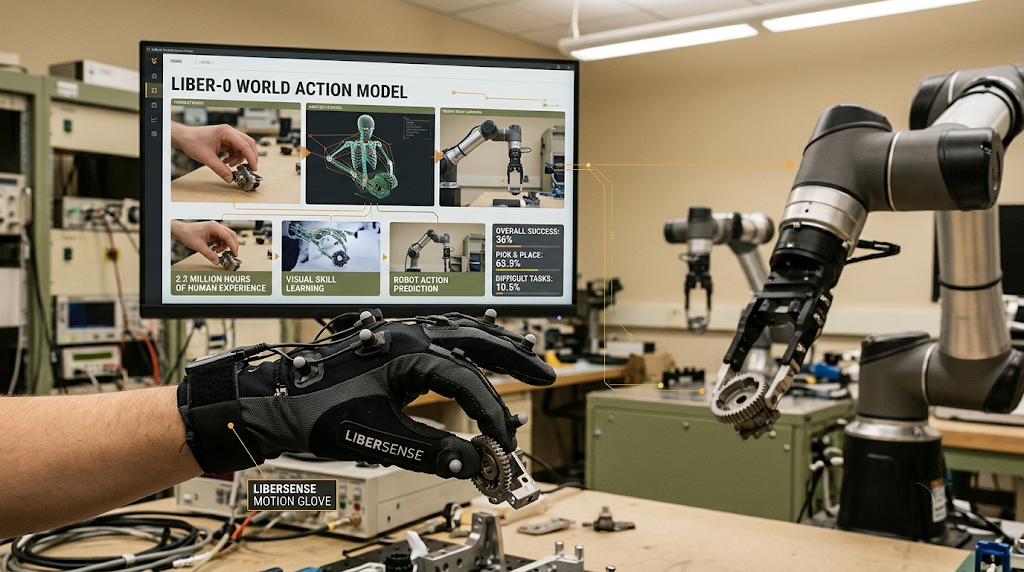
Children learn a lot by watching adults. They see someone open a drawer, then they try it themselves. LiberAI wants robots to learn in a similar way. The company has introduced Liber-0, an AI model trained on more than 2.2 million hours of human experience. It says the model can do some new tasks without robot demonstrations made for those tasks.
What LiberAI Announced
LiberAI is a physical AI startup founded in December 2025. It introduced Liber-0 in early November 2026. News coverage is dated November 4, while the company’s wire release carries a November 3 dateline.
Liber-0 is a World Action Model. It predicts what will happen next in a scene and what action the robot should take. Much of its training came from video of people doing everyday tasks.
How Gloves and Videos Teach a Robot
Video has a problem. It shows what happened, but not exactly how the fingers moved.
So LiberAI also uses light data gloves. They record hand poses while people handle objects. Cameras on the head and wrists record the same moment. This links what the person saw with how their hands moved.
Robots and humans also have different bodies. Liber-0 receives details about the body doing the task, such as arm length or hand shape. This helps it adjust the movement for a robot.
Why Human Data Could Be a Cheaper Teacher
Robot data needs a robot and a trained operator for every demonstration. Gloves do not need a robot nearby, so more people could collect data in more places.
LiberAI’s press release describes a controlled test. After the same robot training, a model pretrained on 10,000 hours of glove recordings beat one pretrained on 2 million hours of ordinary web video.
Robotics & Automation News, citing the company’s technical material, reports another result. A policy trained on 25% of the robot data plus all the glove data scored 75.6. The full robot data alone scored 72.8. The glove data was extra.
Why a 36% Score Is Still Far From Reliable
According to LiberAI’s press release, Liber-0 was tested on 60 tasks proposed by GPT-6, with 10 tries each. The company reports a 36.0% overall success rate.
A third-party summary of the results gives 63.5% for picking and placing, 34.0% for short manipulation tasks, and 10.5% for hard multi-step tasks.
Most attempts therefore failed. All these numbers come from LiberAI’s own evaluation, so treat them as provisional. We have not found an independent repeat test.
“Zero-shot” also needs care. The model still learned from some robot demonstrations during training. They were just not collected for those 60 tasks. No evidence yet shows reliable performance in real factories or homes.
What Comes Next for Liber-0
LiberAI says its gloves record hand poses but not touch or force. Adding those could help with tasks like fastening parts or handling soft objects.
Outside labs will need to repeat the tests on other robots before anyone can judge how well the idea travels.
Liber-0 shows a promising idea: human experience may help teach robots. But a 36% score is a research result, not a finished skill. The next proof will be repeatable success on harder jobs.