What Google Launched: The Basics
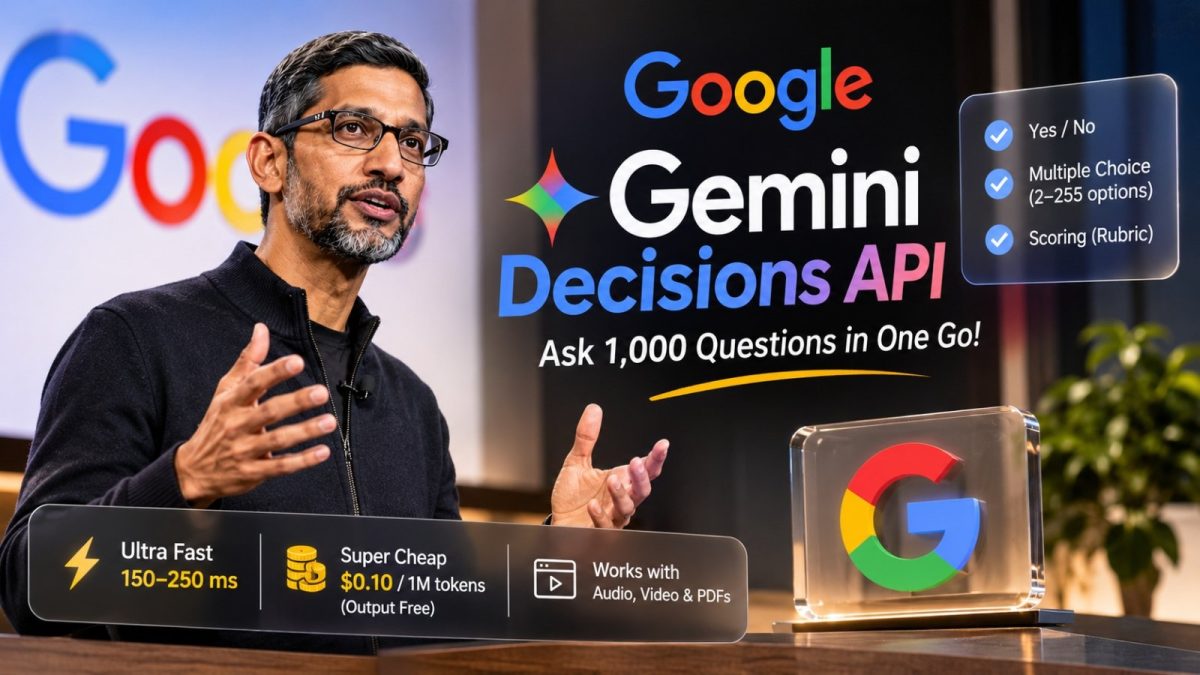
On November 11, 2026, Google came out with the Gemini Decisions API. It runs on a new model called Gemini Decision 1. Sundar Pichai, Google’s CEO, said it can answer up to 1,000 questions about the same input in just one request, and it has a 256K context window.
What Google Launched: How It Works
Most AI models write their answers one token at a time. Gemini Decision 1 doesn’t do that. It goes through the model one time without sampling, so it gives back zero output tokens. What you get are probabilities and confidence scores. It can answer three kinds of questions: yes-or-no, multiple choice (from 2 to 255 options), and scores on a rubric.
The Rise of the “Decision Layer”: A Growing Trend
This is part of a bigger trend. Instead of using giant reasoning models to write out a label, developers are using small classifiers to pick tools, check policies, route models, and grade context. Microsoft announced Microsoft-Decision-1 in October, and TypeSafe AI released its Jev model in September. OpenAI made its Decisions API generally available on October 22. It runs on GPT-6 Luna and can handle 400 questions per request across text, images, and JSON.
The Rise of the “Decision Layer”: Google’s Difference
Google says its version works right away with audio, video, and PDFs in one pass.
Speed and Cost: Cheap and Fast
The main selling point is speed and price. The delay is only 150 to 250 milliseconds, and Google charges $0.10 per million input tokens. The output is free. You only get billed once for the shared input, so adding more questions to a long document costs almost nothing. Google says it’s nearly five times cheaper than Gemini 3.5 Flash-Lite on its shared benchmark suite.
Speed and Cost: Can We Trust the Numbers?
The model also gives a confidence score for every answer. Google says its Expected Calibration Error is 0.0250, which is the lowest in its own internal charts. But those numbers come from Google, and nobody else has checked them at a large scale yet.
How the Competition Compares
On the Artificial Analysis Decision Index, TypeSafe Jev scores 66.23 for overall quality. Gemini Decision 1 is right behind with 65.98, and OpenAI’s GPT-6 Luna gets 60.25. So the race is super close.
The Downside: No Deep Thinking
These models don’t write out a chain of thought, so they can’t solve problems step by step. That could be risky. If an AI agent’s safety checks only rely on a single-pass classifier, an attacker could hide something harmful inside really confusing context that takes several steps to figure out.
The Downside: Availability
For now, Gemini Decision 1 is only on the Gemini Developer API under a v1beta endpoint. Google says Google Cloud support is coming later.