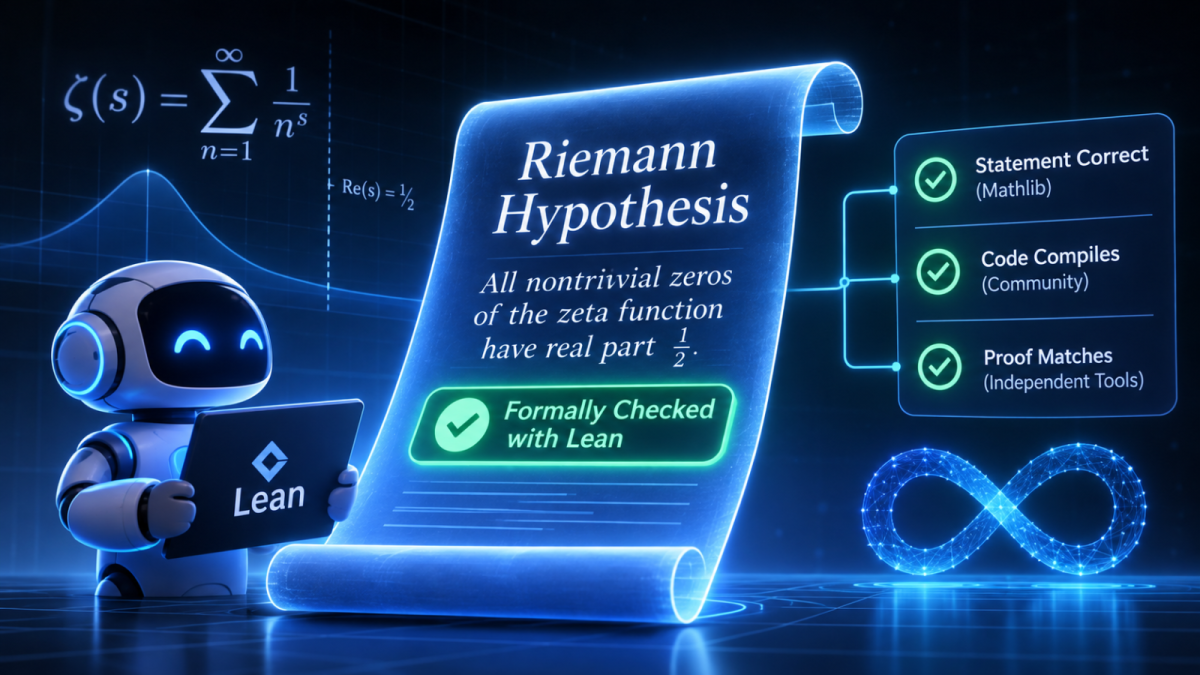
On November 20, 2026, Anthropic mathematician Levent Alpöge released a Lean library of about 17 million lines that he says proves the Riemann Hypothesis, working with Claude. On November 21, the Lean and Mathlib communities put out a joint statement saying they are fully confident the proof is correct. In about a day, this Riemann Hypothesis proof went from "unchecked" to "formally checked." But formal checking isn't the same as all mathematicians accepting it.
What Changed
The statement is backed by the Lean FRO and the Mathlib Initiative. It says the communities spent the past day verifying the proof, and that they certify both the statement and the proof are correct.
How They Checked
According to the statement, there were three main steps:
- The statement is correct: the Riemann Hypothesis statement is already part of Mathlib, and experts in Lean and number theory have vetted it.
- The code compiles: dozens of people reported that it compiled correctly, and they all reproduced the same raw proof export file.
- The code proves that statement: the community pulled the Mathlib statement into its own file and compared it with Alpöge's theorem using two independent tools. Both confirmed that the theorems match.
Digg's summary adds that independent proof checkers also validated the export.
What Lean Checks and What It Doesn't
Lean is software that checks every logical step mechanically. That closes one gap I raised earlier, which is that a Lean proof can be flawless and still prove the wrong statement. The statement-comparison step is how the community says it closed that gap. But the Lean community is the one vouching for it, so readers should check the Mathlib statement themselves. It's a formal version of the claim that all nontrivial zeros of the zeta function have real part one half.
What Remains Open
Mathematicians still want an argument that humans can read, and it takes time for the whole field to accept something like this. Alpöge also says the work covers the Generalized Riemann Hypothesis, but Digg notes that reporting doesn't show any independent verification of that claim. The $1 million Clay Prize and journal publication each follow their own rules and timelines.
State of the Art: A Verification Pipeline
This is a clear example of a pipeline for AI-assisted math: first the claim, then independent compilation, then a statement comparison using separate tools. In August, Claude raised the known share of zeta zeros on the critical line from 41.6% to 67.2%, also with a Lean formalization. So this is the second step in a progression that people can actually see.
Future Potential and Applications
If the result is accepted, it could sharpen what mathematicians know about prime numbers and point to new methods. Pipelines like this could also be reused to check other AI-generated proofs. That's a possibility, not a promise.
Future Impact and Business Opportunities
Proof-checking tools, formalization services and Lean skills could see more demand. AI labs might also use verified math results to show what their models can do, which is why independent checking matters.
Context and Conclusion
The claim came from an employee of a company that went public just days earlier. Readers should keep that in mind, but it doesn't mean we should jump to conclusions. The honest status right now is "formally checked by the Lean community," and the next step is for humans to understand it.