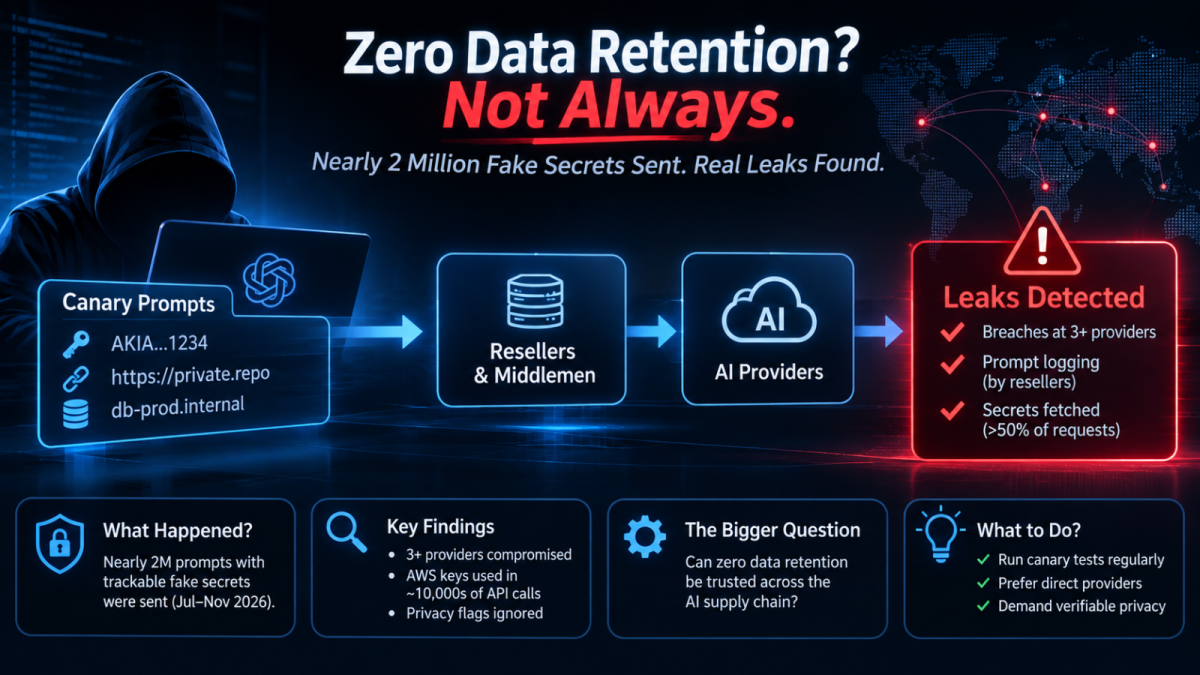
Security researcher HD Moore and his team at Dragos sent nearly two million prompts containing trackable fake secrets to widely used AI services between July and November 2026. According to Ars Technica's report, the results showed breaches, prompt logging by resellers, and privacy settings that were ignored. The findings raise a hard question: can zero data retention, the setting that is supposed to mean a prompt isn't stored, be trusted across the AI supply chain?
What the Experiment Did
The prompts had unique, controlled credentials, URLs, DNS names and links to private repositories. Moore sent the same requests to the same model through different resellers, then tracked which routes led to the secrets being used. This kind of trap is often called a canary, and it works like a tripwire. If anyone touches it, you know the data leaked.
What It Found
Moore reported at least three compromised providers, and stolen bait AWS keys led to tens of thousands of API calls. Some resellers could see and keep customer prompts just through normal logging, with no hack needed. One Chinese AI lab's systems fetched the secret URLs for more than half of the requests sent to its models from July through October. That included about two-thirds of the ones marked no data collection or zero data retention. US hosting providers that resell that lab's models triggered the same fetches. The coverage I saw doesn't name the lab or say whether the fetching was on purpose. Moore's point about the breaches was that a privacy flag doesn't help when the attacker is already inside.
A Confirmed Incident
Together AI said its own coding agent leaked customer prompts after committing a credential to GitHub. It says it has made zero data retention the default for new accounts and moved to short-lived credentials. KBY Technologies reports that OpenRouter removed three providers after the findings.
State of the Art: Canaries as Audits
Canary testing turns a vague privacy promise into something you can measure. Instead of just trusting a provider's policy, a customer can check whether a secret ever gets used.
Future Potential and Applications
Companies could run canary tests as regular audits of AI vendors, much like penetration tests. Healthcare, finance and legal teams that send sensitive prompts to AI services could use them to check claims before signing contracts. This is a possibility, not something people already do as standard practice.
Future Impact and Business Opportunities
The study could push providers to make privacy settings verifiable, and push customers toward direct contracts with large providers or their own hardware. That could create demand for AI vendor audits and monitoring tools.
Limits
The reporting so far comes from secondary summaries. The study looks at a sample of providers, not the whole market. Moore's advice is to run models on your own infrastructure where possible, or deal directly with large providers instead of going through intermediaries.
Conclusion
Privacy settings are only as strong as the weakest link between your app and the model. The study suggests that the weak link is often the middleman.