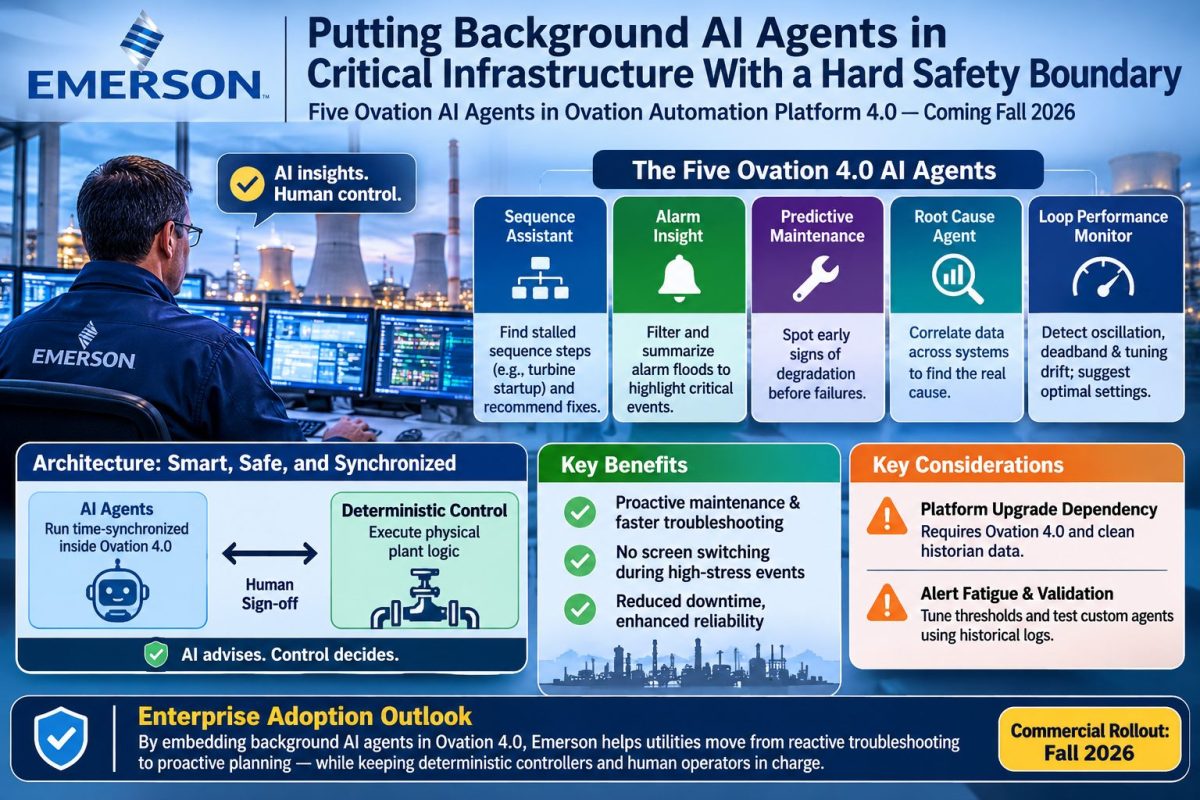
Control rooms in power plants and water systems don't just adopt autonomous software, because one made-up command could trip a turbine or mess up a city's water grid. On July 27, 2026, Emerson announced five specialized Ovation AI Agents built into its Ovation Automation Platform 4.0 for power generation and water treatment utilities. They're set to roll out commercially in fall 2026, and utilities can add the agents one at a time. There's also a firm safety line. Regular deterministic control systems run all the physical plant logic, and the AI agents only work in the background as advisors that need a human to sign off.
These aren't chatbots stuck on the side or separate dashboards. The agents run inside the native Ovation 4.0 workflows, synced in time, so operators never have to switch screens during a stressful event.
What the Five Agents Do
According to Emerson's July 27 news release and coverage from Automation World and CDO Magazine, the first release builds on Ovation Virtual Advisor and covers five plant jobs.
The first two are the Sequence Assistant and Alarm Insight. The Sequence Assistant Agent watches sequential control logic, like steam turbine startups, to find stalled steps and suggest fixes. In early utility testing, it spotted a failed permissive condition in seconds instead of the hours it takes to review the logic by hand. The Alarm Insight Agent cuts through alarm floods by filtering and summarizing, so operators can focus on the main problem instead of hundreds of alerts going off at once.
The next two are Predictive Maintenance and Root Cause. The Predictive Maintenance Agent follows equipment health data to catch small signs of wear before something breaks unexpectedly. When equipment trips or faults, the Root Cause Agent links alarms, trip logs, and live process data across plant systems to find the real failure instead of just the nearby symptoms.
The fifth is the Loop Performance Monitor. This agent checks control loops for oscillation, deadband, and tuning drift, and then gives control engineers parameter suggestions backed by evidence. Emerson said these five come before 28 more planned agents. It also previewed the Ovation AI Agent Builder for its 2026 Ovation Users Group Conference, so utilities can make custom agents around their own plant variables.
What I Think About It
To me, Emerson's strict split between AI that guesses and a distributed control system (DCS) that actually acts is a realistic model for critical infrastructure. Office agents are starting to write straight into CRM and ERP records, but power and water operators have physical safety rules and grid-reliability audits that don't allow unchecked actions. Emerson Power and Water Solutions President Bob Yeager said in the announcement that building pattern recognition into the operators' own tools helps teams move from reacting to problems to planning ahead, without switching screens.
Still, utility engineering leaders have two things to deal with before spreading these agents across a fleet.
First, you need Ovation 4.0. The agents depend on time-synced data inside Ovation Automation Platform 4.0. So utilities on older Ovation versions have to finish upgrading and clean up their historian data before turning on background monitoring.
Second, too many alerts and custom agents need testing. Even with humans approving everything, badly tuned anomaly limits or unchecked custom agents from the Agent Builder can create extra noise of their own. Engineering teams should compare the recommendations against past fault logs first.
What Happens Next
By putting synced diagnostic agents inside Ovation 4.0 and keeping controllers and human operators in charge of anything physical, Emerson makes it easier for industrial plants to try AI. Utilities that start with the most painful diagnostic jobs, like alarm flood triage and control-loop tuning, can cut down fault investigation time without risking plant safety.