Imagine a security guard walking around a factory every day to check machines and equipment. Now imagine a four-legged robot doing the same job. On November 17, 2026, Boston Dynamics and the chip maker GlobalFoundries announced a bigger partnership. The companies plan to bring more Spot robots into chip factories and start testing the humanoid robot Atlas in 2027.
What Did the Companies Announce?
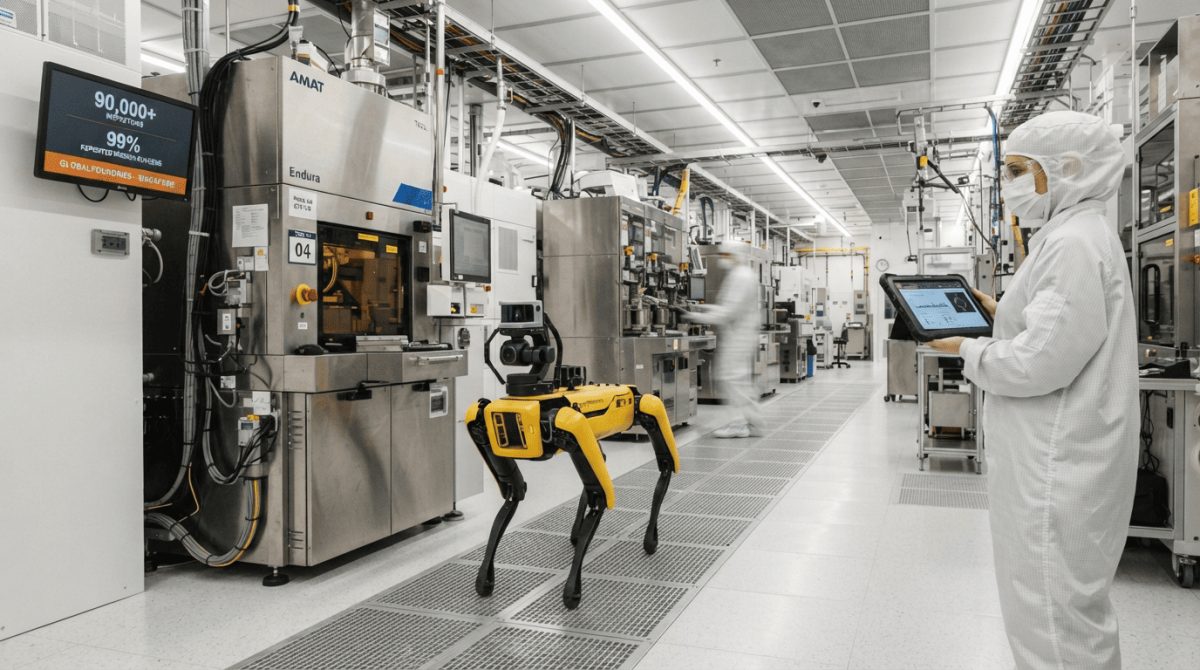
GlobalFoundries plans to use Spot robots at its factories in New York, Vermont, Germany, and Singapore. The company has already used Spot at its Vermont factory for more than four years.
According to the companies, two Spot robots in Singapore have finished more than 90,000 inspections since April 2026, with a 99% mission success rate. The robots also traveled nearly 900 kilometres during this time. The companies reported these numbers themselves.
How Does Spot Inspect Factories?
Spot is a four-legged robot that weighs 33.8 kilograms and can move at up to 1.6 metres per second. An operator can teach Spot a certain route, and the robot can then follow it on its own. During inspections, it can collect images, temperature readings, and other information, depending on the equipment attached to it.
In Singapore, Spot works in an area called the sub-fab. This area has gas tanks, utility systems, and other equipment that supports chip making. GlobalFoundries says the information Spot collects helps workers find problems before equipment breaks down.
Why Is GlobalFoundries Testing Atlas?
Unlike Spot, Atlas is a humanoid robot with a body shaped like a human. This design could help it work in spaces that were originally built for people. But Spot already has years of experience in factories, while Atlas still has to prove itself in chip making. The companies haven't explained exactly what tasks Atlas will do.
Gartner analyst Bill Ray told TechTarget that the partnership looks like an experiment. He also pointed out that larger humanoid robots bring different safety concerns.
What Are the Limitations?
Even though Spot has a reported 99% mission success rate, that doesn't mean it catches every equipment problem. The companies also haven't said how much money the robots have saved.
Spot's battery usually lasts around 90 minutes, though extra equipment can cut its running time. Another important point is that Spot's results come from factory support areas and not from the cleanrooms where chips are made.
What Happens Next?
GlobalFoundries plans to expand Spot's use across four factory locations in the coming months. It also plans to start testing Atlas in early 2027. The companies reported that GlobalFoundries moved 875 routine inspections over to Spot within two weeks.
This partnership shows how robots can take over repeated inspection jobs and let workers focus on other tasks. Spot has already shown that it is useful for factory inspections. But Atlas still needs to prove that it can work safely and reliably inside chip factories.