Imagine ten students running a race, but each student has different shoes and runs on a different track. It would be difficult to decide who is actually faster. Researchers face a similar problem when testing rescue robots.
To solve this, researchers have introduced SPARC, which stands for Standard Platform for Autonomous Rescue Competition. It allows teams to use the same robot so they can compare their software fairly.
What Is SPARC?
On November 11, 2026, researchers published a paper introducing SPARC.
SPARC is a new competition being developed under the RoboCup Rescue Robot League.
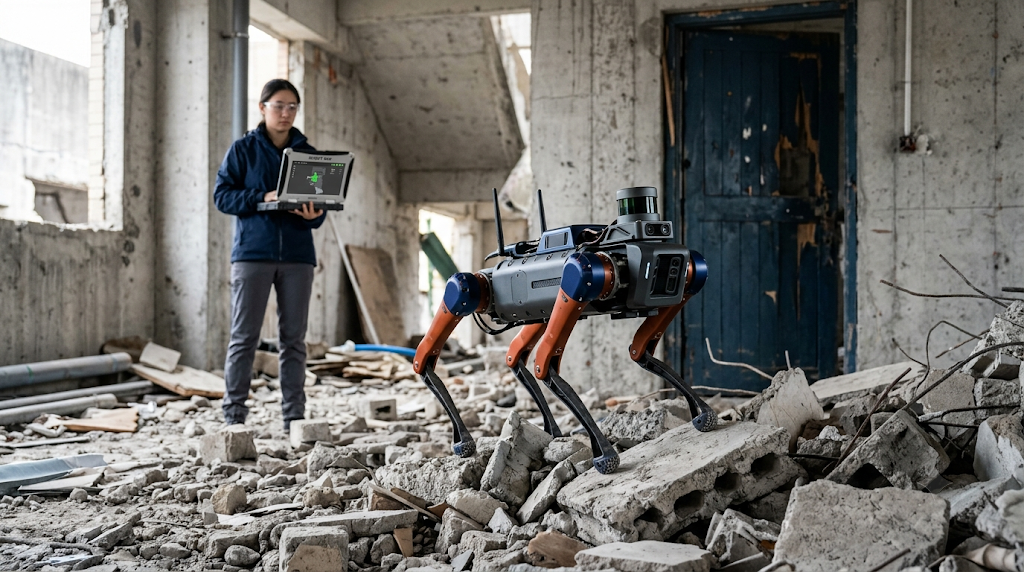
In this competition, every team uses the same robot called Unitree A2-W.
The main goal is to test how well different software systems work instead of comparing different robot designs.
The Unitree A2-W is a commercially available robot that uses both wheels and legs to move.
How Does SPARC Work?
SPARC provides common tools and information that researchers can use to develop their robots.
The researchers have released datasets collected during robotics competitions in 2026. They also provide virtual rescue environments and open-source navigation software.
Every team uses the same robot with two laser scanners and a camera.
These sensors help the robot understand its surroundings.
The software mainly focuses on three tasks: finding the robot's location, creating maps of obstacles and choosing safer paths.
Since everyone uses the same hardware, teams can easily compare their results.
Why Is SPARC Important?
Rescue robots may be useful during earthquakes, building collapses and other disasters.
However, testing a robot on a simple obstacle course is different from using it in a real emergency.
SPARC helps researchers test their ideas under similar conditions.
For example, if two teams use the same robot and track, researchers can see which software performs better.
The competition also encourages teams to share their work. According to the rules, the top three teams must publish their complete robot code.
This could help other researchers learn and improve their systems.
What Are the Limitations?
SPARC is still being developed, and its rules are not fully completed.
The platform does not prove that robots can already rescue people during real disasters.
Real rescue situations can include smoke, broken buildings, unstable ground and communication problems.
These situations are much harder than controlled competition environments.
Some of the available software has also not been fully tested as a complete working system.
What Happens Next?
Researchers plan to use SPARC to improve robot navigation, object detection and movement.
Future competitions may also include tasks where robots use arms to handle objects.
Since the Unitree A2-W is available commercially, teams can buy the robot instead of building one from the beginning.
SPARC is an interesting step toward better rescue robots. It may not help in real emergencies immediately, but fair testing and shared research could make future rescue robots more reliable.