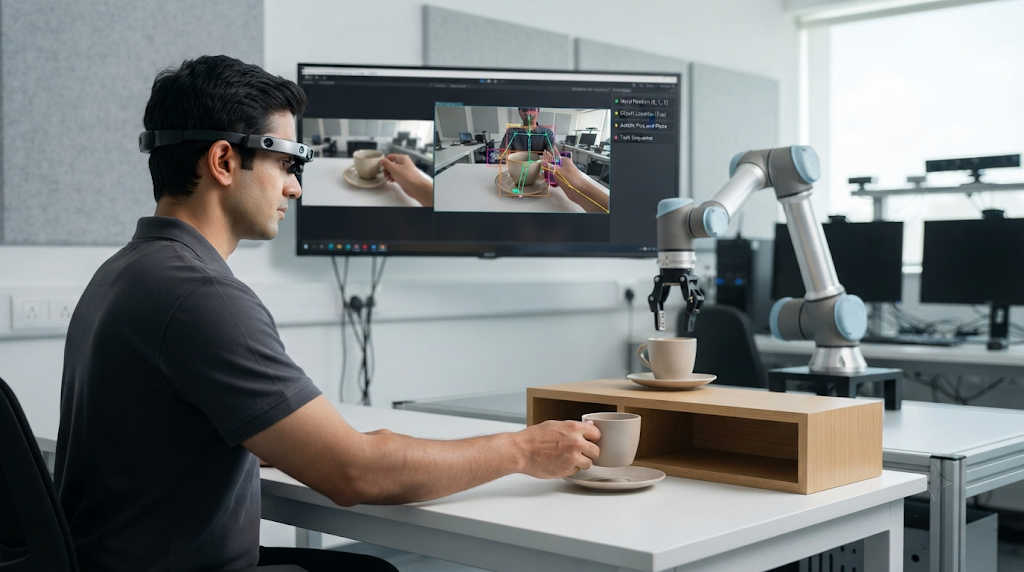
Teaching a robot to wash a cup may sound simple, but robots need to understand how people hold and move objects.
A Bengaluru-based startup called Humyn Labs is helping robots learn these skills by recording people doing everyday tasks.
On November 18, 2026, the company was reported to have raised $47 million to expand its robot training data business.
What Does Humyn Labs Do?
Humyn Labs was founded in February 2026 by Manish Agarwal and Ishank Gupta.
The company does not manufacture robots. Instead, it collects videos of people working and turns them into training data for robot developers.
The $47 million funding includes $26 million in investment led by Accel and $21 million in venture debt led by Lighthouse Canton.
According to the company, it collects data in more than 20 countries, including India, Brazil and South Korea.
Humyn Labs also claims to have 12 paying customers and earned $10 million between April and October 2026.
Around 90% of its revenue reportedly comes from the United States.
How Does Humyn Labs Collect Data?
Workers wear a device with two cameras that record tasks from their point of view.
For example, the cameras might record someone washing dishes, arranging objects or cleaning a room.
Software studies these videos and adds information about hand movements, objects and actions.
Humans also check the results to improve accuracy.
The company's technology can track 21 points on a person's hand and estimate how objects move in three-dimensional space.
This information is then used to create datasets that robot developers can use for training.
Why Is Human Data Important for Robots?
Robots need examples to understand how everyday tasks are performed.
Training robots directly in the real world can be expensive and time-consuming.
Recording people doing normal activities is often easier.
These videos can show how objects are picked up, moved and placed in different environments.
However, collecting more videos does not automatically mean robots will perform better.
The quality and variety of the data are also important.
What Are the Challenges?
One major challenge is that human hands and robot grippers work differently.
People can bend their fingers and adjust their grip using touch. Many robots cannot copy these movements exactly.
Robot developers must convert human actions into movements their machines can actually perform.
Humyn Labs has not yet published independent test results proving that its data improves robot performance.
Privacy is another concern because some recordings happen inside people's homes.
The company needs to address questions about permission, payment, data storage and how recordings are used.
What Happens Next?
Humyn Labs plans to use its funding to improve recording devices, develop data tools and expand offices in San Francisco, London and Seoul.
It also plans to publish a report about data quality and consent checks.
However, no specific robot deployment has been confirmed in the reviewed sources.
Humyn Labs shows how Indian startups can contribute to robotics without building robots themselves.
Its future success will depend on protecting people's privacy and proving that its training data helps robots complete real-world tasks.