Imagine a robot that can lift something as heavy as a small car and place it in exactly the right position.
HD Hyundai Robotics has developed a powerful industrial robot called HDT1000-33 that can lift up to 1,000 kilograms.
On November 18, 2026, the South Korean company announced its first sale. The robot will be used to move heavy engine parts inside a factory.
What Is the HDT1000-33 Robot?
The HDT1000-33 is a heavy-duty industrial robot developed by HD Hyundai Robotics.
The company began developing it in February 2024.
On November 18, 2026, HD Hyundai Robotics held a ceremony to celebrate its first sale in Ansan, South Korea.
According to the company, it is the first robot of this size developed in South Korea.
The robot will help manufacture large engines used in construction machines.
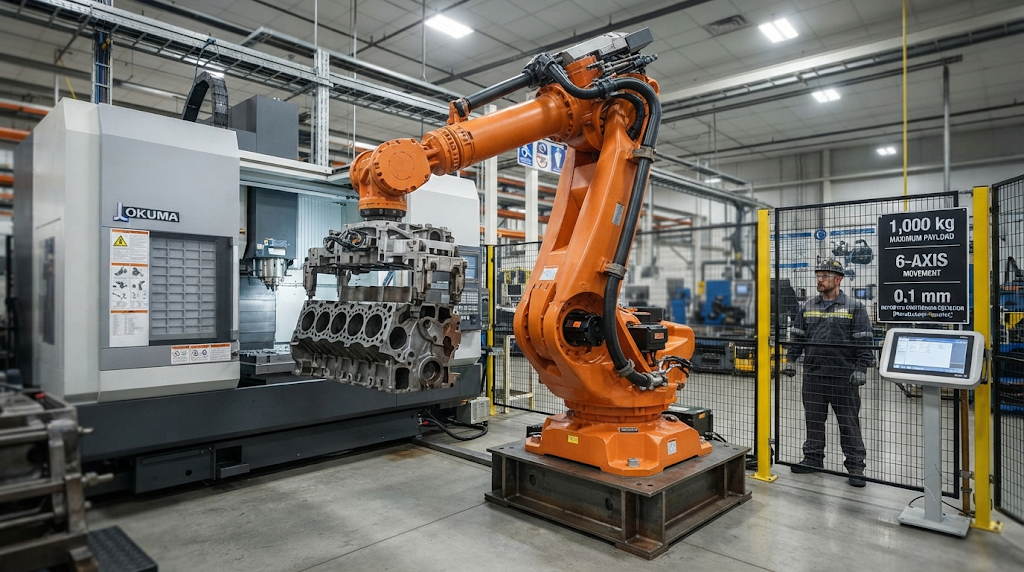
Its main job is to lift heavy engine cylinder blocks, place them into machines and move finished parts to the next production stage.
How Does the Robot Work?
The HDT1000-33 has a robotic arm with six joints.
These joints work like a human shoulder, elbow and wrist, allowing the robot to move and position heavy objects.
The robot can carry loads weighing up to 1,000 kilograms, or one tonne.
HD Hyundai also claims that it can repeatedly place objects within 0.1 millimetre of the correct position.
That is approximately the thickness of a sheet of paper.
This accuracy is important because engine parts must be placed carefully inside manufacturing machines.
Even a small mistake could damage expensive equipment.
However, these performance figures come from the company and have not been independently confirmed.
Why Is This Robot Important?
Manufacturing large engines involves moving extremely heavy parts.
Handling these parts can be difficult and dangerous for workers.
HD Hyundai says its robot can reduce the need for workers to lift heavy materials and help prevent serious workplace accidents.
Unlike humanoid robots that are designed for different activities, the HDT1000-33 focuses on specific industrial tasks.
It is built to repeat heavy lifting and positioning jobs accurately.
The first sale also shows that the robot is moving beyond demonstrations into factory use.
What Are the Limitations?
Although the first sale has been announced, the robot's long-term performance is still unknown.
HD Hyundai has not shared information about its working speed, maintenance costs, reliability or money saved.
Also, a one-tonne lifting capacity does not mean the robot can safely carry that weight at every position or speed.
More real-world testing is needed to understand how well it performs during daily factory operations.
What Happens Next?
HD Hyundai plans to introduce the HDT1000-33 to other heavy industries.
Possible uses include shipbuilding, large automobile parts and electric vehicle battery manufacturing.
However, these are future plans, not confirmed deployments.
The HDT1000-33 shows how powerful industrial robots can help factories handle heavy materials.
Its first sale is an important step, but its real success will depend on how safely and reliably it works over time.