Imagine a tiny flying robot that weighs less than a paperclip and can figure out where it is without help from outside cameras.
Researchers at MIT have developed a robot that can do this using its own sensors and a small computer.
MIT announced the research on November 18, 2026, and the study was published in Science Robotics.
What Is Special About This Tiny Robot?
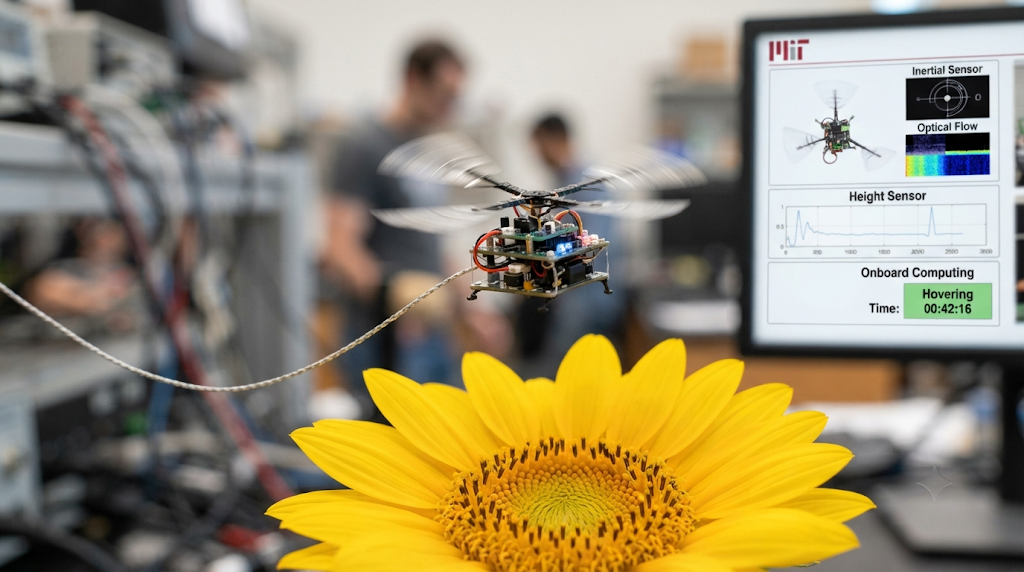
The robot is about the size of a microcassette and has four small wings arranged in a plus shape.
Earlier versions needed cameras placed around a laboratory to track their movements.
The new version can estimate its own position without those cameras.
During testing, it hovered at different heights and flew between selected points.
According to the researchers, its position errors were only a few centimetres.
However, the robot still needs an external power supply to fly.
How Does the Robot Find Its Way?
The robot uses three sensors and a tiny computer to understand its movements.
One sensor measures how much the robot tilts or turns.
Another watches the ground to estimate sideways movement.
The third measures its height above the ground.
A small computer combines this information to estimate the robot's position.
The entire electronics package weighs only 244 milligrams.
Since the added electronics increased the robot's weight, the researchers made its artificial wing muscles 50% larger.
This increased its net lifting force by 46%.
The robot can now produce enough lift to support almost twice its weight.
Why Is This Research Important?
Small flying robots could be useful in places where larger drones cannot easily work.
For example, researchers hope they might one day help pollinate flowers or detect pests on farms.
MIT has suggested possible uses in crops such as almonds and blueberries.
Because these robots are extremely small, they may be able to work around delicate flowers without causing much damage.
However, these farming uses are still future possibilities.
What Are the Limitations?
The robot can estimate its position, but it is not completely independent.
It still receives power through a cable and cannot choose its own routes or avoid obstacles.
During a demonstration involving a sunflower, a researcher used a joystick to give movement commands.
The robot also does not have an onboard camera.
In 2019, Harvard researchers developed a tiny flying robot called RoboBee X-Wing that could fly without a power cable using solar energy.
However, that robot needed very strong light and could not steer itself.
Both projects have solved different problems, but neither has achieved fully independent flight.
What Happens Next?
MIT researchers want to add a camera so the robot can recognize objects and avoid obstacles.
They also hope to develop an onboard power system that would allow it to fly without a cable.
The researchers found that its electronics use only about 6% of the total power, which could help with future improvements.
This tiny robot is an important step in flying robot research. However, more development is needed before it can work independently outdoors or help farmers in real situations.