Why People Are Worried
Open-weight models are AI models whose files anyone can download and run on their own computer. Lately, people online have been talking about saving local copies of these models in case they get harder to get. That talk comes from a single newsletter, so I’d treat it as a mood and not as proof.
What the Evidence Says: China
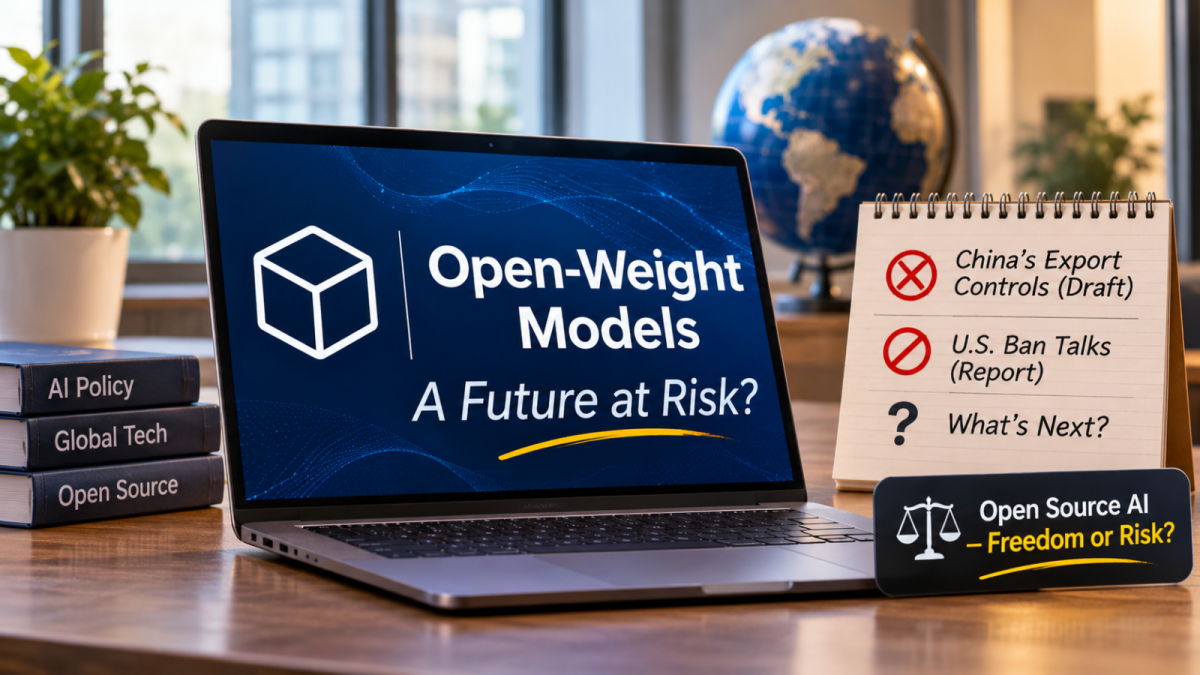
The Center for a New American Security (CNAS) wrote on October 26 that Beijing announced draft export controls. It said this could mean China is moving away from its support for open-weight models, and that people outside China can’t count on regular releases of strong open models anymore. Reuters reported in July that Chinese officials met Alibaba, ByteDance, and Z.ai about limiting overseas access to the most advanced models, including open-weight ones. That was reported as something they were considering, not a rule.
What the Evidence Says: The US
The Trump administration was reportedly bringing back a push to ban Chinese AI models after Kimi K3 came out. But Tom’s Hardware points out that once the weights are downloaded, a ban would be almost impossible to enforce.
What’s at Stake
One analysis says Chinese open-weight models went from under 2% of OpenRouter token use in late 2024 to about 61% by mid-2026. That’s only one source’s claim, so check it before you rely on it.
This Week’s Signals
Tencent said it plans to release the weights for Hy4 later, along with a report on its safety testing. The Hy4 preview weights have been public under the Apache 2.0 license since August 28. Alibaba reportedly put Qwen4-Max into a closed preview, and a proposed US bill would require federal permission to train advanced models. Some nonprofits also sued OpenAI, Anthropic, Google, Meta, and SpaceX AI units to stop frontier development, but I haven’t verified that lawsuit.
Proposals vs. Real Rules
A lot of these items are proposals, drafts, or “considerations,” not binding rules. The US ban reporting is from July, and the talk about stockpiling models is just stories people are sharing. It’s important to separate what’s actually been enacted from what’s only been floated. CNAS also notes that access to Anthropic’s Claude Fable 5 was suspended in June after a Washington directive, and it was later restored.
Questions Still Open
- Has Beijing’s draft actually been finalized, and what does it cover?
- Can the US enforce a ban on Chinese open-weight models once people already have the files?
- Do a model’s safety features survive fine-tuning? Moonshot says its own exploit test score dropped from 90.5% to 81.0% after it removed cyber data, but that’s a lab claim to check.
- What would “open-weight sovereignty” mean for India if Chinese releases slow down and US ones stay gated?
Why It Matters
If open models get harder to download, countries and companies that count on them could lose a cheap way to build their own AI. But right now, a lot of this is still rumor and draft policy, so the safest move is to watch what actually becomes a rule.