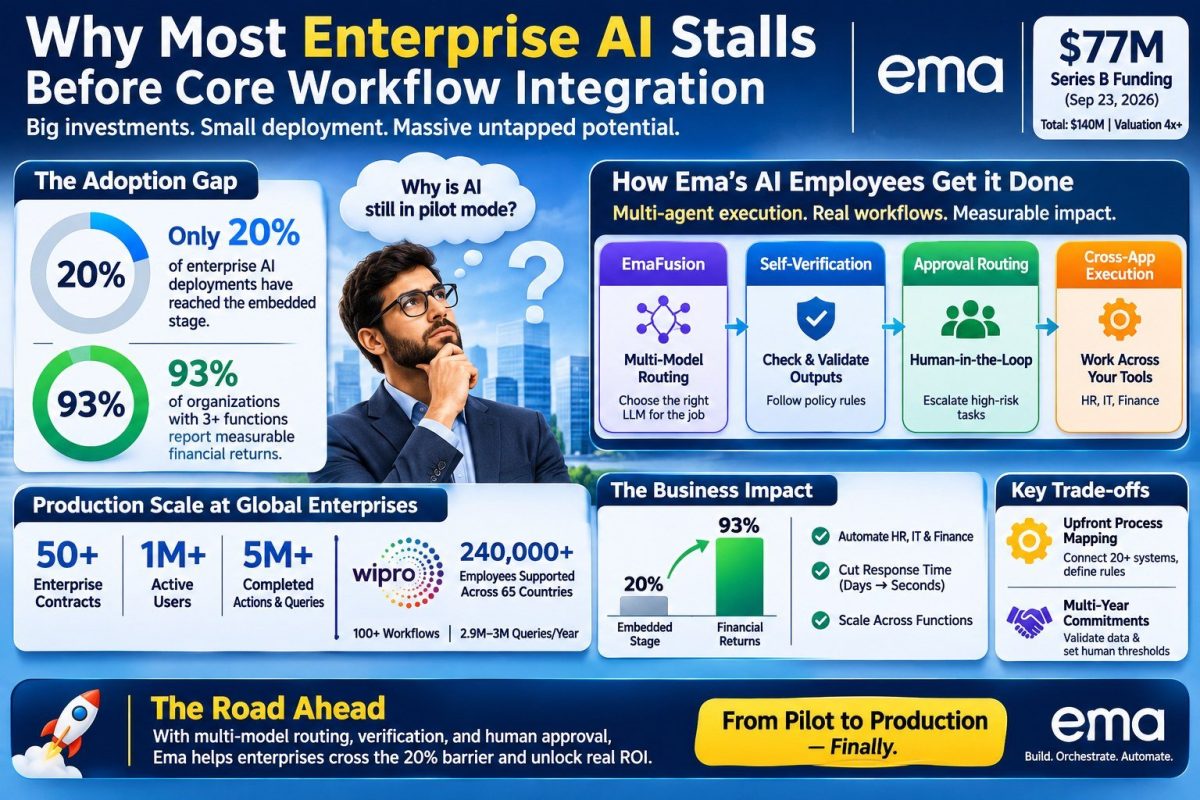
Lots of companies are spending big on generative AI, but most of it never becomes part of everyday work. A September 2026 PYMNTS Intelligence survey looked at 437 AI deployments at large companies. About 62% of those companies said they spent more than $10 million last year. Still, only 20% of the deployments reached the "embedded" stage, where AI is a normal part of daily work. Another 37% had lots of users but no link to real workflows, and 43% were still exploring. The results are very different depending on the stage. Among companies with AI embedded in three or more functions, 93% said they were already getting a return. Only 25% of companies with no embedded functions said the same.
On September 23, 2026, an enterprise AI startup called Ema raised $77 million in a Series B led by Creaegis. Accel, Section 32, Prosus Ventures, Hitachi Ventures, and Wipro Ventures also joined, which brings Ema's total funding to $140 million. The money is meant for companies that are stuck testing HR, IT, and finance automation.
How Ema's AI Employees work
Ema was founded in 2023 by CEO Surojit Chatterjee and Souvik Sen. It builds "AI Employees" for specific jobs that work inside software a company already uses, so nobody has to switch systems. Based on Ema's release and blog, there are three main parts.
The first is EmaFusion, which sends each task to the large language model that fits best based on accuracy, speed, and cost. Builders can also mix AI reasoning with fixed workflow steps, so risky jobs like updating financial records follow strict rules.
The second part is self-checking across apps. The AI Employees connect to a company's main systems using REST APIs and the Model Context Protocol (MCP). They pull information from complicated documents and check their work against company policy. Risky or unusual cases go to a human manager for approval.
The third part is scale. Ema says it has more than 50 enterprise contracts, over 1 million active users, and more than 5 million completed actions and queries. At Wipro, an Ema assistant supports over 240,000 employees in 65 countries. Ema's case study says it automates more than 100 workflows and handles about 2.9 million queries a year, cutting response times from days to seconds.
What I think about it
To me, the gap between the 20% embedded number and the 93% return rate shows why investors liked Ema's plan of working with old systems first and replacing them later. Dealroom's analysis said Ema's bookings have passed $150 million in multi-year contracts, which puts agent platforms in competition with regular software licenses and outsourcing budgets.
Still, leaders should think about two things before rolling this out. First, setup takes work. Ema connected one AI Employee to more than 20 systems in four weeks for over 40,000 employees at a $50 billion company, but that needed clean API access, clear permissions, and escalation rules decided ahead of time. Second, Ema builds deals around multi-year results instead of small trials, so buyers should check that their data is ready before signing.
What happens next
By combining multiple models, built-in checking, and human approval, Ema is going after the control problems that keep about 80% of enterprise AI pilots out of real use. Companies that start with high-volume HR, IT, and finance work and set clear rules for exceptions have the best chance of reaching the embedded stage, which is where the returns show up.