A robot needs more than strong arms to do useful work. It also needs to understand instructions and make decisions. On October 27, 2026, Google Cloud opened Gemini Robotics ER 2 to more developers through a public preview.
The model helps robots understand their surroundings and plan tasks. But making a robot think is different from making it work safely in a real factory.
What Makes Gemini Robotics ER 2 Different?
Google DeepMind introduced ER 2 in July 2026. The October update made it more accessible through Google Cloud's Model Garden.
Unlike traditional robot programs that follow fixed instructions, ER 2 uses visual information to understand changing situations. This could help robots handle tasks that are difficult to plan in advance.
However, the model remains in preview, and wider access does not guarantee reliable performance.
How Does the Technology Work?
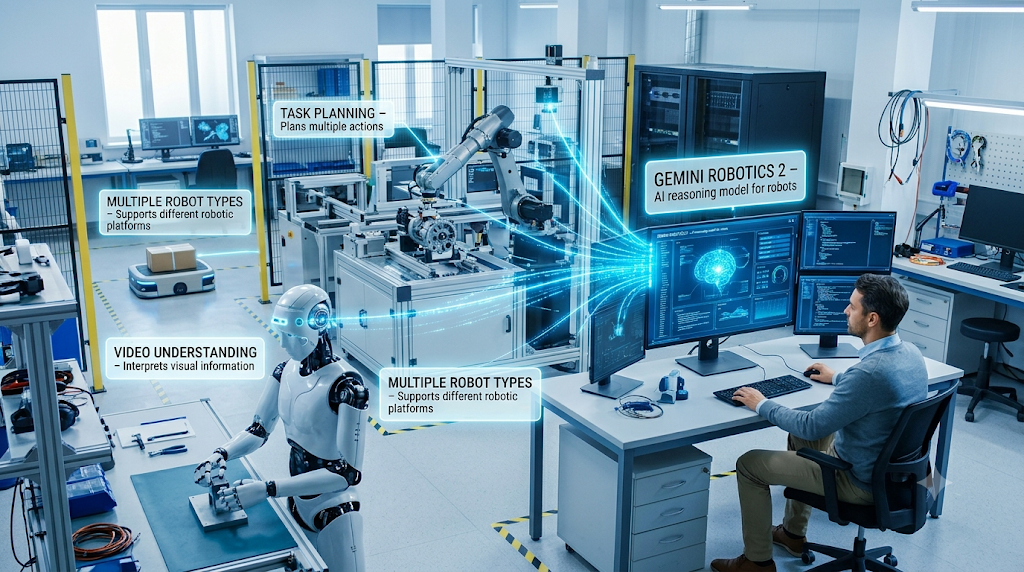
ER 2 processes information such as images, videos, and instructions to understand what a robot should do.
Imagine asking a robot to move a cup onto a shelf. The model identifies the cup, understands the goal, and plans the steps needed to complete the task.
A separate control system handles physical movement. This design allows developers to reuse the planning model across different robots.
However, connecting two systems creates challenges. A good plan may still fail if the robot's sensors or movement controls are inaccurate.
What Do Google's Test Results Tell Us?
According to Google's published Gemini Robotics ER 2 evaluations, the model achieved 91.3% accuracy in identifying important moments in videos. It also achieved 57.4% accuracy when identifying five stages of task progress.
These results show improvement, but they also reveal limitations. The progress-classification result suggests that the model can still misunderstand what is happening during a task.
More importantly, these are Google's own benchmark results, not proof of reliable performance in everyday factories.
Can It Replace Traditional Robot Software?
Traditional industrial robots work well when tasks are repeated in predictable environments. Their movements can be tested and carefully controlled.
ER 2 offers more flexibility because it can interpret new visual information. This may help in warehouses where objects and working conditions change frequently.
However, flexibility comes with uncertainty. A robot might misunderstand a moving object or choose an unsuitable action.
For repetitive factory jobs, traditional programming may remain simpler and more dependable.
What Does This Mean for Developers and Companies?
Developers could save time by using one planning model instead of creating separate planning software for every robot.
However, they must still connect cameras, sensors, movement controllers, and safety systems. Each robot also needs testing before deployment.
Companies must consider cloud processing costs, internet reliability, maintenance, and response speed.
A robot that takes too long to make decisions could slow production or create safety risks.
Why Does Real-World Testing Matter?
Simulation tools such as MuJoCo-Warp and NVIDIA Isaac Sim can help developers test robot behavior before using physical machines.
However, virtual environments cannot perfectly reproduce crowded factories, unexpected obstacles, or damaged equipment.
For this reason, developers should begin with simple tasks and gradually test more difficult situations under human supervision.
What Happens Next?
ER 2 could make robot development easier, especially for teams building different types of machines.
But its success should be measured by more than benchmark scores. The important questions are whether robots can work safely, complete tasks consistently, and operate at a reasonable cost.
Until independent real-world testing becomes available, ER 2 remains a promising technology rather than a proven solution for every robot.