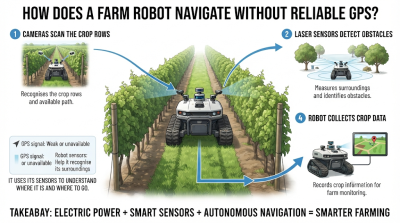
Driving on a normal road is easy because road markings show the way. But moving between narrow rows of plants is much harder, especially when GPS signals are weak.
To solve this problem, an Italian company called FieldRobotics developed a farm robot named HammerHead.
The University of Bologna shared details about the robot on November 16, 2026, after an earlier Italian announcement on November 5.
What Is the HammerHead Robot?
HammerHead is a fully electric agricultural robot that moves using tracks instead of wheels.
It can work automatically or be controlled remotely.
The robot is designed for vineyards and orchards, where it can cut grass, spray crops and carry farming materials.
FieldRobotics is a company that started from the University of Bologna in 2022.
HammerHead was demonstrated at EIMA International 2026, an agricultural machinery exhibition held in Bologna from November 10 to 14.
The robot had also appeared at the same exhibition in 2024.
How Does HammerHead Work Without GPS?
Most automatic farming machines use GPS to find their location.
However, GPS signals can become weak when trees and thick leaves block them.
HammerHead uses laser sensors, cameras and positioning technology to move between crop rows.
Laser sensors measure distances from nearby plants and objects. Cameras help the robot understand its surroundings.
The robot combines this information to follow the correct path.
It can also turn at the end of a crop row without manual control, according to the university.
However, the exact sensors and software used in HammerHead have not been publicly explained.
How Can HammerHead Help Farmers?
HammerHead is designed to do more than basic farming work.
While moving through fields, it can collect information about crops.
This data can help create a digital twin, which is a virtual copy of the farm on a computer.
Farmers could use this information to monitor plant health, identify possible problems and plan treatments.
For example, the robot could collect crop information while cutting grass, saving farmers an extra monitoring trip.
What Are the Limitations?
HammerHead has been demonstrated publicly, but many performance details are still unknown.
The university has not shared its navigation success rate, working speed or sales numbers.
A 2025 FARM SHOW report mentioned the company's claim that HammerHead could work for around eight hours on one charge.
However, this figure has not been independently confirmed.
The robot must also handle difficult conditions such as mud, wet leaves, tall grass and uneven ground.
More real-world testing is needed to understand how reliably it works without human help.
What Happens Next?
In 2025, FieldRobotics CEO Riccardo Fini said HammerHead was available only in Italy, with international sales planned for January 2027.
However, the university's newer announcements did not confirm that schedule.
HammerHead shows how robots could help farmers work in places where GPS is unreliable.
Its technology looks useful, but longer independent farm tests are needed to prove how much time and effort it can actually save.