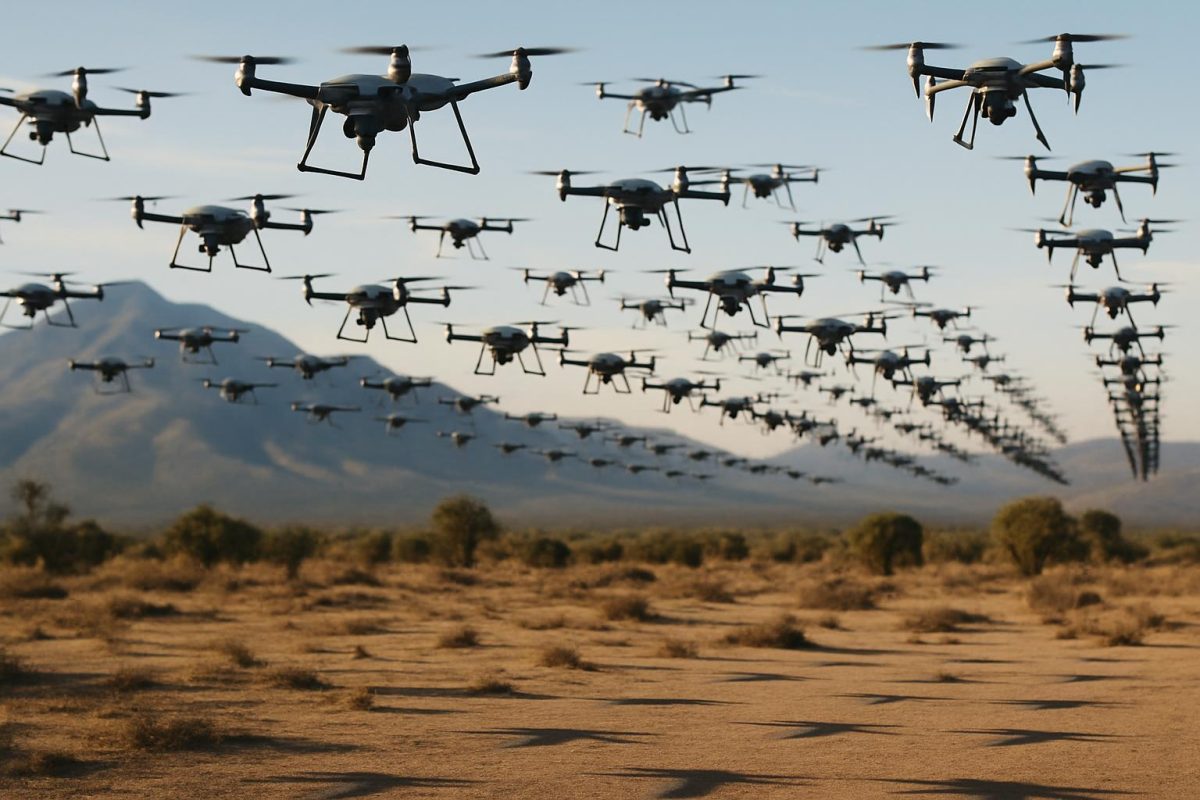
How a swarm coordinates without a boss
A 2025 paper by Jiri Horyna and co-authors, “Swarming Without an Anchor,” studies how groups of unmanned aerial vehicles can maintain relative state estimates when individual drones lose their own localisation data. The researchers report simulations and real-world experiments in which neighbouring information helps preserve cohesive swarm behaviour, although the swarm as a whole can still experience uniform drift. This is a specific research result, not proof that every swarm can safely continue a mission after GPS loss.
In a decentralised swarm, no single drone needs to issue every command. Each aircraft can follow local rules and respond to nearby members. A 2026 conference paper by Amina Mukasheva, Yerkebulan Nurgizat and Roza Koilybaeva describes the familiar separation, alignment and cohesion rules and evaluates them in a custom Python simulation. Separation helps avoid collisions, alignment encourages a shared direction, and cohesion keeps the group together. Because the paper reports simulation results, it should not be presented as a field demonstration.
A May 2025 preprint by Kevin Quinn, Cormac Molloy and Harun Šiljak proposes a different approach based on coupled oscillators. In their method, each drone has an internal rhythm that interacts with those of neighbouring drones, allowing a variable number of drones to form and adapt a swarm. This is a research proposal rather than evidence of routine commercial deployment.
Drone light shows demonstrate coordinated formation flight, but formation choreography and resilient, leaderless coordination are not identical problems. The PROTEASE 2.0 research describes configurable swarm behaviours and evaluates its approach primarily in simulated environments, building on earlier real-drone pre-evaluations.
Why reliability is harder than choreography
The difficult failures are not always obvious. A 2025–26 doctoral thesis by Sinan Oğuz at the Université libre de Bruxelles examines resilient aerial-swarm coordination, including self-organising hierarchies, changing network topologies and proactive fault tolerance. It discusses how a temporary leader can be replaced when needed, while coordination must remain robust as conditions change. These are research approaches, not a guarantee that a swarm will remain reliable in every environment.
Navigation faults add another challenge. The Horyna paper proposes using relative information from neighbours when an individual drone’s localisation drops out. It reports that many disturbances are attenuated, while a uniform translation drift of the entire swarm remains possible. In practical terms, a group may maintain its shape while its overall position slowly drifts.
A separate August 2025 preprint, “SwarnRaft,” proposes using a consensus approach inspired by the Raft algorithm to maintain coordination when GNSS is degraded. The authors describe a prototype evaluated in a simulated swarm using Wi-Fi communications. Its results should therefore be treated as simulation evidence, not as proof of robust operation in real-world flight conditions.
What has actually been shown
Much of the evidence cited here comes from simulations. The Kazakhstan conference paper uses a Python simulation, and the SwarnRaft work evaluates its prototype in a simulated Wi-Fi-connected swarm. These studies can help assess algorithms, but they do not by themselves establish performance in wind, under real radio interference or with imperfect physical sensors.
A separate 2024 study on decentralised fault-tolerant UAV swarm coordination is listed in Drone Systems and Applications. Its findings should be described according to the paper’s actual methods and results; the citation is included below so readers can inspect the original publication.
Hardware-oriented research also exists. The PROTEASE 2.0 work builds on earlier evaluations involving real drones, while its main reported evaluation focuses on simulated formation behaviours. This distinction matters: successful simulation is a useful step, but it is not equivalent to validating a system in operational conditions.
What is in use and what remains experimental
In practice: Coordinated drone displays and research demonstrations show that multiple aircraft can fly in planned formations. The cited work also documents research platforms and tests, but it does not establish that fully decentralised, fault-tolerant swarms are routinely deployed for search, mapping or transport without human intervention.
Experimental: Fully decentralised swarms that can tolerate member loss, navigation failure and communication dropouts while completing a mission autonomously remain an active research area. The cited papers explore parts of this problem, often through simulations or limited experiments.
The constraints that decide it: Communication and battery endurance remain important practical constraints. Every drone needs enough information from its neighbours to coordinate, and radio links can degrade as distances and obstacles increase. Each aircraft also has limited energy, so a failed member may reduce the group’s range or capability.
The practical lesson is to judge a swarm by what it does after a failure, not just by how neatly it flies in ideal conditions. A formation is a demonstration; a swarm that can detect a failure, remain safe and complete its mission under realistic conditions is a much stronger engineering result.